


from The Conversation
— this post authored by Michele Gelfand, University of Maryland
Since Republicans, on average, are five times more likely than Democrats to believe it’s safe now to resume normal business activity, reopening the economy has often been framed as a partisan issue.
But within households, many families are having their own arguments about how lax or strict they should be about the threat of the virus. Is it OK to have friends over? Can we invite Aunt Sally to our birthday party? Can dad slip away to the golf course? Can mom get a haircut?

Please share this article – Go to very top of page, right hand side, for social media buttons.
These conflicts reflect two very different mindsets: Some are uneasy about opening up and going against official guidance like wearing masks. Better be safe than sorry, the thinking goes. Others balk at being told what to do, and feel anxious or even angry about the constrictions being put in place.
These differences aren’t just random personality types; they reflect our primal social mindsets. And unless these differences are better understood, it will be that much more difficult to navigate life under COVID-19.
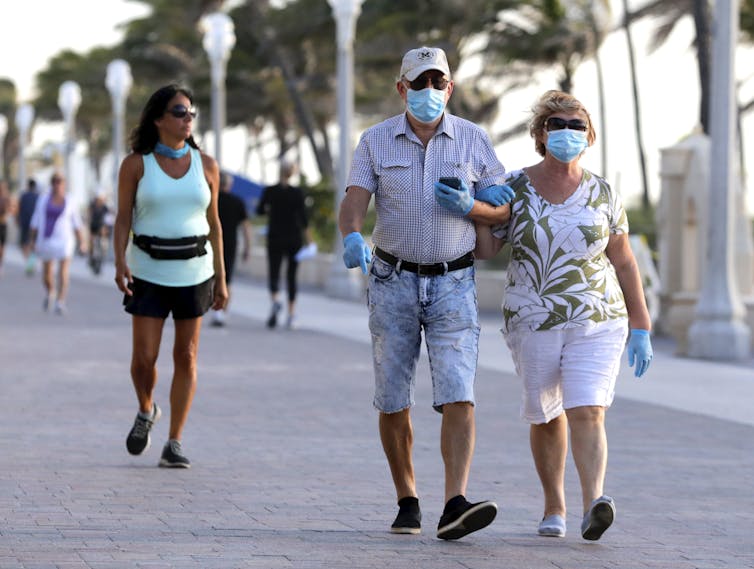
Different mindsets about rules can lead to different behaviors. AP Photo/Lynne Sladky
As a cultural psychologist, I’ve spent the last 25 years researching the relationship people have toward rules.
Some tend to have what I call a “tight” mindset. They notice rules around them, have a strong desire to avoid mistakes, have a lot of impulse control and love structure and order.
Others have “loose” predispositions. They can be skeptical about rules, they’re willing to take risks, and they’re comfortable with disorder and ambiguity. Neither of these mindsets are intrinsically good or bad. But they can influence the behavior of individuals – even nations.
An evolutionary adaptation
At a macro level, think about the immense cultural differences between Singapore and Brazil. According to our research, the former is a tight country. This means that there are many laws and rules in places, and punishments are liberally meted out if people step out of line. In Singapore, you can be fined for spitting and bringing chewing gum into the country is forbidden.
Brazil, on the other hand, tends to be a loose country and is much more permissive. Loose cultures can seem more disordered, even chaotic, but they also tend to be more tolerant of differences and celebrate creative expression – just look at images from the country’s annual Carnival.
At a micro level, think of all the ways these tight-loose tensions play out in households. Are you a helicopter parent or more laid-back? Do your children follow the rules or do they challenge them frequently? Do you leave wet towels on the bed or are they hung neat as a sheet? Do you get “feedback” for the way you haphazardly load the dishwasher, as I do?
These tight-loose differences can reflect the history of a nation or an individual – whether they’ve experienced war, famine and disease, or higher stress and trauma. In a nutshell, the greater the history of experiencing these threats, the higher likelihood of adopting a tighter mindset. At an evolutionary level, this makes sense: Structure and strong social order can be a bulwark against potential danger.
The sweeping lockdowns related to COVID-19 have accentuated these inclinations. Embracing order and constraint in the face of threat, tight-leaning friends and family members are even more fastidious: They may be disinfecting groceries by hand or wiping down door knobs incessantly. Our looser family members and friends, however, are feeling claustrophobic. A mask feels alien to them, and they may view sweeping public health regulations as overreactions.
It’s no wonder some families are experiencing high levels of anxiety and friction in their homes. In addition to the stress of a global pandemic, they’re struggling to adapt a new set of social norms that may run counter to their deepest instincts.
The tight-loose dance
This struggle need not be paralyzing, though. Instead, understanding where each side is coming from can help society successfully negotiate these differences.
A basic principle – backed by a lot of evidence – is that when there is real threat, tightening can serve a purpose. For example, when a community has an increasing number of COVID-19 cases that can potentially overwhelm its health system, it’s critical to collectively abide by rules regarding social distancing, masks and hand-washing. People with loose mindsets, who take encroachments on their personal autonomy very seriously, may find this challenging.
But shaming them, judging them or holding them in contempt isn’t going to be effective. It’s more useful to remind everyone that these constraints are temporary and that the more diligently they’re practiced, the sooner they can be relaxed. Loose-minded citizens can also have a role to play. With their “out of the box” thinking, they can help create new ways to stay connected while distancing – or invent fun things to do at home.
On the flipside, when the threat subsides, people can loosen up with vigilance. Tight-minded citizens struggle with this because the relaxation of rules makes them feel vulnerable. Indeed, our research shows that it takes longer for tighter groups to loosen than the reverse. There may be some evolutionary basis for this, since it’s a way to mitigate risk after experiencing threats.
The key here is gradual steps. Tighter folks may panic at a crowded mall or beach. But slowly acclimating them to visits with a trusted friend or neighbor could make the process of reopening smoother.
As countries begin the long journey back to a new normal of economic activity, we’ll all be doing the equivalent of a tight-loose dance with our friends, colleagues and fellow grocery store shoppers. Above all, learning to appreciate the basis for our social differences will go a long way toward defusing potential conflicts.
And the more we can be ambidextrous – tightening when there’s threat and loosening when it’s safe – the better off we’ll all be.
[Get facts about coronavirus and the latest research. Sign up for The Conversation’s newsletter.]
Michele Gelfand, Distinguished University Professor, Department of Psychology, University of Maryland
This article is republished from The Conversation under a Creative Commons license. Read the original article.
.


