


from the St Louis Fed
— this post authored by Fernando Leibovici, Economist; Ana Maria Santacreu, Senior Economist; and Makenzie Peake, Research Associate
The ongoing global pandemic has led to a burst of protectionism, as evidenced by widespread export restrictions on essential medical equipment to fight COVID-19. According to a report by Global Trade Alert, by the end of March 2020, 54 governments had introduced 46 export curbs on medical supplies.[ 1] Limited access to medical equipment in the middle of a global pandemic poses challenges to countries that depend heavily on imports of these products.

In our previous blog post, we investigated the extent to which the United States relies on international trade for its supply of medical goods that are essential to fight COVID-19. We showed the U.S. is very dependent on the rest of the world for these goods, with a trade deficit of essential medical products equal to 14% of gross output.
In this article, we investigate the cross-country pattern of trade in products that are crucial to fight COVID-19. We examine which countries are the main exporters and importers of these goods, which are net suppliers of these goods, and which are at a higher risk of experiencing supply shortages in their respective attempts to fight COVID-19 due to the ongoing surge of protectionism.
Who Are the Main Exporters and Importers of Essential Medical Equipment?
We collected international trade data at the product level (Harmonized System [HS] six-digit level of disaggregation) for 40 economies in 2018. These economies account for 90% of total world trade.[2] We focused on essential medical equipment to fight COVID-19, following the classification in we used in our previous blog post. The table below reports the list of products.
| Product list | |
|---|---|
| HS 2012 Product Code | Description |
| 340220 | Hand sanitizers |
| 401519 | Nitrile and sterile gloves |
| 621010 | Personal protective equipment |
| 630790 | Medical protective clothing |
| 650500 | Medical headwear |
| 650610 | Other medical headwear |
| 842139 | Oxygen concentrator |
| 900490 | Protective goggles |
| 901812 | Ultrasound systems |
| 901819 | Patient monitors and pulse oximeters |
| 901839 | Bougies, catheters |
| 901920 | Ventilators, oxygen masks, nebulizers |
| 902000 | Breathing masks |
| 902212 | CT systems |
| 902214 | X-ray |
| 902519 | Thermometer |
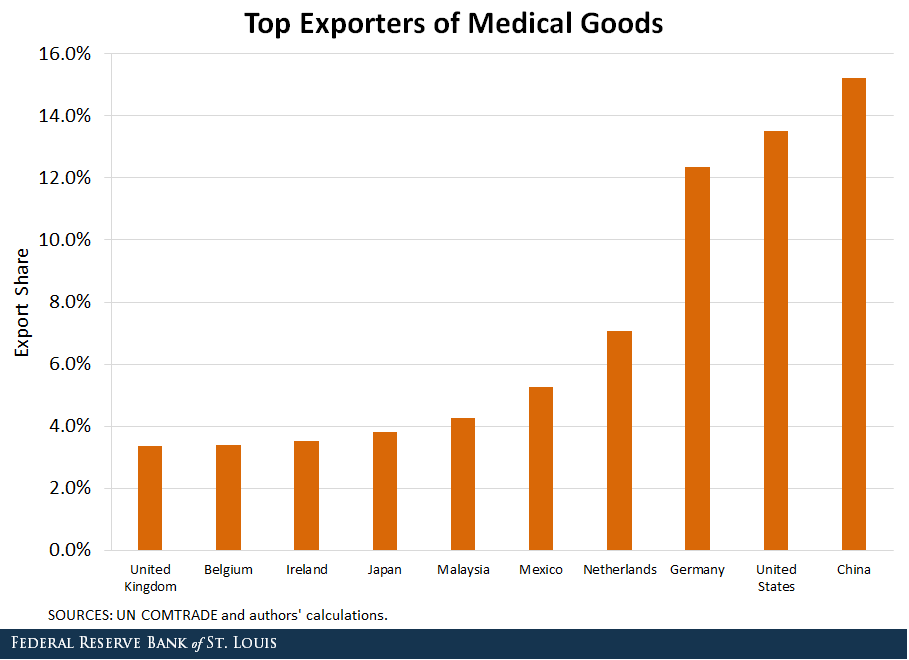
The first figure below shows the share of world exports of essential medical products accounted for by each of the top 10 exporters of these goods. These countries account for 72% of the total exports of these essential medical products. China, the United States and Germany alone supply about 41% of medical equipment to other countries.
The second figure below shows the share of world imports of essential medical products for the top 10 importers. These economies account for 68% of total imports of these essential medical products. Interestingly, the United States accounts for almost one-fourth of the total world import demand for these goods. Germany and China follow, accounting for 9.4% and 6.5% of total imports, respectively.
We thus observe that:
- World exports and imports of essential medical products are highly concentrated in a small set of countries.
- Several countries are both important exporters and importers of these goods.
- The U.S. is by far the biggest importer of these goods and the second-biggest exporter.

Which Countries Depend Most on Essential Medical Equipment Imports?
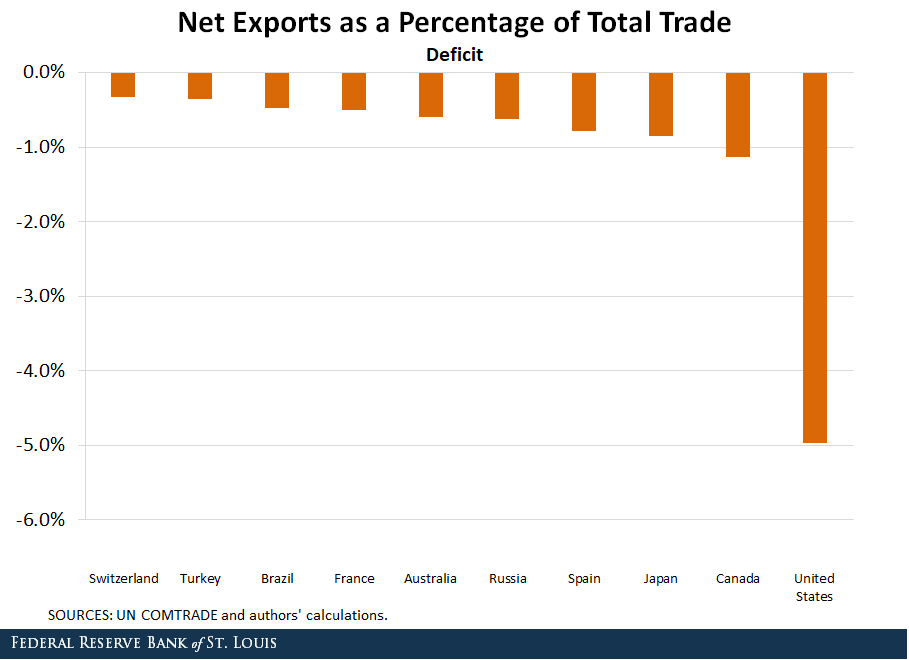
Which countries are at a higher risk of experiencing supply shortages of medical equipment if the main suppliers impose export bans? To answer this question, the figure below shows the top 10 net exporters (the first figure below) and the top 10 net importers (the second figure below) of medical supplies, as a percentage of total trade in these goods.
We find that China, Malaysia, and Germany are among the largest net exporters of these goods, with a surplus relative to total trade in these goods of 4.5%, 1.9%, and 1.6%, respectively. These countries have recently introduced export restrictions on medical supplies, as they need essential medical goods to fight their own pandemic – with China on April 1, 2020, announcing its restrictions on exports of medical supplies and limiting the possibility to export to licensed entities.
These restrictions pose important challenges to countries that depend heavily on imports of essential medical equipment. This is the case with the United States, which has the largest trade deficit at 5% (as a percentage of total U.S. trade of medical products). Canada and Japan follow with deficits of 1.1% and 0.9%, respectively. Spain, a country that has been severely hit by the pandemic, is also among the main net importers (0.8%).

Conclusion
We conclude that export restrictions on essential medical products are hitting countries unequally. Those that depend more on imports of these products are likely to be at a disadvantage to combat the pandemic, insofar as they are not able to rapidly increase their domestic production of these goods. Thus, implementing policies aimed at boosting domestic production of essential medical equipment is likely to be beneficial, even if not always feasible.
Notes and References
1 The Global Trade Alert reports.
2 Total world trade is computed as the sum, across all economies, of exports and imports for all goods and services traded internationally in 2018 (data from the World Development Indicators dataset, World Bank). We rank economies according to their trade share and keep those that, together, account for 90% of global trade. They are: Australia, Austria, Belgium, Brazil, Canada, China, Czech Republic, Denmark, Finland, France, Germany, Hong Kong, Hungary, India, Indonesia, Ireland, Israel, Italy, Japan, Korea, Luxembourg, Malaysia, Mexico, Netherlands, Norway, Philippines, Poland, Portugal, Russia, Saudi Arabia, Singapore, South Africa, Spain, Sweden, Switzerland, Thailand, Turkey, United Kingdom, United States, and Vietnam.
Additional Resources
- St. Louis Fed’s COVID-19 resource page
- On the Economy: How Much Does the U.S. Rely on Other Countries for Essential Medical Equipment?
- Open Vault: Understanding Supply and Demand Shocks amid Coronavirus
Source
Disclaimer
Views expressed are not necessarily those of the Federal Reserve Bank of St. Louis or of the Federal Reserve System.


