


from The Conversation
— this post authored by Grace A. Noppert, University of North Carolina at Chapel Hill
As the COVID-19 epidemic continues to ravage the American public, an unsurprising story emerges: Poor communities are hot spots for COVID transmission. The death rate from COVID-19 appears to be staggeringly high among African Americans compared to whites. The Washington Post reports, for example, that while 14% of the Michigan population is black, 40% of COVID-19 deaths are among blacks.

Please share this article – Go to very top of page, right hand side, for social media buttons.
This is a familiar pattern to a social and infectious disease epidemiologist like myself. It is evidence of centuries of segregation and discrimination that have disproportionately placed people of color in communities without access to health care, with degraded and crowded living conditions and a lack of basic opportunities for health and wellness.
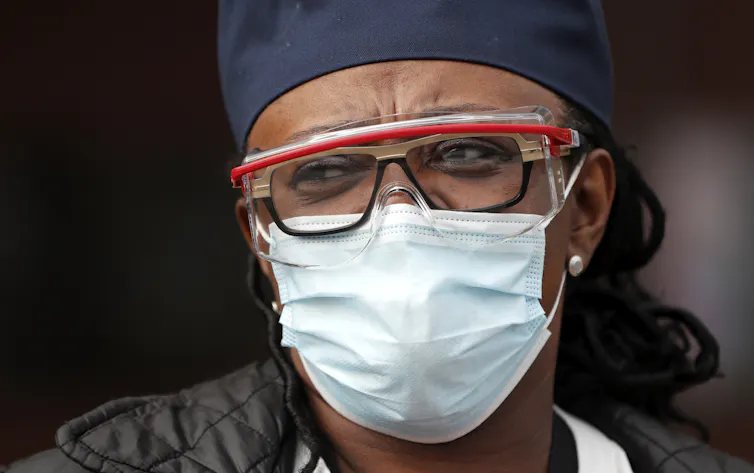
Nurse Shelia Rickman participates in an after-shift demonstration on Monday, April 6, 2020, in Chicago’s Hyde Park neighborhood, after media reports of disproportionate numbers of black people dying from COVID-19 in the city. AP Photo/Charles Rex Arbogast
In the context of the current pandemic, blacks are more likely to have low-paying jobs that do not allow remote work options or offer health insurance or paid medical leave. The result of centuries of sidelining by American society plays out most obviously in worse health.
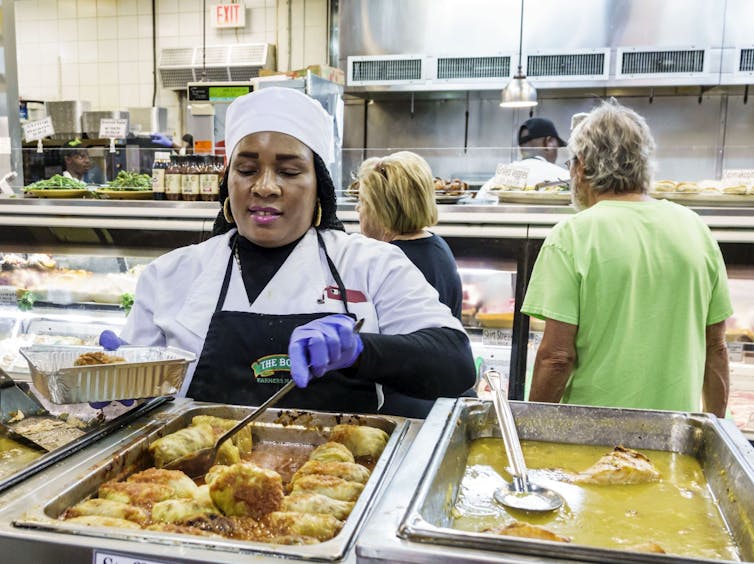
Blacks are more likely to work in low-paying jobs, such as custodial work and food service, that cannot be done remotely. Here, a server adds stuffed cabbage to an order at The Boys Farmers Market in Delray Beach, Fla. Jeffrey Greenberg/Universal Images Group via Getty Images
No wealth, poor health
The poor and marginalized already unfairly bear the burden of other diseases such as asthma, certain kinds of cancer, stroke and cardiovascular disease. This ongoing pandemic looks to be no different. And poverty in the U.S. is very much tied to race and ethnicity. In 2018, 11% of whites had a household income below the federal poverty level compared to 23% of blacks and 19% of Hispanics. People of color are also more likely to live in low-income communities with a lack of access to basic resources for health and wellness.
The link between poverty and infectious disease is well-documented. Influenza-related hospitalizations in low-income neighborhoods are nearly twice that of high-income neighborhoods. Pediatric hospitalizations from bacterial pneumonia are significantly higher in low-income neighborhoods compared to high-income neighborhoods. The same is largely true of tuberculosis in the U.S. where active transmission of TB is ongoing in poor neighborhoods – patterns that are not simply due to more people living in these areas.
TB, in particular, has long been tied to socioeconomic status. Even in the face of a widespread TB epidemic in the U.S. in the early 1900s, there was a noticeable pattern in which people of color, immigrants and those living in poor environments were more likely to be infected with TB and less likely to receive care.
Those of us who study the burden of disease on the poor have seen the same basic pattern play out in the U.S. today. People with TB often experience extreme socioeconomic disadvantage. Poor neighborhoods and people of color continue to disproportionately bear the burden of TB among U.S.-born individuals.
TB: A striking case in point
The case of TB offers a unique vantage point to understand how these inequities emerge. Processes that operate at a societal level, such as residential segregation, have been at work since the early 20th century. Such processes have systematically placed racial and ethnic minority populations in low-income communities with fewer resources and more exposure to environmental hazards.
Urban renewal and development efforts of the 1900s systematically benefited whites, further displacing communities of color. This resulted in minority communities with greater proportions of dilapidated low-quality housing and poverty with direct implications for the subsequent risk of infectious diseases. Thus, non-white populations are unduly placed in settings that both increase exposure to infectious pathogens, such as Mycobacterium tuberculosis(the pathogen causing TB), and limit individuals’ ability to access health care to mitigate the effects of the subsequent disease.
The lack of resources also means that low-income communities have a higher prevalence of chronic conditions. For example, low-income neighborhoods with reduced access to healthy food and fewer opportunities for physical activity have higher rates of high blood pressure, obesity and diabetes. Such chronic conditions often result in compromised immunity, making individuals more vulnerable to infectious diseases.
One of the most insidious effects of living in a low-income community is the chronic toll of stress on the body, particularly the immune system. Socioeconomic disadvantage, via discrimination, job and housing instability, and food insecurity result in increased stress. This stress exposure is biological costly to the body.
Infectious diseases, like TB or COVID-19, can then thrive among populations that are living in low-income communities both because of increased exposure to infectious pathogens and a reduced ability of individuals to fight infections.
Blacks are dying of COVID-19 at higher rates than Caucasians in many cities across the country.
Now is the time for action
COVID-19 seems to be following a similar, albeit amplified, trajectory as TB. If we take no action, the inequities we see will only increase in the coming months and years.
People of color continue to face discrimination in housing and labor markets. For example, redlining practices still exist, though in subtler ways, as evidenced by increased predatory lending practices and diminished access to goods and services in minority neighborhoods. Disinvestment in these communities has created spaces and places where everyone’s life does not count equally, where it is allowable for some people to not have access to the resources to live healthy lives.
While infectious disease epidemics like TB, or now COVID-19, can undoubtedly create health disparities, they will almost certainly exacerbate existing ones, pulling back the curtain on the consequences of the inequality to which we have all become accustomed.
COVID-19 offers us a moment in time to pay attention to these inequities. Pockets of COVID-19 transmission in any community keep the risk of an enduring epidemic alive for every community.
I believe it should be a high priority for policymakers to partner with local health care practitioners and community organizations to provide low-income communities with resources to deal with this epidemic. These interventions should reduce or eliminate the cost of testing and treatment, and offer social and economic support for families that may need time from work for medical treatment, or have lost jobs because of COVID-19. Finally, as the possibility of treatments and vaccines develop, plans need be put in place that deliver the interventions to low-income communities first, not last.
[You need to understand the coronavirus pandemic, and we can help. Read The Conversation’s newsletter.]
Grace A. Noppert, Postdoctoral Scholar in Epidemiology, Carolina Population Center, University of North Carolina at Chapel Hill
This article is republished from The Conversation under a Creative Commons license. Read the original article.


