


from The Conversation
— this post authored by Thurston Domina, University of North Carolina at Chapel Hill
Schools aren’t only places where kids learn. They are also places where kids eat.

Please share this article – Go to very top of page, right hand side, for social media buttons.
Thanks to the National School Lunch Program, 30 million U.S. children – some 60% of all school-aged kids – regularly eat some combination of breakfast, lunch and afternoon snacks at school. Federal subsidies ensure that school meals are affordable for all children to stave off hunger and malnutrition.
But what is happening to meals provided by the nation’s largest child nutrition program as public schools shut their doors to contain the spread of the coronavirus pandemic?
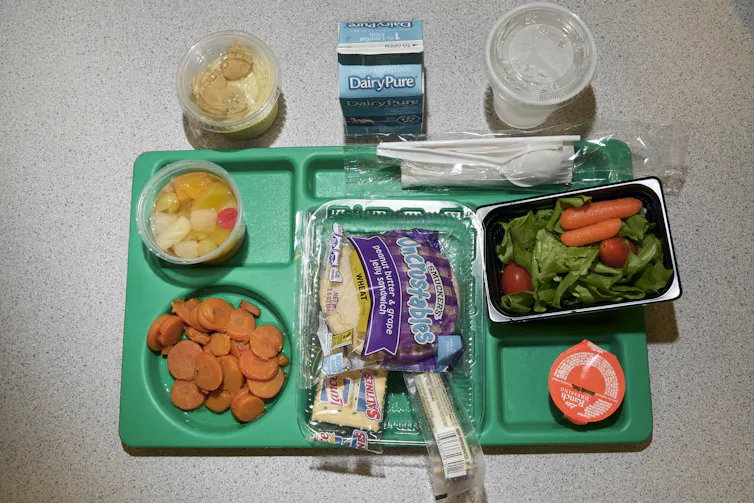
An East Brainerd Elementary School lunch, Chattanooga, Tennessee. The Washington Post via Getty Images
Based on my research on how schools provide meals for poor children, I worry that these closures might leave some of the nation’s poorest children without access to nutritious meals.

School meals address hunger
Despite persistent concerns about the nutritional quality of school lunches and wasted cafeteria food, serving school meals clearly improves students’ consumption of calcium, meat and vegetables and a wide array of essential vitamins and minerals.
This nutritional boost is particularly vital for the 18% of U.S. kids whose parents sometimes or frequently can’t afford enough nutritious food for the whole family. These children get approximately a quarter of the calories they consume from school meals.
Empty cupboards and missed meals substantially threaten children’s healthy development. Research tracking the long-term effects of 1960s-era policy efforts that expanded the National School Lunch Program indicates that when kids regularly eat lunch, they’re more likely to finish high school and perhaps go on to college.
Further, over the last few years a new federal program designed to provide free lunches to all students in schools that enroll large proportions of low-income children appears to be working. Test scores are rising and student behavior is improving at the schools taking part in it.
Under federal law, no student pays more than US$2.90 for their lunch. But about half of public school students pay far less. Families whose household income is less than 185% of the poverty line, currently about $48,000 per year for a family of four, pay up to 40 cents for each meal. Students whose families of the same size get by on less than 130% of that same mark, or below $34,000, pay nothing at all.
More than two-thirds of the children who eat school meals get them for free or at a steep discount.

How to feed kids when schools close
Many low-income families of course can get some additional help through other kinds of federal aid.
That includes the Supplemental Nutrition Assistance Program. But SNAP’s complex eligibility requirements exclude many Americans who are are having trouble getting food on their tables.
What’s more, SNAP benefits are limited. For example, a family of four can get no more than $646 in this aid per month, typically falling short of covering the full cost of all nutritional needs.

Absent fundamental changes to the nation’s safety net, I believe school leaders should make sure that schools keep playing an important role in student nutrition – even when schools are closed to protect public health.
And schools are indeed looking for ways to provide meals to students whose schools are closed due to the pandemic. The USDA has identified one path. It is letting schools that participate in a summer meals program for kids from low-income areas to serve meals even if they close due to this pandemic.
While this strikes me as a helpful step, I don’t think that it will be enough.
That’s because the schools eligible to take part in the summertime program serve just a tenth of the children who participate in the school lunch program. Unless Congress acts to provide emergency funds to cover the cost of feeding students whose schools have closed – and fast – it will be up to local communities and their food banks to fill the nutritional gap.
[Like what you’ve read? Want more? Sign up for The Conversation’s daily newsletter.]
Thurston Domina, Professor, Educational Policy and Organizational Leadership, University of North Carolina at Chapel Hill
This article is republished from The Conversation under a Creative Commons license. Read the original article.


