


Written by rjs, MarketWatch 666
 Here are some selected news articles from the week ended 22 February 2020.
This article is a feature every Monday evening on GEI.
Please share this article – Go to very top of page, right hand side, for social media buttons.
Uncompleted well backlog rose to 7.3 months in January despite the fewest horizontal wells drilled since June 2017
Oil prices rose for a 2nd week, following 5 straight weeks of price markdowns, as supply cutoffs in Libya and Venezuela and the falling rate of new coronavirus infections in China supported prices…after rising 3.4% to $52.05 a barrel as oil traders dismissed demand concerns last week, the benchmark price of US light sweet crude for March delivery opened higher on Tuesday after the US imposed sanctions on Rosneft, Russia’s largest oil company, for trading with Venezuela, but that brief rally was capped as hopes for an OPEC+ emergency meeting on the impact of the Chinese virus faded and prices closed unchanged on the day…however, a new rally kicked in Wednesday, as the Saudis called for an OPEC “fire brigade” to put out China’s viral pandemic, with oil settling $1.24, or about 2.4% higher, at $53.29 a barrel, as traders turned their focus to the supply squeezes in Venezuela and war torn Libya…oil prices continued higher for the 6th time in seven sessions on Thursday after the EIA reported a smaller crude inventory increase than traders were expecting, as the expiring March WTI oil contract gained 49 cents, or 0.9%, to settle at $53.78 per barrel while the more actively traded April oil benchmark closed up 39 cents, or 0.7%, at $53.88 a barrel….however, renewed concerns about demand being squeezed by the economic impact of the coronavirus outbreak hit prices Friday, and U.S. crude prices for April dropped 50 cents 0.9% to $53.38 a barrel, pressured by a reported rift in the Saudi – Russia crude-production alliance…but despite that Friday selloff, oil prices still finished the week 2.6% higher from the prior week’s close at their highest level in about a month, with the April contract price rising 2.0% on the week..
Natural gas prices also ended higher this week, largely on the strength of a late-winter cold snap…after ending 1.1% lower at $1.837 per mmBTU after bouncing off a 4 year low last week, the contract price of natural gas for March delivery jumped 14.4 cents on Tuesday, the biggest one-day gain in over a year, in reacting to a much colder forecast for the western half of the country through next week and closed at $1.981 per mmBTU, its highest price in over a month…but prices retreated 2.6 cents from there on Wednesday after warmer revisions to the long-range outlook, and lost another 3.5 cents on Thursday as the cold snap that had driven up demand early in the week was expected to move out beginning Friday…prices continued to slide Friday on further warmer trends in the latest weather models, crushing hopes for a return to $2 gas, with March gas settling down 1.5 cents at $1.905/mmBTU, still holding onto a 3.7% gain on the week..
The natural gas storage report on the week ending February 14th from the EIA indicated that the quantity of natural gas held in storage in the US fell by 151 billion cubic feet to 2,343 billion cubic feet by the end of the week, which left our gas supplies 613 billion cubic feet, or 35.4% higher than the 1,730 billion cubic feet that were in storage on February 14th of last year, and 200 billion cubic feet, or 9.3% above the five-year average of 2,143 billion cubic feet of natural gas that has been in storage as of the 14th of February in recent years….the 151 billion cubic feet that were withdrawn from US natural gas storage this week matched the average forecast for a 151 billion cubic feet withdrawal by analysts surveyed by S&P Global Platts, while it was less than the 163 billion cubic feet withdrawal reported during the corresponding week of last year, but was still more than the average 136 billion cubic feet of natural gas that have been pulled from natural gas storage during the second week of February over the past 5 years….
The Latest US Oil Supply and Disposition Data from the EIA
US oil data from the US Energy Information Administration for the week ending February 14th indicated that even with a sizable decrease in our oil imports and a sizable increase in our oil exports, we still had a bit of oil left to add to our stored commercial supplies for the fifteenth time in the past twenty-three weeks….our imports of crude oil fell by an average of 431,000 barrels per day to an average of 6,547,000 barrels per day, after rising by an average of 366,000 barrels per day during the prior week, while our exports of crude oil rose by an average of 594,000 barrels per day to 3,564,000 barrels per day during the week, which meant that our effective trade in oil worked out to a net import average of 2,983,000 barrels of per day during the week ending February 14th, 1,025,000 fewer barrels per day than the net of our imports minus our exports during the prior week…over the same period, the production of crude oil from US wells was unchanged at 13,000,000 barrels per day, and hence our daily supply of oil from the net of our trade in oil and from well production totaled an average of 15,983,000 barrels per day during this reporting week..
US oil refineries reported they were processing 16,210,000 barrels of crude per day during the week ending February 14th, 190,000 more barrels per day than the amount of oil they used during the prior week, while over the same period the EIA’s surveys indicated that an average of 59,000 barrels of oil per day were being added to to the supplies of oil stored in the US….hence, this week’s crude oil figures from the EIA appear to indicate that our total working supply of oil from net imports and from oilfield production was 286,000 barrels per day less than what what was added to storage plus what our oil refineries reported they used during the week….to account for that disparity between the apparent supply of oil and the apparent disposition of it, the EIA just inserted a (+286,000) barrel per day figure onto line 13 of the weekly U.S. Petroleum Balance Sheet to make the reported data for the daily supply of oil and the consumption of it balance out, essentially a fudge factor that they label in their footnotes as “unaccounted for crude oil” … (for more on how this weekly oil data is gathered, and the possible reasons for that “unaccounted for” oil, see this EIA explainer)….
Further details from the weekly Petroleum Status Report (pdf) indicated that the 4 week average of our oil imports rose to an average of 6,700,000 barrels per day last week, now just 4.1% less than the 6,990,000 barrel per day average that we were importing over the same four-week period last year….the 59,000 barrel per day net addition to our total crude inventories was all added to our commercially available stocks of crude oil, while the quantity of oil stored in our Strategic Petroleum Reserve remained unchanged….this week’s crude oil production was reported to be unchanged at 13,000,000 barrels per day because the rounded estimate of the output from wells in the lower 48 states was unchanged at 12,500,000 barrels per day, while a 6,000 barrel per day decrease Alaska’s oil production to 481,000 barrels per day still added the same rounded 500,000 barrels per day to the rounded national total….last year’s US crude oil production for the week ending February 15th was rounded to 12,000,000 barrels per day, so this reporting week’s rounded oil production figure was 8.3% above that of a year ago, and 54.2% more than the interim low of 8,428,000 barrels per day that US oil production fell to during the last week of June of 2016…
Meanwhile, US oil refineries were operating at 89.4% of their capacity in using 16,210,000 barrels of crude per day during the week ending February 14th, up from 88.0% of capacity the prior week, and close to the recent average refinery capacity utilization for the second week of February…however, the 16,210,000 barrels per day of oil that were refined this week were 3.2% more than the 15,711,000 barrels of crude that were being processed daily during the week ending February 15th, 2019, when US refineries were operating at 85.9% of capacity….
With the increase in the amount of oil being refined, gasoline output from our refineries was also higher, increasing by 284,000 barrels per day to 9,525,000 barrels per day during the week ending February 14th, after our refineries’ gasoline output had decreased by 662,000 barrels per day over the prior week… after this week’s increase in gasoline output, our gasoline production was fractionally higher than the 9,489,000 barrels of gasoline that were being produced daily over the same week of last year….meanwhile, our refineries’ production of distillate fuels (diesel fuel and heat oil) increased by 15,000 barrels per day to 4,852,000 barrels per day, after our distillates output had decreased by 139,000 barrels per day over the prior week…after this week’s increase in distillates output, our distillates’ production for the week was nearly 2% above the 4,759,000 barrels of distillates per day that were being produced during the week ending February 15th, 2018….
Even with the increase in our gasoline production, our supply of gasoline in storage at the end of the week decreased for the third week in a row after twelve consecutive increases, and for the 17th time in 35 weeks, falling by 1,971,000 barrels to 259,078,000 barrels during the week ending February 14th, after our gasoline supplies had decreased by 72,000 barrels over the prior week….our gasoline supplies decreased by more this week because our exports of gasoline rose by 148,000 barrels per day to 770,000 barrels per day, while our imports of gasoline rose by 15,000 barrels per day to 421,000 barrels per day, and because the amount of gasoline supplied to US markets increased by 196,000 barrels per day to 8,918,000 barrels per day…even after this week’s inventory decrease, our gasoline supplies were 0.9% higher than last February 15th’s gasoline inventories of 256,847,000 barrels, and 3% above the five year average of our gasoline supplies for this time of the year, which historically has been near the annual supply peak…
Meanwhile, with the small increase in our distillates production, our supplies of distillate fuels decreased for the 15th time in 21 weeks and for 30th time in the past 46 weeks, falling by 635,000 barrels to 140,587,000 barrels during the week ending February 14th, after our distillates supplies had decreased by 2,013,000 barrels over the prior week….our distillates supplies fell by less this week because the amount of distillates supplied to US markets, an indicator of our domestic demand, fell by 92,000 barrels per day to 3,728,000 barrels per day, while our exports of distillates fell by 64,000 barrels per day to 1,343,000 barrels per day and while our imports of distillates rose by 25,000 barrels per day to 127,000 barrels per day….but even after this week’s decrease, our distillate supplies at the end of the week were still 1.4% more than the 138,683,000 barrels of distillates that we had stored on February 15th, 2019, even as they improved to about 4% below the five year average of distillates stocks for this time of the year…
Finally, even with lower oil imports and higher oil exports, our commercial supplies of crude oil in storage rose for the eighteenth time in thirty-five weeks and for the thirtieth time in the past 52 weeks, increasing by 415,000 barrels, from 442,468,000 barrels on February 7th to 442,883,000 barrels on February 14th…but even after 4 straight increases, our crude oil inventories were still roughly 2% below the five-year average of crude oil supplies for this time of year, even as remained roughly 36% higher than the prior 5 year (2010 – 2014) average of crude oil stocks after the last week of January, with the disparity between those comparisons arising because it wasn’t until early 2015 that our oil inventories first rose above 400 million barrels….even though our crude oil inventories had generally been rising over the past year, except for during the past summer, after generally falling until then through most of the prior year and a half, our oil supplies as of February 14th were 2.6% below the 454,512,000 barrels of oil we had in commercial storage on February 15th of 2019, while still 5.3% above the 420,479,000 barrels of oil that we had in storage on February 16th of 2018, while at the same time remaining 14.6% below the 518,683,000 barrels of oil we had in commercial storage on February 17th of 2017, which followed a period when we had been adding 10 million barrels per week to storage…
This Week’s Rig Count
The US rig count was up a bit for the 3rd time in 25 weeks over the week ending February 21st, after being unchanged the prior two weeks, but it was still down by nearly 27% from the end of 2018….Baker Hughes reported that the total count of rotary rigs running in the US increased by one to 791 rigs this past week, which was still down by 256 rigs from the 1047 rigs that were in use as of the February 22nd report of 2019, and 1,138 fewer rigs than the shale era high of 1,929 drilling rigs that were deployed on November 21st of 2014, the week before OPEC began to flood the global oil market in an attempt to put US shale out of business…
The number of rigs drilling for oil increased by 1 rig to 679 oil rigs this week, which was still 174 fewer oil rigs than were running a year ago, and much less than the recent high of 1609 rigs that were drilling for oil on October 10th, 2014….at the same time, the number of drilling rigs targeting natural gas bearing formations was unchanged at 110 natural gas rigs, still down by 84 gas rigs from the 194 natural gas rigs that were drilling a year ago, and way down from the modern era high of 1,606 rigs targeting natural gas that were deployed on September 7th, 2008…in addition to the rigs drilling for oil & gas, two rigs classified as ‘miscellaneous’ continued to drill this week; one on the big island of Hawaii, and one in Lake County, California, while the “miscellaneous” rig that had been drilling in Washoe County, Nevada, over the past fourteen weeks was shut down… a year ago, there were no such “miscellaneous” rigs deployed..
Offshore drilling activity in the Gulf of Mexico was down by one to 22 rigs this week, with 21 of those Gulf rigs drilling in Louisiana waters and one rig drilling offshore from Texas…that was still 3 more Gulf rigs than were deployed a year ago, when 17 rigs were drilling offshore from Louisiana and two were operating in Texas waters…since there are no rigs deployed off other US shores elsewhere at this time, nor were there a year ago, the current Gulf of Mexico rig count as well as the count of last year is equal to the national offshore rig total in both cases..
The count of active horizontal drilling rigs was up by one to 712 horizontal rigs this week, which the highest horizontal rig count since November 1st of last year, but still 202 fewer horizontal rigs than the 916 horizontal rigs that were in use in the US on February 22nd of last year, and also well down from the record of 1372 horizontal rigs that were deployed on November 21st of 2014….at the same time, the vertical rig count was up by 2 rigs to 32 vertical rigs this week, but those were still down by 31 from the 63 vertical rigs that were operating during the same week of last year…. on the other hand, the directional rig count was down by two rigs to 45 directional rigs this week, and those were also down by 23 from the 68 directional rigs that were in use on February 22nd of 2019…
The details on this week’s changes in drilling activity by state and by major shale basin are shown in our screenshot below of that part of the rig count summary pdf from Baker Hughes that gives us those changes…the first table below shows weekly and year over year rig count changes for the major oil & gas producing states, and the table below that shows the weekly and year over year rig count changes for the major US geological oil and gas basins…in both tables, the first column shows the active rig count as of February 21st, the second column shows the change in the number of working rigs between last week’s count (February 14th) and this week’s (February 21st) count, the third column shows last week’s February 14th active rig count, the 4th column shows the change between the number of rigs running on Friday and the number running before the same weekend of a year ago, and the 5th column shows the number of rigs that were drilling at the end of that reporting week a year ago, which in this week’s case was the 22nd of February, 2019…
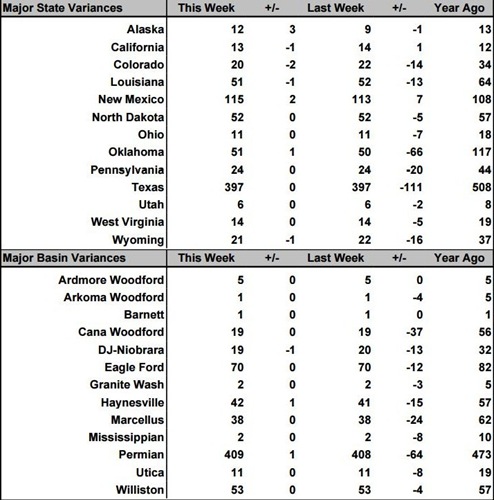
The “zero change” in Texas and the one rig increase in the Permian basin hide a lot of underlying activity in that region this week…in the westernmost Texas Permian basin, four rigs were added in Texas Oil District 8, which corresponds to the core Permian Delaware, while two rigs were pulled out of Texas Oil District 7C, or the southern Permian Midland, and at the same time, 3 rigs were pulled out of Texas Oil District 8A, or the northern Permian Midland …hence, for the overall Permian basin to be showing a one rig increase for the week, both of the rigs added in New Mexico had to have been set up for drilling in the western reaches of the Permian Delaware…elsewhere, the rig pulled out of the DJ-Niobrara chalk of the Rockies front range accounts for one of Colorado’s two rig reduction, while the rig that was added in the Haynesville was in northwest Louisiana, even as the state still saw a decrease on the removal of the Gulf rig and a land based rig in the south…meanwhile, gas rigs were unchanged in spite of that Haynesville shale addition because another gas rig in a basin not tracked separately by Baker Hughes was shut down at the same time…
DUC well report for December
Tuesday of this past week saw the release of the EIA’s Drilling Productivity Report for February, which includes the EIA’s January data for drilled but uncompleted oil and gas wells in the 7 most productive shale regions…for the eleventh month in a row, this report showed a decrease in uncompleted wells nationally in January, as both drilling of new wells and completions of drilled wells decreased…..for the 7 sedimentary regions covered by this report, the total count of DUC wells decreased by 34 wells, falling from a revised 7,716 DUC wells in December to 7,682 DUC wells in January, which now represents 8.6% fewer DUCs than the 8,401 wells that had been drilled but remained uncompleted as of the end of January of a year ago…this month’s DUC decrease occurred as 1,014 wells were drilled in the 7 regions that this report covers (representing 87% of all U.S. onshore drilling operations) during January, down by 9 from the 1,023 wells that were drilled in December and the lowest number of wells drilled since June 2017, while 1,048 wells were completed and brought into production by fracking, a decrease of 55 well completions from the 1,103 completions seen in December and the least completions since December 2018….at the January completion rate, the 7,682 drilled but uncompleted wells left at the end of the month now represents a 7.3 month backlog of wells that have been drilled but are not yet fracked, up from the 7.0 month backlog of a month ago, as the backlog rate is now rising due to falling completions, rather than through increased drilling…
Both oil producing and natural gas producing regions saw DUC well decreases in January, even as three of the seven major basins saw small DUC increases…the number of DUC wells remaining in the Oklahoma Anadarko decreased by 50, falling from 761 at the end of December to 711 DUC wells at the end of January, as 60 wells were drilled into the Anadarko basin during January while 110 Anadarko wells were being fracked….at the same time, DUC wells in the Eagle Ford of south Texas decreased by 12, from 1,404 DUC wells at the end of December to 1,392 DUCs at the end of January, as 156 wells were drilled in the Eagle Ford during January, while 168 already drilled Eagle Ford wells were completed….in addition, the drilled but uncompleted well count in the Niobrara chalk of the Rockies’ front range decreased by 10 to 457, as 133 Niobrara wells were drilled in January while 143 Niobrara wells were completed….on the other hand, DUC wells in the Bakken of North Dakota increased by 27, from 814 DUC wells at the end of December to 841 DUCs at the end of January, as 97 wells were drilled into the Bakken in December, while 70 of the drilled wells in that basin were being fracked…in addition, the Permian basin of west Texas and New Mexico saw its total count of uncompleted wells rise by 14, from 3,490 DUC wells at the end of December to 3,504 DUCs at the end of January, as 452 new wells were drilled into the Permian, while 438 wells in the region were being fracked….
Among the natural gas producing regions, the drilled but uncompleted well count in the Appalachian region, which includes the Utica shale, fell by 6 wells, from 543 DUCs at the end of December to 537 DUCs at the end of January, as 77 wells were drilled into the Marcellus and Utica shales during the month, while 83 of the already drilled wells in the region were fracked….however, the natural gas producing Haynesville shale of the northern Louisiana-Texas border region saw their uncompleted well inventory increase by 3 wells to 240, as 39 wells were drilled into the Haynesville during January, while 36 Haynesville wells were fracked during the same period….thus, for the month of January, DUCs in the five major oil-producing basins tracked by in this report (ie., the Anadarko, Bakken, Niobrara, Permian, and Eagle Ford) decreased by a net of 31 wells to 6,905 wells, while the uncompleted well count in the natural gas basins (the Marcellus, Utica, and the Haynesville) decreased by 3 wells to 777 wells, although as this report notes, once into production, more than half the wells drilled nationally will produce both oil and gas…
Utica Shale well activity as of Feb. 15 –
- DRILLED: 157 (147 as of last week)
- DRILLING: 109 (123)
- PERMITTED: 475 (479)
- PRODUCING: 2,451 (2,443)
- TOTAL: 3,192 (3,192)
Three horizontal permits were issued during the week that ended Feb. 15, and 12 rigs were operating in the Utica Shale.
Operator says containment worked at Coitsville well site – Youngstown Vindicator – State agencies are saying there was no risk to people or the environment after a motorist reported seeing water overflowing Sunday at a well site in Coitsville. The site operator also said systems worked as intended. “Someone drove by, made up things and went to the news,” said a representative from Bobcat Energy Resources LLC. “There was no problem with the well.” The well site, on U.S. Route 422, is where brine – or salt water – is pumped. The spokesman explained that a filter pump “ran too long.” The concerned motorist also contacted the Ohio Department of Natural Resources. There was no immediate danger to the area, ODNR confirmed. “Based on conversations with the caller, company and inspector, there was no sign of an external release at Bobcat Energy Resources LLC,” a statement from ODNR said. Inspectors from the Division of Oil and Gas Resources Management followed up at the site Monday. “The site experienced an electrical failure which led to brine being released into a closed on-site containment system. The system functioned as designed, and there is no risk to any person or the environment,” the ODNR statement explains.The Ohio Environmental Protection Agency also stated that the site “worked properly,” and that the equipment “prevented a release into the environment.”
First Look: See what’s going on at the potential site of the next ethane cracker – It hasn’t yet gotten the final investment decision that supercharged Shell’s Beaver County petrochemical plant, but work and investment is still going on at the proposed site of PTT Global Chemical America’s polyethylene plant in Belmont County, Ohio.PTT, a Thailand-based petrochemical company, has been considering for the last several years a site to build a plastics plant similar to the one that Shell Chemical is building further up the Ohio River in Potter Township, Beaver County. PTT’s site is the location of a former AEP coal-burning power plant in Mead Township, Ohio, across the river from Moundsville, West Virginia.A final investment decision could come sometime this year, a spokesman for PTT, Dan Williamson, told the Business Times on Thursday. The project was first announced by then-Ohio Gov. John Kasich in April 2015.The plant would take Marcellus and Utica shale gas and create ethylene, the building blocks of plastic products. PTT and Daelim Chemical, the South Korean firm that is its partner on the project, have spent about $100 million on engineering design and have received air and waterways discharge permits from the Ohio Environmental Protection Agency. PTT recently received $20 million from JobsOhio in a grant for revitalization work at the site, at which the former coal plant has long since been demolished and taken away.”The JobsOhio grant provides the project with the necessary resources to continue engineering work and site preparation that must be done in the coming months,” the PTT spokesman said.Bechtel Corp., the general contractor and project manager for Shell’s massive construction project in Beaver County, is the engineering, procurement and construction company for the PTT project as well.This week, the Business T imes visited the region near the site and saw from afar how the site preparation has been going. It’s difficult to gain an overall view of the site, either in Ohio where it’s located or neighboring Moundsville, West Virginia. But here are some photos.
Congressional Democrats Join the Debate Over Plastics’ Booming Future – Towers and tanks rise from the banks of the Ohio River 25 miles northwest of Pittsburgh, where Shell Polymers plans to produce 1.6 million metric tons of plastic pellets annually. To the Trump administration, the petrochemical industry and regional economic development officials, this state-of-the-art petrochemical plant offers a glimpse of the new economy for a part of Appalachia devastated when the steel industry collapsed a generation ago. Promoters of the Shell plant see it as the first among a number of new plastics manufacturers conveniently located amid thousands of fracking sites in the region’s Marcellus shale, a natural gas field that produces a massive amount of ethane. The gas is used in plastics production. The sites would be tied together by an expanding network of natural gas wells, processing facilities, pipelines and a giant underground storage facility, potentially funded in part by $1.9 billion in Trump administration loan guarantees. As industry and local authorities count thousands of new jobs and millions in tax revenues, battle lines have been drawn. Scientists warn of premature deaths from air pollution. Environmentalists foresee a plastics climate bomb. And now congressional Democrats have entered the fray, proposing a three-year moratorium on all new plastics plant construction nationwide, while the National Academy of Science studies the consequences of such a build-out on health and climate change. A far-reaching bill that Democrats call the Break Free from Plastic Pollution Act, has nary a Republican sponsor. But the legislation, which would also hold plastics manufacturers responsible for cleaning up plastic waste, helps frame a raging national debate over plastics in an election year. And it could set the stage for action on plastics reform, should the Democrats defeat President Trump and win the Senate. A moratorium would hold off development of the plastics manufacturing hub in Appalachia and stall plant expansions in the nation’s primary petrochemical production area along the Gulf Coast, while scientists studied the impacts in both regions. “These plants are poisoning the land, air and human beings,” said Sen. Tom Udall of New Mexico, a Democrat and the bill’s lead sponsor in the Senate. “It’s having a dramatic impact. We have to pause any expansion.” The American Chemistry Council, a chemical industry lobby group which envisions as many as five plastics manufacturing plants in Pennsylvania, Ohio and West Virginia, countered by touting the benefits of plastics, such as making cars lighter so they use less petroleum and emit fewer greenhouse gases.
DEP Fines Landfill Near Pittsburgh for Problems Tied to Fracking Waste – The Pennsylvania Department of Environmental Protection has fined a Westmoreland County landfill that had been passing pollution from oil and gas drilling waste into a local sewage treatment plant. The fine is part of a consent agreement with Westmoreland Sanitary Landfill to find a solution for the plant’s leachate, the liquid waste formed when rain and moisture percolates through the landfill. As part of the settlement, the landfill will pay a $24,000 fine and reduce the amount of waste it generates by closing up part of the landfill’s open area and installing an evaporator and other treatment equipment for the liquid waste. Ro Rozier, a spokeswoman for the landfill, said in an emailed statement the company was “pleased with the terms and conditions” of the agreement. Rozier said the company was “committed to investing substantial amounts of capital to purchase and install technology and equipment capable of treating and evaporating the leachate generated from the landfill on site. We are confident that our plan for onsite treatment and evaporation will resolve the landfill’s recent leachate disposal issues.”In May, a Fayette County judge ordered the landfill to stop sending its liquid waste to the Belle Vernon Municipal Authority’s sewage treatment plant, which had reported problems meeting water quality standards for its treated sewage. The sewage plant sought the injunction because the leachate it was receiving from the landfill was high in salts and radioactive materials found in drilling waste, which the landfill had been taking for several years. The landfill’s own waste reports showed the leachate it was sending the treatment plant had an “oil like” or “petroleum sheen.”StateImpact Pennsylvania reported in September a loophole in state and federal waste disposal laws allowed the landfill to send its untreated leachate to the Belle Vernon sewage plant. DEP officials told Belle Vernon’s operators to continue accepting the leachate, and stipulated that the landfill would pay any fine incurred by the sewage plant for exceeding pollution standards for its discharge into the Monongahela River. Tests showed the contaminants, including radium, were exiting the treatment plant and going into the river, a drinking water source for hundreds of thousands of people.
Chevron to trim 320 jobs in Pennsylvania —Chevron Corp. plans to eliminate 320 jobs as a result of its decision to liquidate its assets in the Appalachian Basin and ultimately close its Appalachian Mountain Business. “We are taking active steps to reduce job loss and will facilitate the placement of as many impacted employees as we can with other Chevron business units,” said a Feb. 6 letter Chevron company officials sent to state Department of Labor & Industry. The California-based energy company said it was providing significant advance notice of the layoffs to government stakeholders and employees despite the fact that most of the job cuts will not occur until later this year. An initial round is scheduled for April 6, although some employees will be offered temporary assignments with extended layoff dates, potentially through Dec. 31. Two office locations and a total of 320 workers will be affected. The office in Moon will lay off 288 employees, the company said. The Mount Braddock location in Fayette County will lay off 32 employees. Chevron controls about 890,000 acres in the Marcellus and Utica shales across Pennsylvania, West Virginia and Ohio. The Appalachian shale operations contributed to more than half of a massive impairment charge that the company revealed for the fourth quarter. The company announced in December that the charge, which writes down the value of assets on Chevron’s books, will be between $10 billion and $11 billion.
Appalachia producers risk crackup if gas output keeps growing: Cabot CEO – The head of one of Appalachia’s largest shale gas producers said the region’s drillers are heading for a crackup if they keep producing more gas in the face of the current low commodity prices. “I have a hard time rationalizing why industry is growing into the market today,” Cabot Oil & Gas Chairman and CEO Dan Dinges told analysts on the company’s fourth-quarter 2019 earnings call Friday. “I do think … rationalization is going to have to prevail in this market that’s not sustainable, and the balance sheets are not sustainable out there.” “I don’t know why anybody would be drilling wells … as a growth measure into this market,” Dinges said. Cabot is dialing back its 2020 capital spending to $575 million, a 27% drop from 2019, and will be laying down one of its three rigs in March. Cabot’s guidance for the first quarter calls for roughly 2.375 Bcfe/d of natural gas production, 3% less than the fourth quarter of 2019. The driller, which said it generates positive cash flows at $2/Mcf gas prices, is ready to clip its activity further if prices stay low, Dinges said. “We are at a maintenance level of capital because we don’t think it is prudent to drill up all your core inventory and push it out at a losing proposition.” “The company continues to analyze the outlook for the natural gas markets in 2020 and beyond, and is prepared to reduce capital spending further if market conditions warrant it,” the company said in its earnings release. Cabot reported realizing $2.15/Mcf for its gas production in Q4, a 31% drop from the same period a year ago, while still generating free cash flows of $109.5 million and adjusted income of $120.8 million, or 30 cents per share, a 55% drop from Q4 2018 and just under analysts’ expectations. Dinges reiterated Cabot’s intention to use 50% of the free cash flow to pay dividends with some of the remaining 50% used to retire some of Cabot’s debt. He steered clear of any discussion of using the extra cash to buy assets in a market where many other producers are trying to unload assets to fix their balance sheets. “To have an M&A transaction, it’s just cumbersome,”
Chester County appeal denied in Mariner East 2 pipeline case – Chester County did not show that it would suffer irreparable injury if Sunoco is allowed to continue installing part of the controversial Mariner East 2 pipeline project on two county-owned properties, thus failing to prove it needs an emergency injunction against the work, a state appeals court judge has ruled.The county, in an appeal filed last month by the commissioners over work on the pipeline at the Chester County Library property and along the Chester Valley Trail, failed to meet the legal stringent requirements to win an injunction against Sunoco Pipeline, Commonwealth Court Judge Michael Wojcik said in his denial filed Tuesday.Those requirements include a likelihood of success on the merits of the appeal and proof that the county would suffer damage that it would not be able to be financially compensated for, the judge wrote. The county contended the use of the open trench method of construction by Sunoco violated terms of an easement it had granted to the pipeline company in the past.“While commissioners maintain that Sunoco’s use of the open trench method without county’s consent constitutes a trespass, the court is not persuaded this alone proves irreparable injury,” Wojcik wrote. “To the extent that the county argues that Sunoco is operating outside of the agreed upon terms of the easements, any damage to county property caused by such action is compensable.”The company had argued the method of construction had been approved by the state Public Utility Commission and the PUC had authority over the project, not the courts. The ruling means work on the pipeline at the library, begun last month, can continue. Officials with Energy Transfer Partners, Sunoco’s parent company, did not respond immediately to a request for comment.
What contamination lurks on – and under – shuttered South Philly refinery – When blasts ignited a massive fire at the Philadelphia Energy Solutions refinery last June, residents feared that the spectacular blaze contaminated the air they breathe. Now that the U.S. Bankruptcy Court has approved the sale of the refinery complex to Hilco Redevelopment Partners, which wants to replace the refinery with a mixed-use development, concerns have shifted from air quality to contamination of the ground and the water beneath the two-square-mile property. Indeed, a host of hazardous chemicals including cancer-causing benzene lurk beneath the land where crude oil was processed, stored, and shipped starting 150 years ago, according to government and corporate documents reviewed by The Inquirer. Many compounds, especially benzene, have been found to exceed levels set by the state as acceptable for nonresidential property, according to reports compiled by the Pennsylvania Department of Environmental Protection and Evergreen Resources Group, which is handling a cleanup plan for Sunoco and has posted thousands of pages of documents online. Sunoco owned the refinery for decades until 2012, when it was sold to PES. Records reflect pollution that occurred before, during, and after the Sunoco years, though officials say there’s no way to tell exactly who is responsible for each kind of pollution over the property’s long industrial history. Sunoco, now a subsidiary of Energy Transfer LP, entered the refinery into a state program for cleanup in 2006. The cleanup plan is still being reviewed and applies only to environmental liabilities during Sunoco’s ownership. So although the full extent of the contamination is still being assessed, documents show that more than a dozen tongue-tripping chemical compounds have leaked, spilled, or otherwise found their way into the ground or aquifers in excess of state safety standards. The complex has been divided into 11 “areas of interest” for the cleanup. Portions of all 11 are contaminated.
Examining The Risks Of Radioactive Drilling Waste | West Virginia Public Broadcasting — On this West Virginia Morning, we visit Clay County where educators are revamping the idea of home economics class to inspire resilience in student populations. We also bring you a conversation about radioactive natural gas drilling waste. Every day, thousands of trucks filled with waste from natural gas drilling take to the roads across the Ohio Valley. The waste contains radioactivity and poses threats to workers, communities and the environment. Freelance science journalist Justin Nobel spent nearly two years reporting on this topic. He interviewed hundreds of scientists, environmentalists, state regulators and industry workers, and he uncovered never-before-released early reports from the oil and gas industry that highlight the radioactivity problem and its risks to workers and the public. Energy and environment reporter Brittany Patterson spoke with Nobel via Skype about his reporting published in January in Rolling Stone titled “America’s Radioactive Secret.” We bring you an excerpt from their conversation. West Virginia Public Broadcasting reached out to the trade group, the West Virginia Oil and Natural Gas Association. In a statement, executive director Anne Blankenship said the industry is highly regulated and does not expose workers or the public to high levels of radiation. She said her association disagrees with the Rolling Stone article, calling it “purposefully misleading, biased and exaggerated.”
WV House Energy Committee passes bill to increase tax collections on out-of-state royalties – On Tuesday, members of the House Energy Committee voted to pass a bill aimed at increasing tax collections from royalties on natural resources owned by those living outside the state. House Bill 4610 would require lessees who make natural resource royalty payments for in-state property to any nonresident lessor to withhold personal income tax on their payments and send them to the state tax commissioner. The bill will be sent to the floor of the House with a recommendation that it pass, but will first be referred to the House Finance Committee. Currently, nonresidents who receive royalty payments from resources on property in the state are required to pay state income tax on their payments, but the existing system relies on nonresidents to come forward and voluntarily pay their taxes, according to House Energy counsel Robert Akers. “In the bill, the Legislature finds that West Virginia is not collecting all of these taxes from out-of-state mineral owners, because no reliable mechanism exists and a method to collect these taxes from out-of-state interests needs to be developed so that taxes are collected uniformly from both in- and out-of-state mineral owners,” he said. “The purpose of the bill is to ensure these out-of-state mineral owners file and pay their West Virginia income tax – which is due.” The bill applies to coal, oil, gas, limestone, gravel, sand, ores and rare earth elements, timber and forest products, Akers said. “It’s essentially anybody who pays severance taxes,” he said. Withholding the tax is optional for lessors who receive less than $1,000 annually in royalty payment, Akers said.
House takes tax credit route in hopes of spurring natural gas development – – The House of Delegates Finance Committee approved two bills Wednesday creating separate tax credits in hopes of boosting development in the natural gas industry in the Mountain State.The first, HB 4421, called the Natural Gas Liquids Economic Development Act, would provide a credit to businesses that store or transfer natural gas. The companies would pay their inventory and equipment property tax to the county where they are operating but would be able to receive a credit in that amount against their corporate net income and personal income taxes.Supporters, like Delegate Bill Anderson, R-Wood, said the credit would help in the efforts to attract a natural gas storage hub and an ethane cracker plant.“We have the potential but we have to begin seriously looking at getting the hub in place somewhere in this region. Otherwise, we’re going to put all of these liquids in pipelines and we’re going to Louisiana and we’re going to send them to Texas and that’s where the jobs are going to be,” The bill passed on a voice vote Wednesday morning.In the committee’s Wednesday afternoon meeting, it passed a second tax credit bill for natural gas. HB 4019, called the Downstream Natural Gas Manufacturing Investment Tax Credit Act of 2020.The bill would allow eligible taxpayers to take a credit against the portion of state income taxes that come from the taxpayer’s investment in a new or expanded downstream natural gas manufacturing facility provided it creates new jobs. It’s similar to the state’s existing Economic Opportunity Tax Credit. The credit would determined by a complicated formula that determines the percentage of new jobs created with the project. The credit will be calculated on a 10-year period. If it’s not all used it can be taken during a second 10-year period.
Mountain Valley Pipeline extension clears environmental review by FERC – Plans to extend the Mountain Valley Pipeline 75 miles into North Carolina moved forward Friday, even as the initial project remains mired in legal and regulatory challenges. The Federal Energy Regulatory Commission concluded that while there would be some environmental damage caused by building the so-called MVP Southgate, it could be minimized to “less than significant levels.” An environmental impact statement released by FERC is a major step forward for the pipeline, which would originate at Mountain Valley’s terminus in Chatham, head southwest through Pittsylvania County and cross into North Carolina, extending to Alamance County near Burlington. “We look forward to safely and responsibly providing the reliable access to natural gas needed for home and business use across the region,” MVP Southgate spokesman Shawn Day said. Construction of the $468 million project is expected to start this year, Day said. Completion is targeted for 2021. In open houses and public hearings, many people spoke of widespread problems with muddy runoff from construction sites of Mountain Valley, which is seeking to regain suspended federal permits that have caused a lull in construction of the 303-mile pipeline. “Even when faced with a climate emergency, FERC continues to award new permits to polluters who cannot adhere to the erosion and sedimentation requirements of their current plans for the mainline Mountain Valley Pipeline,” Russell Chisholm, co-chair of the Protect Our Water, Heritage, Rights Coalition, said in a statement Friday.. But FERC said the same problems are not expected with the pipeline extension. “Because 2018 was an unusual year yielding record breaking precipitation amounts and given the flatter terrain where the Southgate Project would be constructed, we do not anticipate [it] would experience the same issues with erosion and sediment control,” the more than 1,000-page report stated.
FERC ruling keeps plans for Southgate pipeline on track – The 75-mile MVP Southgate Pipeline, proposed to carry shale natural gas into north central North Carolina, has no environmental issues that should prevent construction, the Federal Energy Regulatory Commission has ruled.The $470 million project is designed to carry gas from the much larger Mountain Valley Pipeline, which is currently stalled by court and regulatory challenges to its construction. That 430-mile pipeline is designed to carry natural gas from the Utica and Marcellus shale fields into central Virginia. The Southgate project, being built by Equitrans Midstream Corp. (has faced fewer challenges so far, although there have been some objections. FERC staff issued the Final Environmental Impact Statement for the project on Feb. 14. “We conclude that approval of the Project would result in some adverse environmental impacts, but these impacts would be reduced to less-than-significant levels through implementation of our recommendations and Mountain Valley’s proposed avoidance, minimization, and mitigation measures,” the FERC says. The pipeline still needs to get permits related to endangered species protections, natural and historic preservation and applicable air quality permits. The Southgate extension would carry gas from a compressor station in Chatham, Virginia, into North Carolina, northwest of Eden, and travel southeast to Graham. It’s slated for completion in 2021. The pipeline’s primary customer will be Dominion Energy North Carolina Gas, based in Gastonia. The Atlantic Coast Pipeline, a partnership of Dominion Energy Inc. (NYSE: D) and Duke Energy Corp. (NYSE: DUK), is slated to be completed in 2022. That $8 billion project is currently stalled by court and regulatory challenges.
Key Line 5 legal challenge could wrap soon ⋆ Canadian oil company Enbridge has not yet shown that its ongoing installation of support anchors along the controversial Line 5 pipeline complies with environmental protection laws, according to a new ruling issued by Administrative Law Judge Daniel L. Pulter. The 18-page order made public last week rejected all but one of the petitioners’ legal challenges to the state-issued permits Enbridge has received to install the supports. Pulter’s decision stems from a legal challenge filed in May 2018 by the Straits of Mackinac Alliance and Grand Traverse Band of Ottawa and Chippewa Indians against the Michigan Department of Environment, Great Lakes and Energy (EGLE). The city of Mackinac Island joined the appeal last year, and Enbridge intervened as an interested party in the case. “We are pleased that the Administrative Law Judge agreed with EGLE in dismissing the claims raised by the Petitioners,” said EGLE spokesman Dean Scott in an email. “EGLE looks forward to addressing the sole remaining issue in the case, which was raised by the Administrative Law Judge himself at the January 28, 2020 hearing.” But the sole remaining issue is a big one for the Line 5 opposition’s environmental case against the pipeline: The question of whether EGLE adequately determined that Enbridge’s proposed method for installing the anchors minimized potential harm to the environment and Great Lakes. Enbridge maintains that the anchors, which elevate the Line 5 pipeline above the lakebed, are necessary to ensure the pipeline is properly supported. The ruling also allows legal challenges to the Line 5 project to move forward. “Most of the things our side lost on were long shots with this administrative appeal and we knew it going in,” said David Holtz, spokesman for the Oil & Water Don’t Mix coalition that opposes Line 5. “We were hoping to get a shot at proving our environmental case and that’s what we got.” .
Activists Demand National Grid Halt Project To Extend A Fracked Gas Pipeline Through North Brooklyn –A coalition of North Brooklyn residents and environmental groups are fighting to stop National Grid’s plan to extend a natural gas pipeline through Bushwick, Williamsburg and Greenpoint.The gas company broke ground on a seven mile pipeline, starting in Brownsville, back in 2018. But since last fall, several blocks in North Brooklyn have been ripped up to make way for the final two phases of the pipeline, which National Grid wants to extend to its Greenpoint depot.”We don’t want this pipeline,” Kevin LaCherra, of Greenpoint, told a crowd of some 60 people rallying at National Grid’s construction site Saturday morning. “We want renewables now.”Residents and environmental groups, including Sane Energy Project, North Brooklyn Extinction Rebellion, Sunrise NYC, Assemblymember Joe Lentol and State Senator Julia Salazar’s office, rallied in 20-degree weather Saturday morning at National Grid’s construction site at Moore Street and Manhattan Avenue, marching along streets lined with pipelines and construction equipment equipment. Activists demanded Mayor Bill de Blasio and Governor Andrew Cuomo oppose the company’s request to the Public Service Commission for rate increases that would help pay for the last two phases of the project, which require $185 million over the next three years, according to documents the company submitted to the commission.”They didn’t let Bushwick and Williamsburg and Greenpoint know this pipeline was coming until it was right at their doorsteps,” Lee Zieshe, a community engagement coordinator with Sane Energy Project, told Gothamist. The project has outraged North Brooklyn residents, who have protested the pipeline – called the Metropolitan Natural Gas Reliability Project – at community meetings in recent months. Brooklyn’s Community Board 1 unanimously voted against the project last week, Brooklyn Eagle reported. “People are frustrated because it’s 2020. We need to be getting off fossil fuels and here is National Grid wanting to raise our monthly bills to invest hundreds of millions of dollars in a new fracked gas pipeline,” Zieshe said. “That’s just insanity.”
Group urges Murphy to veto Pinelands Commission minutes – – In the more than 40-year history of the New Jersey Pinelands Commission, only once has the state’s governor exercised his authority to veto the agency’s meeting minutes to stop an action from being finalized. The New Jersey Sierra Club wants Gov. Phil Murphy to become the second governor to veto Pinelands Commission meeting minutes in order to force the commissioners to redo their vote on a resolution to block a controversial natural gas pipeline from moving forward through the southernmost portion of the Pines. “We would rather no meeting than a bad meeting,” Sierra Club Director Jeff Tittel said in the Feb. 11 letter urging Murphy to veto the minutes of the commission’s Jan. 10 meeting. The meeting featured a vote on a resolution to place a stay on the commission’s prior approval of the South Jersey Gas pipeline through Cape May and Cumberland counties. But the resolution failed by a 4-5 vote. The resolution’s defeat was the latest development in the long history of twists, turns and lawsuits surrounding the proposed pipeline project, which is easily among the most controversial proposals to ever come before the commission, which is responsible for regulating development and land use within the million-acre Pinelands. The 22-mile gas line was proposed in part to fuel the formerly coal-powered BL England plant, which was to be converted to natural gas. But the project hit a major snag last year when BL England announced it was no longer interested in repowering the plant and would not tie into the planned gas line.
State regulators won’t do more asbestos testing at Weymouth compressor site – – State regulators will not further test contaminated fill for asbestos at the construction site of a natural-gas compressor station despite the urging of local activists. Residents fighting the compressor station on the banks of the Fore River sat down with regulators last week to voice their concerns, including that the firm hired to oversee the cleanup of contamination on the site did not adequately test bricks that were dumped on the property years ago after being removed from a furnace across the street. TRC tested eight bricks found at the site and did not detect asbestos. But Michael Lang, environmental coordinator of the East Braintree Civic Association, learned that the firebrick industry stopped adding asbestos to their firebrick around 1972, meaning bricks closer to the surface likely would not have asbestos in them. Lang shared this information at the meeting last week, and Bellafiore said residents were told regulators would look into it. But Courtney Rainey, director of government affairs and municipal partnerships for the state Department of Environmental Protection, suggested in an email to legislators that more testing will not take place. “Regarding asbestos on site, through the investigation and assessments conducted to-date, asbestos has not been identified as a contaminant of concern at the site. Because some fire bricks can contain asbestos, some of the bricks were analyzed for asbestos and the results were negative,” Rainey wrote. Bellafiore on Friday said asbestos is a huge health and safety issue and something that is in everyone’s best interest to investigate further.
Ransomware Shuts Gas Compressor for Days in Latest Attack– A recent ransomware attack caused a U.S. natural gas compressor facility to shut for two days, the latest in a string of attacks targeting the country’s energy infrastructure over the past few years. Hackers sent emails with a malicious link, known as a phishing attack, to gain control of the facility’s information technology system, the Department of Homeland Security said Tuesday in an alert. The agency didn’t say which facility was targeted, when the attack occurred or who was behind it. It appears likely that the attacker explored the facility’s network to “identify critical assets” before executing the ransomware attack, according to Nathan Brubaker, a senior manager at the cybersecurity firm FireEye Inc. This tactic — which has become increasingly popular among hackers — makes it “possible for the attacker to disable security processes that would normally be enough to detect known ransomware indicators,” he said. The DHS alert comes amid increased concern about whether aging U.S. energy facilities are equipped to ward off cyber-attacks that could result in power failures and disruptions to oil and natural gas supply. In 2018, several pipeline companies saw their electronic systems for communicating with customers shut down after being targeted by hackers. Regulators have urged better oversight for pipeline cybersecurity, which is overseen by the Transportation Security Administration. DHS announced in 2018 that it was working with the TSA and the Department of Energy on a pipeline cybersecurity initiative. Operations at the facility have been restored, according to an official the Department of Homeland Security’s Cybersecurity and Infrastructure Security Agency, who requested anonymity speaking about the matter. The official said the incident illustrates the risk that ransomware poses to industrial control systems. Though the hackers didn’t gain control of the gas compression facility, the operator decided to perform a controlled shutdown after being unable to read and aggregate real-time operational data from certain devices. While ransomware is usually designed to block access to a computer system until a sum of money is paid, the DHS notice didn’t specify what the hackers were demanding in the gas compressor cyber-attack. The facility’s emergency response plan didn’t specifically address the risk of cyber-attacks, DHS said.
Oil and gas firms ‘have had far worse climate impact than thought’ – The oil and gas industry has had a far worse impact on the climate than previously believed, according to a study indicating that human emissions of fossil methane have been underestimated by up to 40%. Although the research will add to pressure on fossil fuel companies, scientists said there was cause for hope because it showed a big extra benefit could come from tighter regulation of the industry and a faster shift towards renewable energy.Methane has a greenhouse effect that is about 80 times more potent than carbon dioxide over a 20-year period and is responsible for at least 25% of global heating, according to the UN Environment Programme. In the past two centuries, the amount of methane in the atmosphere has more than doubled, though there has long been uncertainty about whether the source was biological – from agriculture, livestock or landfills – or from fossil fuels. There were also doubts about what share of fossil methane was naturally released and what share was from industry. For a more accurate comparison, a team at the University of Rochester in the US examined levels of methane in the pre-industrial era about 300 years ago. This was achieved by analysing air from that period trapped in glaciers in Greenland. The sample – made up of about a tonne of ice – was extracted with a Blue Ice Drill, capable of producing the world’s biggest ice cores. The findings, published in Nature, suggest the share of naturally released fossil methane has been overestimated by “an order of magnitude”, which means that human activities are 25-40% more responsible for fossil methane in the atmosphere than thought. This strengthens suspicions that fossil fuel companies are not fully accounting for their impact on the climate, particularly with regard to methane – a colourless, odourless gas that many plants routinely vent into the atmosphere. An earlier study revealed methane emissions from US oil and gas plants were 60% higher than reported to the Environmental Protection Agency. Accidents are also underreported. A single blowout at a natural gas well in Ohio in 2018 discharged more methane over three weeks than the oil and gas industries of France, Norway and the Netherlands released in an entire year. Fracking also appears to have worsened the problem. Atmospheric methane had started to flatten off at the turn of the century, but rose again after a surge in fracking activity in the US and elsewhere.
Morrisey stresses importance of Atlantic Coast Pipeline ahead of oral arguments – WV MetroNews – West Virginia Attorney General Patrick Morrisey, union laborers and other state officials are speaking out about the Atlantic Coast Pipeline in advance of oral arguments in a case to overturn its blocked construction. Morrisey held a press conference on Thursday at the state Capitol with dozens of workers to speak on why he thinks the U.S. Supreme Court must overturn the ruling by a circuit court of appeals. West Virginia is part of the 18-state coalition in arguing the 4th Circuit Court of Appeals in Richmond, Virginia was inaccurate in ruling the U.S. Forest Service lacked authority to grant the rights-of-way through forestland beneath federal trails. In December 2018, the court halted the development of the 605-mile natural gas pipeline that would go from West Virginia to North Carolina.. “If you set a precedent that you can’t put a pipeline, even if its buried 600 feet under federal land, you’re going to bring to halt so much economic development in our country,” Morrisey said on Thursday. Morrisey focused much of the press conference on the economic effect in communities of having the pipeline shut down. The pipeline, if it’s completed, would transport natural gas through Harrison, Lewis, Upshur, Randolph and Pocahontas counties en route to Virginia and North Carolina. Tax revenues in those counties are losing a combined $400 million a year, according to Morrisey. He said those counties depend on that to support other ventures in public safety and fighting the opioid epidemic.
Dominion still banking on end of 2021 completion of Atlantic Coast Pipeline – Dominion Energy CEO Thomas Farrell recently confirmed the company still anticipates completing construction of the Atlantic Coast Pipeline by the end of 2021, and introducing the first product into the system in 2022.“Project costs of approximately $8 billion are in line with the high end of the ‘judicial option’ range we provided about a year ago,” Farrell said recently during an earnings report conference call. Farrell also said he’s confident the U.S. Supreme Court by May or June will reverse the Fourth Circuit on a ruling regarding a U.S. Forest Service permit where the pipeline would cross the Appalachian Trail. Dominion voluntarily halted all major construction activities on the pipeline in December 2018 following a ruling from the U.S. Court of Appeals for the Fourth Circuit that denied a permit issued by the Forest Service allowing the pipeline’s route to go through two national forests and under the Appalachian Trail.And, “we continue to work with the U.S. Fish and Wildlife Service on a re-issued biological opinion, and are pleased that [the Federal Energy Regulatory Commission] reinitiated formal consultation [recently],” Farrell said. “We applaud the [Fish and Wildlife] Service for taking the time to consider thoroughly the feedback provided by the court during the prior judicial proceedings, and we believe an updated biological opinion will be issued during the first half of this year,” Farrell said. “Upon receipt of the updated biological opinion, we intend to notify FERC and anticipate thereafter the recommencement of construction across major portions of the pipeline,” Farrell said. As for a court decision vacating an air permit at a compressor station in Buckingham County, Virginia, “we are working on a number of solutions which we expect will resolve the issue during the second half of the year.” And meanwhile, “we can deliver a very material amount of contracted volumes to customers on our existing schedule even if permit resolution delays the in-service date of the project’s third compressor station,” Farrell said. Environmental advocates, meanwhile, have continued to call on the Federal Energy Regulatory Commission to stop construction of the Atlantic Coast Pipeline project.
A pipeline runs through Southern news deserts – Columbia Journalism Review – THE PROPOSED PATH of the Atlantic Coast Pipeline snakes 600 miles through West Virginia, Virginia, and North Carolina. Construction of the 42-inch-wide natural gas pipeline was halted in December 2018; later this month, the Supreme Court will hear arguments over a key permit that it would need to start up again. If the pipeline is built, then one of its three planned compressor stations – massive facilities that help compress and transport natural gas – will be located in Northampton County, North Carolina, a swampy, rural region where the vast majority of residents are black. The county is already home to industrial hog farms, a wood-pellet plant, and large landfills – other industrial projects that have enormous effects on the surrounding land and its residents. Northampton is also one of six counties in North Carolina without a newspaper, according to a University of North Carolina report on expanding news deserts. The number of newspapers in the state has declined by 22 percent since 2004. Pipeline updates – concerning permits, protests, hearings, lawsuits, and risks – are not consistently covered in state newspapers or newspapers in neighboring counties, if they’re covered at all. All three states crossed by the Atlantic Coast Pipeline have a dearth of local newspapers, according to the UNC report. West Virginia has three counties without a newspaper; Virginia has seven. In about half of the 25 counties along the Atlantic Coast Pipeline route, print news comprises a single weekly paper; several weekly or daily papers cover more than one county. The counties along the route are some of the most rural and economically depressed parts of the US, in a region that is historically reliant on extractive fossil fuels. In North Carolina, seven of the eight counties the proposed pipeline would run through are predominantly black. These places lack consistent, informative local coverage of energy, justice, and the environment because of the declining number and resources of print news outlets, shifting the balance of news sources toward expanding corporate media monopolies. The absence leaves ample space for powerful campaigns by Duke and Dominion, the pipeline’s developers and buyers of its natural gas, as well as industry-aligned lobbyists and politicians, to shape the pipeline narrative. Another result is misinformation and confusion about the status of a massive energy project that affects tens of thousands of people, several endangered species, and a variety of fragile ecosystems. In some cases, property owners have been caught unaware of their rights or legal options when Dominion came knocking to claim eminent domain.
Hurst: Virginia not doing enough on pipelines – Sediment steadily encroaching onto private property. Road closures and traffic jams. Man-made erosion of the lush Appalachian Mountains. This has become the new normal for the residents of my district and far too many others who live in Southwest Virginia.The unfortunate truth is that this is what so many of us warned about when the Mountain Valley Pipeline Project filed for its construction permit in 2015. Now, almost five years later, following dubious arguments and deceitful reassurances from big energy and stakeholders of the MVP, the commonwealth’s environment and its citizens are more at risk to the consequences of this project than ever before.In 2018, the MVP racked up more than 300 permit violations for carelessly violating Virginia’s water quality standards, failing to repair broken equipment, allowing man-made erosion to occur, poor stormwater management, and more. These violations averaged more than one per day during construction and were unquestionably significant. The commonwealth clearly understands the crisis that these violations bring, as made evident by the Office of the Attorney General’s decision to sue the MVP alongside the Department of Environmental Quality over the high number of violations in late 2018.While I’m proud of the work the Attorney General has done to hold the Mountain Valley Pipeline accountable, Virginia is not doing nearly enough to defend our environment from the threats we face. As I stated in the Agriculture Chesapeake and Natural Resources’ Subcommittee on Natural Resources last Wednesday morning, we have not seen any substantive change of heart, change of action, change of principle, or change of practice to make sure that pipeline projects are done in a safe and reliable manner. A lack of guidelines and legislation within the commonwealth have allowed these violations to continue to occur at an unsustainable rate. The legislation I have proposed will put an end to this. House Bills 643, 644, and 646 will safeguard our citizens and environment while holding the MVP accountable for its negligent practices. These three bills, that all passed out of the Agriculture Chesapeake and Natural Resources Committee on Wednesday, work in tandem to ensure that pipeline projects under construction in the commonwealth strictly comply with safety regulations to the fullest extent of the law.
US FERC ends consideration of new oil pipeline rate system – The US Federal Energy Regulatory Commission Thursday ended consideration of a potential overhaul of how oil pipelines set their rates, a decision welcomed by pipeline owners who want to keep the current indexing system that allows annual rate increases. It has been longstanding FERC policy to set a ceiling on oil pipeline rates, allowing pipelines to raise their shipping fees up to that limit and forcing shippers to bring complaints to FERC when they think the rates exceed the actual costs of service. FERC reviews the index every five years to ensure it corresponds to industry-wide oil pipeline cost changes. The commission will consider a new index later this year for the five-year period starting July 1, 2021 Oil producers and other pipeline customers had urged the commission to adopt a cost-of-service rate structure closer to those used in the electricity and natural gas pipeline sectors. FERC voted 2-1 to end the rulemaking, with Commissioner Richard Glick dissenting. Andy Black, president of the Association of Oil Pipe Lines, said the current rate indexing system protects pipeline customers and provides and incentive for pipeline companies to control their costs. Pipeline executives have said in recent fourth-quarter earnings calls that they were watching for FERC’s decision on the four-year-old rulemaking. “Pipeline companies need a way to operate their businesses efficiently and with certainty, and FERC’s existing approach allows us to do so,”
Judge allows South Carolina suit over offshore tests to proceed – (Reuters) – A federal judge ruled on Tuesday that some of the claims raised by South Carolina in a lawsuit against the Trump administration over seismic tests for oil and gas deposits in Atlantic waters may proceed, but dismissed four others. Coastal states and environmental groups have taken legal steps to try to block Trump administration efforts to open up the U.S. East Coast to offshore oil and gas exploration. The United States is still processing permit applications for companies to conduct seismic testing – a precursor to drilling and the subject of the lawsuit – despite shelving its plan to vastly expand offshore drilling. U.S. District Judge Richard Mark Gergel in South Carolina ruled that the state’s claim that President Donald Trump lacked the power to extend offshore oil and gas drilling to areas that had been placed off limits by his predecessor, Barack Obama, may move forward. The Trump administration had asked the judge to dismiss South Carolina’s claims in the suit. In the ruling, Gergel said the U.S. government’s motion to dismiss the claims “quite strikingly” failed to state that a federal judge in Alaska last year overturned Trump’s attempt to open the Atlantic to oil and gas leasing and that the administration shortly thereafter put its efforts to expand oil and gas exploration there on hold.
Salvage company says Coast Guard, federal official violating oil pollution laws at site of Golden Ray – The salvage company originally hired to get the Golden Ray cargo ship out of St. Simon’s Sound is now claiming the Coast Guard and a federal on-scene coordinator are violating federal pollution laws. The company, DonJonSMIT, filed a claim in federal court on Thursday saying a salvage plan about to be implemented could cause an environmental disaster. The salvage plan involves cutting the ship into eight pieces and loading each one onto a barge. DonJonSMIT says that it is extremely high risk and has failed with similar shipwrecks. The claim states that despite DonJonSMIT’s multiple requests for information from the Coast Guard, they refused to respond and instead unlawfully delegated its sole decision-making authority to the Golden Ray’s owner. T&T Salvage, based in Texas, is in charge of salvaging the Golden Ray and its cargo of 4,200 cars, which hold oil, gas and batteries. The Altamaha Riverkeeper, which has been monitoring the environmental impact of the wreck, says T&T Salvage has said as many as 800 of those cars could end up in the water. Don Jon Smit said its plan would have been less hazardous, and cheaper, but was rejected by the ship’s owner. The court claim says the Coast Guard, not the ship’s owner, should have had the final say on who would do the salvage.
LNG Market Catches a Chill as Gas Prices Drop— A plunge in prices is shaking some of the more marginal players out of the liquefied natural gas market, chilling what until recently was the hottest part of the energy industry. Major utilities from Orsted A/S in Denmark to Iberdrola SA in Spain are exiting the business. Naturgy Energy Group SA has made no secret it isn’t comfortable with the volatility of LNG and was reported as considering an exit, and Vattenfall AB of Sweden won’t even think about entering. The moves drain momentum from a push by companies in almost every corner of the energy industry to start trading LNG. Over the past decade, commodity trading houses and oil majors have joined other utilities such as RWE AG in building their trading desks and investing in new facilities to handle the fuel. “Now it is a pretty painful moment for the LNG market with such low prices,” Frank van Doorn, Vattenfall’s head of trading, said in an interview. Optimism about the industry’s prospects has crashed into economics. New export projects from Australia to the U.S. have flooded the market with new supplies at the moment that warmer weather and the coronavirus in China curbed demand. The result is brimming storage tanks in Europe and prices for the commodity testing record lows. Lower prices are putting some LNG exporters in a complicated situation where they must decide whether to shut in production or accept losses in delivering cargoes at prices that won’t cover their own costs, “In this environment we do see some curtailments already for a few certain LNG suppliers globally,” De Luca said. “This summer I wouldn’t be surprised to see more extensive maintenance planned as some operators choose to use the low price environment to plan upkeep and repairs. We are now approaching levels that some more price-sensitive U.S. LNG shippers would make losses on full costs.” Activity in the LNG industry reached its highest level in five years in 2018, with contracts signed to deliver a total of 123 billion cubic meters of the fuel, according to a report from the International Energy Agency. Much of this increase relates to the development and financing of new liquefaction projects. A record-setting capacity of more than 170 billion cubic meters of natural gas liquefaction got final investment decisions, or FID, last year. While shipments continue to set new records, gas prices around the globe have fallen, and that has gutted margins for spot LNG traders
US oil, gas rig count down 5 to 825, gas total lowest since late 2016: Enverus Total US oil and gas rig counts were down a net five last week to 825, rig data provider Enverus said Thursday, amid continued low commodity prices and producers’ efficient operations and restrained capital outlays throughout domestic basins. Most of the rig reductions was seen in oil plays, where rigs fell by five to 678.There was a one-rig gain in rigs not classified as oil or gas. Rigs chasing natural gas dropped by one to 144 and fell to the lowest total since November 2016. The total US rig count is the lowest since early February 2017. “Some of the smaller basins across the US continue to drop rig counts in first-quarter 2020, but looking forward, Platts Analytics is expecting rig activity to remain relatively flat for the remainder of 2020 as oil prices hover around $50-$55/b,” said Matt Andre of S&P Global Platts Analytics. The largest US basins showed little week-on-week change, as most moved up or down a rig or two. The Permian Basin of West Texas/New Mexico gained two rigs to 415, while the Eagle Ford Shale of South Texas shed two rigs leaving 80. The Williston Basin situated in North Dakota/Montana and the DJ Basin largely in Colorado each remained steady for the third consecutive week at 54 and 26 rigs, respectively. The Haynesville Shale in Northwest Louisiana/East Texas and the SCOOP/STACK plays in Oklahoma each gained a rig to 42 rigs each. The Marcellus Shale largely in Pennsylvania also gained a net rig, making a total 39. This translated to the Marcellus Dry sub-category gaining three rigs to 21, while the Marcellus Wet lost two rigs, leaving 18. The Utica Shale mostly in Ohio shed a rig for a total of 11. One reason for the drop in rigs is smaller 2020 capex, as operators have walked their capital budgets back largely by single digits. The efficiencies during the last five years of $50-ish/b oil has taught producers to do more with less and eke oil and gas out of the ground at ever-lower breakeven prices.
Natural-gas prices tally biggest one-day gain in over a year, post highest finish in a month – Natural-gas futures jumped by nearly 8% on Tuesday, with forecasts for colder weather in much of the U.S. lifting prices to their highest finish in roughly four weeks. Oil futures, meanwhile, settled flat as traders weighed worries about the coronavirus and its impact on energy demand, along with a forecast for a slowdown in U.S. shale oil output. The move for natural gas appears to be “a reaction to a much colder forecast for the western half of the country through next week, even though the key Midwest and Northeast consuming regions are forecast above average,” Marshall Steeves, energy markets analyst at IHS Markit, told MarketWatch. “Thus, the gains could prove precarious.” March natural gas climbed by 14.4 cents, or 7.8%, to settle at $1.981 per million British thermal units on the New York Mercantile Exchange. That was the highest finish for the front-month contract since Jan. 17 of this year, and biggest one-day percentage rise since Jan. 14, 2019, according to Dow Jones Market Data. Tuesdays’ move marked a bounce back for the commodity, which suffered a loss of 1.1% last week, and touched its lowest levels since March 2016. Despite the day’s sharp climb in natural gas, Christin Redmond, commodity analyst at Schneider Electric, said in a daily note that “technical indicators predict that it will be very difficult for [natural-gas] prices to break back above key resistance of $2.00 [per million Btus], especially as the bears still maintain control of trend.”
US working natural gas in underground storage decreases by 151 Bcf: EIA – – US natural gas in storage last week fell at a rate more than the five-year average for only the second time this year, according to data released by the US Energy Information Administration on Thursday, allowing Henry Hub futures to hang on to gains made earlier this week. Storage inventories fell by 151 Bcf to 2.343 Tcf for the week ended February 14. The pull was more than an S&P Global Platts’ survey of analysts calling for a 151 Bcf withdrawal. It was less than the 163 Bcf pull reported during the corresponding week in 2019 but more than the five-year average draw of 136 Bcf, according to EIA data. It marked only the second time the draw was more than the five-year average this year. Storage volumes now stand 613 Bcf, or 35.4%, more than the year-ago level of 1.730 Tcf and 200 Bcf, or 9.3%, more than the five-year average of 2.143 Tcf. Falling temperatures, mostly in the US Midwest, bumped up residential and commercial demand for natural gas 5.2 Bcf/d week over week, increasing the Lower 48’s call on storage, according to S&P Global Platts Analytics. Total demand was up 6.9 Bcf/d week over week. LNG feedgas was the only demand source to decline, with volumes falling 0.9 Bcf/d. Losses were largely attributable to reduced flows into the Sabine Pass and Cameron LNG export facilities as fog and maintenance-related activities weighed on demand. Upstream, supplies were up 1.2 Bcf/d, led by a 0.7 Bcf/d increase in onshore production volumes. Net Canadian imports were also up approximately 0.4 Bcf/d week over week. The NYMEX Henry Hub March contract added 1.2 cents to $1.967/MMBtu in the minutes of trading following the weekly storage report. Summer 2020 prices traded at $2.09/MMBtu, an increase of 7% from the lows established last week. Further out on the curve, winter 2020-21 Henry Hub prices have seen a steady increase in support, with prices up roughly 3% relative to the lows established in early February. A forecast by Platts Analytics’ supply and demand model expects a 143 Bcf draw for the week ending February 21, which is 21 Bcf stronger than the five-year average. The week in progress has seen balances tighten further, with demand rising by 2.7 Bcf/d and supplies falling by 0.3 Bcf/d. Most of the demand gains were linked to a 3.2 Bcf/d increase in residential and commercial consumption.
EIA expects natural gas production and exports to continue increasing in most scenarios — According to projections published in the U.S. Energy Information Administration’s (EIA) Annual Energy Outlook 2020 (AEO2020), total dry natural gas production in the United States will continue to increase until 2050 in most of the AEO2020 cases, primarily to support growing U.S. exports of natural gas to global markets. The United States began exporting more natural gas than it imports on an annual basis in 2017, driven by increased liquefied natural gas (LNG) exports, increased pipeline exports to Mexico, and reduced imports from Canada. In most of the AEO2020 cases, net natural gas exports continue to increase through 2050, and most of the increase is in the near term. The AEO2020 Reference case represents EIA’s best assessment of how U.S. and world energy markets will operate through 2050, assuming no significant changes in energy policy occur. Side cases show the effects of changing model assumptions: the High and Low Oil Price cases simulate international conditions that could drive crude oil prices higher or lower, and the High and Low Oil and Gas Supply cases vary production costs and resource recoverability within the United States. EIA expects dry natural gas production to total 34 trillion cubic feet (Tcf) in 2019 once the final data is in. In the AEO2020 Reference case, EIA projects that U.S. dry natural gas production will reach 45 Tcf by 2050. Production growth results largely from continued development of tight and shale resources in the East, Gulf Coast, and Southwest regions, which more than offsets production declines in other regions. Dry natural gas production from these three regions accounted for 68% of total U.S. dry natural gas production in 2019 and, in the Reference case, 78% of dry natural gas production in 2050. Most of the increase in dry natural gas production is coming from natural gas formations such as the Marcellus and Utica in the East region and the Haynesville in the Gulf Coast region. A smaller but still significant portion of the growth is from natural gas production in oil formations (also known as associated gas), especially in the Permian Basin in the Southwest region. In the Reference case, both U.S. natural gas exports by pipeline and U.S. LNG exports continue to grow through 2030. LNG exports account for most of the export growth because more LNG export facilities are becoming operational and more projects are under construction. In the Reference case, EIA projects that LNG exports will almost triple, from 1.7 Tcf in 2019 to 5.8 Tcf in 2030, the equivalent of nearly 16 billion cubic feet per day (Bcf/d). LNG exports remain at this level through 2050 as U.S.-sourced LNG becomes less competitive in world markets and as more countries become global LNG suppliers.
Demand for liquefied natural gas set to double by 2040, according to Shell – Worldwide demand for liquefied natural gas, or LNG, rose by 12.5% to hit 359 million tons last year, according to Royal Dutch Shell’s annual LNG Outlook report. Citing forecasts, Shell said that LNG demand was expected to double by 2040 to 700 million tons, with natural gas set to play “a growing role in shaping a lower-carbon energy system.” Shell added that LNG imports in China grew by 14% last year, while Bangladesh, India and Pakistan saw imports reach 36 million tons, representing growth of 19%. “The global LNG market continued to evolve in 2019 with demand increasing for LNG and natural gas in power and non-power sectors,” Maarten Wetselaar, integrated gas and new energies director at Shell, said in a statement issued Thursday. “Record supply investments will meet people’s growing need for the most flexible and cleanest-burning fossil fuel,” he added. “While we see weak market conditions today due to record new supply coming in, two successive mild winters and the Coronavirus situation, we expect equilibrium to return, driven by a combination of continued demand growth and reduction in new supply coming on-stream until the mid-2020s.” LNG refers to natural gas that has been cooled down to turn it into a liquid. This makes it easier to both store and transport. According to the U.S. Energy Information Administration (EIA), the “volume of the liquid is 600 times smaller than the gaseous form.” While natural gas is a fossil fuel, the EIA states that burning it for energy “results in fewer emissions of nearly all types of air pollutants and carbon dioxide (CO2) than burning coal or petroleum products to produce an equal amount of energy.” In 2019, the International Energy Agency (IEA) said that “coal-to-gas switching” had saved approximately 500 million tons of CO2 since 2010.
Gas explosion shuts down facilities near Port of Corpus Christi – A natural gas line exploded Monday in Corpus Christi, temporarily halting production at nearby facilities at the Port of Corpus Christi.Corpus Christi firefighters were called to a natural gas line rupture and fire near the northbound lanes of Interstate 37 and Buddy Lawrence Drive shortly before 8:30 a.m. Monday, KRIS-TV reported. The fire was contained and normal traffic resumed about an hour later.No injuries were reported but with the fireball next to the Corpus Christi Citgo refinery, authorities closed part of I-37 and other underground pipelines in the area as a precaution. Nearby industrial facilities at the port followed suit. Although not directly affected by the fire, the Javelina Gas Processing Plant off I-37 receives natural gas from other lines in the area. The facility told the Texas Commission on Environmental Quality that those lines were shut off, prompting the plant to vent and flare thousands of pounds of butane, ethylene and other compounds.Port of Corpus Christi officials reported that the fire did not affect operations at South Texas waterway but port police assisted in securing the scene. The cause of the fire remains under investigation. Citgo officials confirmed that a pipeline owned by a third party caught fire outside the company’s east refinery and was extinguished without injury.”This incident does not pose any threat to the surrounding community, our employees or contractors,” the company said in a statement.Read the latest oil and gas news from HoustonChronicle.com
Crude oil spill in Tabbs Bay spread to Bayland Marina in Baytown, officials say – – Oil spilled in Tabbs Bay near Baytown earlier this month has spread to Bayland Marina as the U.S. Coast Guard and other agencies continue to try and clean up the spill, officials said Tuesday. Officials said the Bayland Marina is a natural collection point for the bay, which means currents carry debris and oil residue to that location. Coast Guard officials were alert by the Texas General Land Office about the amount of emulsified oil. Officials said an oil spill response team along with other agencies are at the scene cleaning it up.Coast Guard officials said an estimated 630 gallons of oil were spilled from an out-of-service wellhead on Feb. 3, which impacted a mile of the shoreline. Officials previously said about 840 gallons of oily water were collected. READ: Nearly 840 gallons of ‘oily water’ collected from Tabbs Bay after crude oil spill over the weekend. Booms were deployed in three stages to contain the spill and prevent impact to the Houston Ship Channel and the surrounding environment.The cause of the spill is under investigation.
Decades after oil spill, Barnett Shale lake deemed safe – Nearly three decades after a large oil spill contaminated it, Bass Lake near the North Texas town of Gorman has been deemed safe for recreational use and redevelopment, the Railroad Commission said Thursday. The spring-fed lake, on the edge of the Barnett Shale about 130 miles west of Dallas, was contaminated when a pipeline ruptured in April 1990, spilling 294,000 gallons of crude oil into the Sabana River and onto surrounding land.A cleanup hampered by heavy rains recovered just 42,000 gallons of oil. City leaders in 2018 enrolled the lake and a neighboring park in the Railroad Commission’s Brownfields Response Program, which assists in cleaning conataminated lands.Railroad Commission tests of lake water, soil, sediment and groundwater revealed that compounds related to the spill were within safe levels, the agency said.
TEXAS: Trial to begin over Arkema chemical plant fire during Harvey — Wednesday, February 19, 2020 — Opening statements are expected to begin today or tomorrow in a trial over a 2017 explosion at Arkema Inc.’s chemical plant in suburban Houston.
UGSC finished regular gasoline price rises amid supply constraints – US Gulf Coast finished regular differential jumped 4.40 cents/gal to NYMEX April RBOB futures minus 9.25 cents/gal, amid lower availability of prompt material to send to the New York Harbor area. The finished regular gasoline to be shipped on Colonial Pipeline shipping cycle number 14 was heard traded 3 cents below cycle 13 material, since Thursday was the last day to schedule finished grade for cycle 13. “It has been a crazy week across the board,” a trader said. The support likely came from the FCC outages heard along the week. “Support on prices is more due to Bayway, Chevron-Pasadena, Lyondell, Shell-Convent. I think Baton Rouge is pretty much restarted and the Citgo outage was brief,” another trader said, citing recent refinery outages, which have supported higher gasoline prices. The month-long unplanned outage of the 145,000 b/d FCCU at Phillips 66’s 258,000 b/d Bayway refinery in New Jersey pulled more gasoline than usual up the Colonial Pipeline into New York Harbor as Friday begins the last shipping cycle on the Colonial Pipeline for 13.5 RVP gasoline. RVP will drop to 11.5 with the next cycle, Cycle 14. On Wednesday, market sources said Shell reported a problem with a 46,000 b/d reformer at the plant over the weekend. Reformate is used to increase octane in gasoline and is necessary for transitional and summer grade gasoline, which needs lower RVP. “It is just too many refining units down,” the same broker added. “It seems to be more issue with the finished grade than CBOB,” a second trader said, since the US Gulf Coast CBOB differential added only 1.50 cents/gal, to be assessed at futures minus 16.50 cents/gal. Market sources said that the 502,500 b/d ExxonMobile’s Baton Rouge refinery has an important production of regular finished gasoline and the run cuts after the fire could be adding support to the finished grade more than any other.
Investors Tightening the Screws on Oil, Gas Acquisitions –Owing to a collapse of oil prices at the end of 2018, M&A activity in oil and gas has almost ground to a halt after a flurry of deals last autumn. After a decade of funding the expansion of unconventional oil and gas, Wall Street investors have lost patience and want a return on their investment. Andrew Dittmar, Senior M&A Analyst at Enverus, notes, “investors who funded the shale revolution over the last decade have become vocal in advocating for pay-outs and cutting back on providing new capital. That flowed through to limited M&A and a negative reaction to deals for much of the year.”[i] There are various explanations as to why mergers and acquisition activity has dramatically slowed [ii] but fundamentally they boil down to money. After more than a decade of expansion, investors see a mature industry, with slowing productivity, which should be maximising profits and generating returns rather than pursuing growth. [iii] Wall Street has become less impressed with growing output production figures and more interested in getting a return on investment. This is especially so in an environment in which prices have fallen. For example, natural gas prices fell by 50 percent in 2019 compared to 2018, with little prospect in the near term for any price improvement. In fact, this has led some companies to close natural gas wells, whilst others have paid pipeline operators to take their gas.[iv] Likewise, the collapse in the oil price to between $50 and $60 a barrel with no prospect of serious uplift means there is more focus on restraining spending, maximizing profits and generating returns. As a result, Wall Street banks have tightened the financial screws when lending to E&P companies, whether it is for new operating capital, boosting output or even mergers and acquisitions. The change in investor sentiment is perceptible in industry spending, industry bankruptcies and mixed results of recent mergers and acquisitions. Haynes and Boone recently released its Energy Bankruptcy Report which shows that number of oilpatch bankruptcies increasing from 24 in 2017, to 28 in 2018 and rising to 42 in 2019.[vi]
US shale oil production set for slow growth in February, March: EIA | S&P Global Platts – US shale oil production is set to increase only 11,000 b/d in February and 18,000 b/d in March, low growth levels not seen in over three years, the US Energy Information Administration said Tuesday, with only the Permian Basin increasing output in the months. Last month, EIA pegged February output growth at 22,000 b/d in its initial estimate before halving that figure in its revised forecast 30 days later in its Drilling Productivity Report. The last time the agency’s forward growth forecast for shale oil was lower was January 2017, when the growth rate was pegged at 2,000 b/d and total shale oil output was supposed to reach 4.542 million b/d. The EIA sees total US oil production at 9.156 million b/d in February and 9.174 million b/d in March. The Permian in West Texas/New Mexico is pegged to grow in February by 42,000 b/d on month to 4.816 million b/d and increase by 39,000 b/d in March to 4.855 million b/d. For March 2020, oil output the Eagle Ford, sited in South Texas, should remain steady at 1.369 million, production in the Anadarko Basin in Oklahoma is forecast to drop by 10,000 b/d to 526,000 b/d, while production in the Niobrara Shale in Colorado should fall by 8,000 b/d. Output in the Bakken Shale of North Dakota/Montana should recede by about 2,000 b/d next month to 1.472 million, while in natural gas-prone Appalachia, oil production is predicted to be down 1,000 b/d to 145,000 b/d. EIA has forecast progressively lower growth levels in the second half of 2019, after its initial prediction of an 85,000 b/d increase for September 2019, as rig counts dropped, E&P companies exhausted their capital budgets and already-volatile oil prices inched down for a time. Since then, the agency’s monthly outlook for total US output growth has dwindled each month. For example, the agency initially predicted 74,000 b/d of growth in October, 58,000 b/d for November, 49,000 b/d in December and 30,000 b/d for January. Last month, it pegged output growth at 22,000 b/d, but in the last 30 days revised that number lower for February to 11,000 b/d. The last time the agency’s forward growth forecast for shale oil was that low was for January 2017, when the growth rate was pegged at 2,000 b/d and total shale oil output was supposed to reach 4.542 million b/d.
Horizontal drilling drought returns to Barnett Shale – More than five weeks have passed since any oil company has filed for a drilling permit with the Railroad Commission of Texas for a new horizontal well in the Barnett Shale, a natural gas-rich geological formation that surrounds the Dallas-Fort Worth Metroplex.There is still one active drilling rig in the shale play, according to the Baker Hughes Rig Count, but the region frequently goes two weeks at a time without a horizontal drilling permit being filed. A five-week horizontal drilling permit drought hit the region in April and May 2019.Although a February 2013 study by the Bureau of Economic Geology at the University of Texas at Austin estimated that the Barnett has 44 trillion cubic feet of recoverable natural gas reserves, it might have to remain in the ground for financial reasons. With natural gas trading below $2 per million British thermal units on Louisiana’s Henry Hub, drilling and hydraulic fracturing in much of the region isn’t cost-effective.Oklahoma City-based Devon Energy had long been the region’s top horizontal driller, but it cut activity before selling assets and exiting the shale play in December. Houston exploration and production company Lime Rock Resources has emerged as the region’s top horizontal driller with 21 permits filed last year. Irving oil company Pioneer Natural Resources is preparing for a heavy round of horizontal drilling in an area of the Permian Basin known as the Midland Basin. The company is seeking permission to drill 13 wells in Martin County and another two in Midland County. All of the wells target the Spraberry field at total depths ranging from about 8,400 to 11,100 feet. Oklahoma City oil company Chesapeake Energy has filed its first major batch drilling permits in Texas since a fatal accident in Burleson County. Three horizontal wells in Webb County target the Briscoe Ranch field of the Eagle Ford Shale while two more in Burleson County target the Giddings field in the same formation. There were no horizontal drilling permits filed in the East Texas shale play, but Nacogdoches-based Dual Production Partners plans to drill a vertical well in San Augustine. The well targets the oil-rich Nacogdoches field down to a vertical depth of 1,300 feet. Despite the horizontal drilling drought, Graham-based Texas Shallow Oil & Gas is preparing to drill a vertical well on its Logan lease in Young County. The well targets the Young County Regular field down to a vertical depth of 700 feet. There are several saltwater disposal wells being developed in the western end of the Permian Basin known as the Delaware Basin that will require vertical wells to be drilled. APC Water Holdings, DBM Water Services and Solaris Water Midstream plan to develop a combined 14 injection wells to support saltwater disposal in Loving County.
Texas Hill Country showdown — A fight over building a natural gas pipeline that will cut through the scenic Texas Hill Country is heating up after a federal judge shot down a request by opponents to halt construction. U.S. District Court Judge Robert Pitman rejected a request for a temporary restraining order that would have halted Kinder Morgan’s $2 billion Permian Highway Pipeline. The 430-mile natural gas pipeline is being built through the habitat of the golden-cheeked warbler, an endangered songbird, and over parts of the Edwards Aquifer, a source of drinking water to millions and home to several threatened and endangered species of salamander, fish and insects. Judge Pitman said opponents in an endangered species lawsuit failed to show a level of harm that would require a restraining order, but he ordered Kinder Morgannot to clear vegetationwithin the warbler’s range during nesting season, March 1 through July 31. Taking advantage of that two-week window between now and March 1, Kinder Morgan has already started clearing land along the route in the Hill Country. The company has vowed to stop those activities during the bird’s nesting season and resume them once it is over. Although the pipeline project is only expected to disturb less than 1 percent of the warbler’s habitat, Kinder Morgan has bought more than 1,300 acres of land near Austin that will be set aside for the rare songbird. But the fight is far from over. Opponents have vowed to keep fighting and the company still has to resolve the endangered species lawsuit and a separate landowners lawsuit.
Opponents of Kinder Morgan Hill Country pipeline vow to keep fighting – Opponents of a controversial natural gas pipeline through the picturesque Texas Hill Country lost a legal battle but vow to continue their fight against Houston pipeline operator Kinder Morgan. A U.S. district court judge in Austin on Friday rejected a request for a temporary restraining order that would have halted the $2 billion natural gas Permian Highway Pipeline. The pipeline is being built through the habitat of the golden-cheeked warbler, an endangered songbird, and over parts of the Edwards Aquifer, a source of drinking water to millions and home to several threatened and endangered species of salamander, fish and insects. Judge Robert Pitman said opponents failed to show a level of harm that would require a restraining order, but he ordered Kinder Morgan not to clear vegetation within the warbler’s range during nesting season, March 1through July 31. Construction has begun on the western end of the pipeline’s 430-mile route from the Permian Basin to the Katy Hub, but Kinder Morgan isn’t out of the woods in the Texas Hill Country. The request for a temporary restraining order was only part of an endangered species lawsuit filed Feb. 5 by the cities of Austin and San Marcos, Hays and Travis counties, the Barton Springs Edwards Aquifer Conservation District and four landowners. The company, its subcontractors and the project also face a federal lawsuit filed by five Hill Country landowners. The endangered species lawsuit is on a path to head to trial, said Jessica Karlsruher, executive director of the Texas Real Estate Advocacy and Defense Coalition, a nonprofit that represents landowners who oppose the project. The coalition seeks to reform Texas eminent domain laws used by Kinder Morgan and other companies to acquire land for pipelines. The group favors the model used by power line companies in which the proposed route is discussed at public hearings and finalized by a state agency. “The final routing decision should be made by public officials accountable to all the citizens of Texas,” Karlsruher said. “Kinder Morgan executives should not have the unilateral power to decide where to build an industrial highway that affects thousands of landowners and dozens of communities.”
Kinder Morgan CEO offers new guidance on Permian Pass Pipeline – Houston pipeline operator Kinder Morgan plans to build the company’s third pipeline to move natural gas from the Permian Basin of West Texas to the Gulf Coast but the project may have to wait until more customers sign up. Kinder Morgan brought its Permian Basin-to-Corpus Christi Gulf Coast Express Pipeline into service in September while construction continues for its Permian Highway Pipeline, which will move gas from the West Texas shale play through the Texas Hill Country to the Katy Hub near Houston. The company’s CEO Steve Kean told the Houston Chronicle that Kinder Morgan remains in talks with producers to build the Permian Pass Pipeline, a proposed project that will move 2 billion cubic feet of natural gas per day from the prolific West Texas shale play to interstate pipelines and liquefied natural gas export terminals in East Texas and Louisiana. “While we were in deep discussions mid-last year, that has cooled a bit as producers re-examine their capital commitments,” Kean said. “I still think we’re going to need it.” Unlike the Permian Highway Pipeline, which still faces two federal lawsuits filed by opponents, the Permian Pass Pipeline will not go through the scenic and environmentally sensitive Hill Country. Instead, Kean said the Permian Pass Pipeline will be routed through an area north of Austin and south of Dallas with a termination point in East Texas.
Texas Railroad Commission Releases First-Of-Its-Kind Report On Natural Gas Flaring -As oil and gas production has ramped up in the Permian Basin, so has flaring. Flaring is the burning off of natural gas – a byproduct of oil extraction – when there isn’t room, or desire, to transport it in existing pipelines. As common as flaring is, its emissions are also damaging to the atmosphere.Now, Texas Railroad Commissioner Ryan Sitton has released a report that looks at the practice and prevalence of natural gas flaring in the Texas oil and gas industry. The Railroad Commission is the state’s energy regulator.“It’s really the first report we’ve seen from a railroad commissioner on this really controversial topic,” says Mose Buchele, energy and environment reporter for KUT Austin.Buchele says in the report, the commission measures flaring by looking at how much an oil and gas company burns natural gas compared to how much oil it produces. But he says that’s more of a measure of efficiency than of environmental impact.The oil and gas industry supports that form of measurement, but environmental groups are skeptical. They’re skeptical because the commission has the authority to regulate flaring more stringently but has not. Methane is what’s burned during flaring, and it’s a gas that contributes to climate change.“Also, it’s just vastly wasteful; everybody recognizes this. People in industry recognize this. There’s one estimate that says that enough gas is flared to power every home in Texas,” Buchele says. “It’s just a big waste of energy even putting aside the environmental impact.”Buchele says companies flare because it’s not profitable for them to transport and sell it. He also says the report doesn’t indicate whether the commission will begin to regulate flaring more aggressively.
Texas regulator calls out state’s worst, best companies for natural gas flaring (Reuters) – One of Texas’ oil and gas regulators on Tuesday defended the state’s high rate of natural gas flaring, but named companies that burn off the most gas and said he would hold public meetings on the controversial practice. Flaring, or deliberately burning gas produced alongside oil, has surged with crude production in Texas, but can worsen climate change by releasing carbon dioxide. The report includes a set of flaring and venting data to be updated quarterly, the first set of such data the state has released. Ryan Sitton, one of three elected oil and gas regulators, said Texas’ flaring intensity is lower than other oil-producing areas, including North Dakota, Iran, Iraq and Russia. Its flare volumes – around 650,000 thousand cubic feet per day (Mcf/d) in 2018 – are “high for recent history” but do not surpass some years in the 1950s, according to Sitton’s report. “The state as a whole is still well below historical levels and most of the rest of the world,” Sitton said in the report. EP Energy, Endeavor Energy Resources, Surge Operating and Jagged Peak Energy had the state’s highest rates of “flaring intensity,” a measurement of flaring volume against oil production, according to the report. The companies could not be reached immediately for comment, but Jagged Peak was recently purchased by Parsley Energy, whose chief executive has criticized Jagged Peak’s high flaring rates. Companies with the lowest flaring intensity in Texas included Pioneer Natural Resources, EOG Resources, ConocoPhillips and Chesapeake Energy Corp. Oil drillers tend to flare or vent gas when they lack pipelines to move it to market, or prices are too low to make transporting it worthwhile. Venting releases unburned methane, which is many times more potent than carbon dioxide as a greenhouse gas. Texas regularly allows companies to burn or vent gas in excess of regulations. It has issued more than 35,000 flaring permits since 2013 and has not denied any, according to the state commission.
Pioneer Natural CEO calls on investors to divest in companies with high flaring – (Reuters) – The chief executive of Pioneer Natural Resources, Scott Sheffield, on Thursday called on energy investors to sell shares or pull funding from companies that have rates of natural gas flaring. The practice of burning off natural gas produced alongside more profitable oil has become a top issue for investors, who are focused on sustainability measures and already are frustrated by a decade of poor financial returns in oil and gas. Flaring has surged with U.S. oil output, but can worsen climate change by releasing carbon dioxide. If producers in the Permian Basin, the top U.S. shale field, cannot drop flaring rates below 2% of gas produced by the first half of next year, when new pipelines would have come online, Sheffield asked investors in public shares, bonds or private equity firms to “end up either not doing business or sell whatever you have in regard to that company.” The idea, Sheffield said during an earnings call, came out of a late January workshop in Austin, Texas, coordinated between Columbia University and the University of Texas at Austin, which brought together producers, pipeline companies, policymakers, non-governmental organizations, academics and analysts to talk about Permian Basin flaring. The workshop was invitation-only, but Columbia plans to release a report on it.
An unexpected side effect of fracking: Chlamydia – To the consternation of fracking fans everywhere, researchers at the Yale School of Public Health this weekend confirmed a correlation reported two years earlier between intense fracking activity and a local increase in certain sexually transmitted diseases. The first study had been in Ohio; the new one was in Texas.Other side effects of fracking include earthquakes, methane emissions, groundwater contamination, sundry pollution,hydrocarbon spills and health risks, but the risks to health usually cited are silicosis and congenital heart defects, not STDs. Yet here we are.In relevant Texas counties, the researchers found heightened rates of chlamydia and gonorrhea, but for some reason not syphilis, reports senior author Nicole Deziel of the Yale School of Public Health, writing with Joshua Warren and Elise Elliott of the Harvard T.H. Chan School of Public Health in the journal Sexually Transmitted Diseases.Rates of gonorrhea and chlamydia rose 15 percent and 10 percent, respectively, in fracking-intense Texan counties compared to Texan counties without any fracking, they found.“The lack of an association between shale drilling activity and rates of syphilis may be because this STI occurs most commonly in men who have sex with men, which compose only a small proportion of the male population, making it difficult to study,” writes the team. They don’t mention herpes. (The U.S. Centers for Disease Control and Prevention also says syphilis is more common among men.) Why might rates of gonorrhea and chlamydia in Texas fracking fields be higher? Because fracking is a labor-intense industry that often involves “importing” specialized workers, the scientists explain. Who are these mobile workers? Young men living in temporary camps with limited connections to the community, who seek company as young men do, the authors elaborate. There was no information on condom use rates among these migratory males.
Sheridan Production, Extraction Oil and Gas Reveal Layoffs – Houston-based Sheridan Production Co. will lay off 116 employees effective March 31, 2020, according to a notice sent to the Oklahoma Office of Workforce Development. No further information surrounding the layoffs was provided in the notice. Sheridan was established in 2006 by industry veteran Lisa Stewart, who partnered with the private equity investment firm Warburg Pincus to implement the Sheridan investment strategy. During her oil and gas career Stewart held several leadership roles at El Paso and prior to that she spent 20 years at Apache Corp. On Sept. 15, 2019, Sheridan Holding Company II, LLC and eight affiliated debtors filed for Chapter 11 bankruptcy. The plan of reorganization was approved and became effective on Jan. 17, 2020. Separately, Denver’s Extraction Oil & Gas Inc. reported plans to lay off 20 percent of its workforce, which equates to approximately 60 workers from its headquarters and field operations in the D-J Basin, according to the Denver Business Journal. “We reorganized our workforce into a more streamlined structure that better matches our operational footprint here in Colorado,” Brian Cain, company spokesman told the Denver Business Journal. “Unfortunately, this resulted in difficult but necessary organizational changes … This was a difficult decision and one we did not take lightly.” Extraction Oil & Gas Inc. is an independent energy exploration and development company focused on exploring, developing and producing oil, gas and NGLs primarily in the Wattenberg Field in the D-J Basin of Colorado. These companies’ layoffs are the latest in a string over the past year for the oil and gas industry. A few of the latest announcements include:
EIA revises global liquid fuels demand growth down because of the coronavirus – In the February 2020 update of its Short-Term Energy Outlook (STEO), the U.S. Energy Information Administration (EIA) forecasts that global liquid fuels demand will average 101.7 million barrels per day (b/d) in 2020, 1.0 million b/d more than the 2019 average but 378,000 b/d less than was forecast in the January 2020 edition of the STEO. The change in the forecast is driven by a combination of lower-than-expected heating fuel consumption caused by the Northern Hemisphere’s warmer-than-expected winter, an expected slowing of economic growth in general, and the particular economic effects of the 2019 novel coronavirus (COVID-19) outbreak. EIA estimates that COVID-19 will reduce China’s total petroleum and liquid fuels demand by an average of 190,000 b/d in 2020. This forecast is based on estimates of three components:
- The reduction in demand for petroleum and liquid fuels caused by the general decline in Chinese economic activity as measured by gross domestic product (GDP)
- The volume of foregone jet fuel consumption in China caused by flight cancellations
- The additional impact on China’s demand for other transportation fuels
As with any forecast, EIA’s estimates contain a number of uncertainties and limitations. Notably, this forecast is particularly sensitive to the duration of the demand disruption caused by COVID-19. EIA assumes that the timing of COVID-19’s impact on petroleum demand will follow a similar path as the 2003 SARS coronavirus outbreak: demand reductions will intensify in February, peak in March, and steadily decline during April, May, and June. GDP-induced impacts will linger through December. However, the 2003 SARS coronavirus and COVID-19 have different rates of transmission, detection, and mortality. Consequently, EIA considered the example of the 2003 SARS coronavirus outbreak when estimating duration and peak of the demand impacts, but it did not consider it when estimating the levels of petroleum demand reductions. A more detailed discussion of how EIA estimated the demand revisions appeared in the February 11 This Week in Petroleum.
Permian and Bakken Refiner Wants to Be Change Agent – The developer of two grassroots U.S. oil refineries reported late last week that it has formally completed and adopted a stringent program for identifying, evaluating and managing environmental and social risks tied to the projects. Meridian Energy Group, Inc., which plans to build new refineries in the Bakken Shale formation and the Permian Basin, stated that its new Environmental and Social Management Plan (ESMP) aligns with the Equator Principles – a risk management framework embraced by 101 financial institutions in 38 countries. “Meridian took this approach from day one, not because of government dictates or to fulfill the terms of government subsidies or funding, but because it is what its founders and management team chose to do,” Meridian CEO William Prentice told Rigzone. “These professionals wanted to create a firm that would be a profitable agent of change in cleaning up one of the most archaic and dirty segments of the energy industry.”Prentice described ESMP as a “common baseline and framework” for employees and company partners – such as contractors – to navigate potential or actual environmental and social risks and impacts during project development and operations. Meridian’s two refinery projects include the Davis Refinery in Belfield, N.D., and a similar facility in Winkler County, Texas, near the city of Kermit. The company has stated the 49,500-barrel per day (bpd) North Dakota project and the 60,000-bpd Texas project will each qualify as a “Synthetic Minor Source” from an emissions perspective. As this March 2019 Rigzone article notes, the designation applies to benzene and sulfur removal in gasoline production, flare stack output and volatile organic compound releases. The company contends that its flagship Davis Refinery will produce one-tenth of the air emissions and less than one-half the total greenhouse gas emissions compared to the U.S. refinery industry average.
South Dakota House passes Gov. Kristi Noem’s riot boosting bill, sends it to the Senate – The South Dakota Senate will take up Gov. Kristi Noem’s riot boosting bill after the House passed it on Tuesday. The House passed House Bill 1117 in a 45-25 in a vote on Tuesday. Rep. Jon Hansen, R-Dell Rapids, questioned if violence should be legal under South Dakota law. The bill holds people who riot accountable, he said. Ahead of the House’s vote on Tuesday afternoon, about 20 tribal members protested the bill in the Capitol rotunda, which is next to Noem’s office. They walked in a circle, yelling, “Gov. Noem, we are not a riot,” and carrying signs stating, “Our voices will not be silenced.” The protest lasted about three minutes before Highway Patrol told them to leave the building because they didn’t have a permit to be there. They stood in the House gallery as they watched the debate and vote on the House floor. After the House’s vote, a woman began yelling at the House members about the bill and said she was expressing her freedom of speech as she was removed from the gallery. Noem’s 2020 riot boosting bill will repeal the sections of her 2019 riot boosting law that the federal court struck down as unconstitutional in September, replace the definition of “incitement to riot” with one that meets the constitutional restrictions on free speech and updates the civil penalties to follow the proposed bill’s “incitement to riot” language. The House’s debate on the bill was split along party lines, with Republicans arguing the bill protects the First Amendment right to peacefully protest and Democrats arguing that it’ll land the state in court again because it chills free speech. Rep. Manny Steele, R-Sioux Falls, said the bill doesn’t contain anything about peaceful protest, which is everyone’s right to do.
North Dakota regulators OK expansion of Dakota Access Pipeline — North Dakota regulators on Wednesday green-lighted the proposed expansion of the Dakota Access Pipeline, which involves building a pump station in Emmons County to help push up to twice as much oil through the line every day. Energy Transfer plans to begin construction on the facility this spring following the PSC’s unanimous decision to grant the company an amended permit for the project. The company said it’s “pleased” with the vote, and added in a statement that the decision “brings us another step closer to being able to optimize the existing pipeline to safely transport up to 1.1 million barrels of crude oil per day, to more efficiently accommodate the increasing market demand for Bakken crude oil.” The PSC’s approval could be challenged in court by the Standing Rock Sioux Tribe, which still seeks to shut the pipeline down through a federal lawsuit it filed over the project when it was under construction in 2016. The tribe also intervened in the expansion case before the PSC. Standing Rock Chairman Mike Faith said he wasn’t surprised by the vote but was “very disappointed to hear today’s outcome.” The tribe is examining its options for legal recourse, he said. Energy Transfer still seeks approvals from regulators in Iowa and Illinois to complete its expansion plans, which include putting in a total of three pump stations along the 1,200-mile line and making upgrades to boost the horsepower of other pumping facilities. With its planned capacity increase, the pipeline would have the ability to take three-quarters of all oil produced in North Dakota to market, transporting it closer to refineries in other states or toward ships that would carry it overseas.
Standing Rock Sioux Tribe: “The PSC failed to do its job” by approving Dakota Access pipeline expansion Texas-based Energy Transfer has received the approval they were seeking to build a $40 million pump station near Linton, a station they say is necessary to increase the volume of oil the Dakota Access Pipeline can move. “After one of the most extensive public hearings in commission history, to me it’s clear that this pipeline optimization project meets all of North Dakota’s sighting criteria, and is in the best interest of our citizens, and will move an enormous amount of oil and it will move it more safely and more efficiently,” said Commissioner Randy Christmann. The Standing Rock Sioux Tribe had been fighting the plan for months, saying it would increase the probability of a disastrous oil spill. Tim Purdon is the Tribe’s Attorney. “The tribe throughout this process identified specific documents and safety information that would help the commission make its decision, the commission chose not to get those documents, the people downstream from the pipeline in Emmons County and at Standing Rock Reservation, I think they expected due diligence here and I don’t think they got it,” said Purdon In court documents, Energy Transfer said the pump station would produce only “minimal adverse effects on the environment and the citizens of North Dakota.” Allyson Two Bears, the Standing Rock Director of Environmental Regulations says they now need to be ready for anything. “We’re gonna do our best to be prepared for this, and hope that we can get some cooperation with this company eventually to be able to let us sit at the table and let us participate in some of these exercises because now were facing the doubling, were facing twice the risk and now need to be prepared,”
Agency: North Dakota oil production drops 3% in December (AP) – North Dakota regulators say oil production in December was down about 3% from November. The Department of Mineral Resources says the state produced an average of 1.47 million barrels of oil daily in December. That’s down from 1.51 million barrels from the prior month. North Dakota also produced about 94.8 billion cubic feet of natural gas in December, up from 94 billion cubic feet in November. Statewide, companies flared 16% of all gas produced in December, above the 12% target. There were 15,979 wells were producing in December, down from a record 16,110 in November. The December tallies are the latest figures available.
2 Million Pounds of Radioactive Fracking Waste Illegally Dumped in Oregon Landfill – A chemical waste landfill in Oregon has been accepting millions of pounds of radioactive fracking waste from North Dakota, violating Oregon environmental regulations. According to the Bend Bulletin, Oregon Department of Energy officials recently issued a “notice of violation” to Chemical Waste Management’s landfill near the small town of Arlington for accepting a total of 2 million pounds of Bakken oil field waste that was delivered by rail in 2016, 2017, and 2019. Some of the waste, when tested, registered radium at 300 times the Oregon state limit. Even with the violations, the landfill won’t be fined because, according to Magic Valley, state officials believe operators misunderstood state guidelines. Environmental advocates plan to pressure state leaders to determine how Oregon became “a fracking dumping ground,” as some are calling it. Chemical Waste Management has not accepted another load of Bakken oil field runoff since September 2019. The landfill owners and managers must now create a risk assessment and action plan to address the dumping violation.
US panel delays vote on Oregon pipeline amid process issues (AP) – A U.S. regulatory agency on Thursday delayed a vote on a proposed natural gas pipeline and marine export terminal in Oregon, with one member saying greenhouse gas emissions and endangered species should be considered and blasting the decision-making process as “rotten.” The issues bluntly raised at the meeting of the Federal Energy Regulatory Commission in Washington came on top of objections to the mega-project by Oregon’s Department of Land Conservation and Development. In a letter released late Wednesday, the department said the Jordan Cove Energy Project would harm the environment and had failed to obtain necessary permits and to provide information requested by the department. “Coastal effects analyses show that the project will negatively impact Oregon’s coastal scenic and aesthetic resources, a variety of endangered and threatened species, critical habitat and ecosystem services, fisheries resources, commercial and recreational fishing and boating, and commercial shipping and transportation, among other sectors,” the department said in the letter to a Jordan Cove official. The proposed natural gas terminal and 230-mile (370-kilometer) pipeline would permit shipment of natural gas from the United States and Canada to Asia and would be the West Coast’s first liquefied natural gas export terminal. The Trump administration supports energy export projects and in particular Jordan Cove, a project of Pembina, a Canadian company. It has proposed streamlining approval of gas pipelines and other energy projects by limiting states’ certification authorities under the U.S. Clean Water Act. The three members of the federal commission were all appointed by President Donald Trump. U.S. Sen. Ron Wyden, an Oregon Democrat, urged Trump last month to appoint a full and bipartisan five-member commission before a ruling is made on Jordan Cove. Otherwise, a decision could be interpreted as politically motivated, he said. While the commission delayed the issue Thursday, member Bernard McNamee said he was giving it an initial “nay” until he could study Wednesday’s decision by the Oregon agency. Commissioner Richard Glick had harsh words for the way the panel operates, saying it ignores environmental impacts. “We really don’t consider or include those environmental impacts in our decision-making process,” Glick said at the meeting. “Something’s really rotten with that.”
Legal action threatened to stop construction of Keystone XL- Conservation and environmental groups filed notices today of their intent to sue the U.S. Fish and Wildlife Service, Bureau of Land Management and the companies behind the Keystone XL pipeline for failing to consider the effects of the pipeline – including likely oil spills–on endangered species, including whooping cranes and pallid sturgeon. Previously the U.S. District Court in Montana ruled that the Trump administration violated bedrock environmental laws when officials approved a federal permit for the pipeline, including by failing to adequately address the risks of oil spills on listed species. “The Trump administration continues to ignore the catastrophic impacts of Keystone XL as it attempts to ram this dirty fossil fuel project down America’s throat,” said Eric Glitzenstein, the Center for Biological Diversity’s litigation director. “History shows that oil spills are going to occur, and yet the agencies failed once again to analyze how spills might harm waterways and, subsequently, people and endangered species.” Despite admitting that multiple oil spills are likely to occur – both large and small – the agencies argue that such events will be infrequent and will have minimal impact on the environment. Yet spills have been anything but infrequent since President Trump in 2017 cleared the way for the pipeline to be built. That year, a spill from the Keystone I pipeline leaked more than 407,000 gallons of crude oil in South Dakota, and a spill in October 2019 leaked 383,000 gallons of crude. Notice has also been provided to TC Energy, which recently stated its intention to commence construction activities in April. Without a proper analysis and mitigation under the Endangered Species Act, however, such construction would clearly be unlawful and result in severe harm to endangered species, including not just the crane and sturgeon, but also the American burying beetle, whose habitat falls squarely within the footprint of the project. TC Energy claims it is working on a habitat conservation plan that would mitigate impacts to at least the beetle, but this is far from complete and has not been exposed to any expert and public review. The law flatly prohibits construction in the absence of such review and a finalized conservation plan.
Protesters in Kahnawake will remain in place until Wet’suwet’en hereditary chiefs are satisfied — Protesters in Kahnawake remain on the Candiac line train tracks in support of the Wet’suwet’en hereditary chiefs opposed to a Coastal GasLink natural gas pipeline in northern BC. Kahnawake’s traditional government – the Mohawk Nation at Kahnawake – issued two news releases this week in support of the blockades. The nation is part of the broader Haudenosaunee (Iroquois) Confederacy and secretary Kenneth Deer spoke to CTV News about the nation’s reason for supporting the hereditary chiefs in BC. “They are traditional people like ourselves,” he said. “We’ve been here since time immemorial. We have our own political system, a clan system, we have a constitution that pre-dates European contact, and these kinds of political systems have been subject to repression by the Canadian government and replaced by the Indian Act and elected councils.” Coastal GasLink has promoted the fact that it has signed agreements with the elected leadership of 20 First Nations along the pipeline’s route, but Deer and other traditional leaders are not part of the elected council system. Kahnawake’s elected council – the Mohawk Council of Kahnawake – also stated its support of the Wet’suwet’en protests and condemned the RCMP’s use of force against the protesters. Deer and others have drawn parallels between the current protests and those in the summer of 1990 when Kahnawake joined Kanesatake to protest the municipality of Oka’s plans to expand a golf course on traditional Mohawk land. Then, protesters from both communities blocked several roads and the Mercier Bridge. Now, according to Deer, it is time to return the favour.”When we were surrounded by the police and the army, all those Indigenous people across Canada supported us, so when they ask for help, we have to reciprocate,” said Deer. “We have to do what they did for us 30 years ago.” Canadian Indigenous Services Minister Marc Miller said “modest progress” was made with the protesters in the Mohawk community of Tyendinaga, who have halted train service across much of Eastern Canada. Outgoing Conservative Leader Andrew Scheer criticized the protesters Friday. “These protesters, these activists, may have the luxury of spending days at a time at a blockade, but they need to check their privilege, they need to check their privilege and let people whose job depends on the railway system – small business, farmers – do their job,” said Scheer. The confederacy responded to Scheer in a news release condemning his statements, and Deer warned about using the “rule of law” argument against the protesters.
Canada fracking pipeline faces fierce defiance – The Canadian government is ramping up attacks on indigenous First Nation land in an effort to support fossil fuel interests. Wet’suwet’en activists have fought for years to stop the Coastal GasLink firm building a mammoth fracked gas pipeline through their territory. On Thursday last week police enforced a Coastal GasLink injunction, removed people from the Unist’ot’en protest camp, and arrested Wet’suwet’en members. “Indigineous people see what’s happening to us and see what’s happening to our territory and our pristine waters – and to our people on the ground, having semi-automatic weapons aimed at us,” said Wet’suwet’en spokesperson Molly Whickham. The attack has been met with a surge of resistance throughout Canada. For more than a week, activists mounted blockades over a key railway line in an effort to defend First Nation land from the Canadian government. On Monday thousands of protesters shut down central Toronto, and other large protests took place throughout Canada. Protesters have organised resistance in cities for months, many blocking roads and occupying government offices. “This is far from over,” said Whickham. “We’ve had day after day of invasion and we’re still here. We’re still not giving up.”
Canadian police had ‘no authority’ to search pipeline activists, says watchdog – Canadian federal police had “no legal authority” to make ID checks and searches on activists seeking to block a pipeline project on Indigenous territory, according to newly released correspondence from the force’s oversight body. The nine-page letter written by Michelaine Lahaie, chair of the Civilian Review and Complaints Commission for the RCMP, offers scathing criticism of the police’s continued use of tactics against Indigenous people which she had previously warned against. The document was released as Justin Trudeau’s government struggles to deal with a growing protest movement in support of the Wet’suwet’en nation’s fight against a controversial natural gas pipeline in British Columbia. In recent weeks, demonstrations have sprung up across the country, blockading major railway lines and obstructing access to ports and government buildings. On Thursday, Canada’s largest rail operator, CN Rail, obtained a court injunction giving it permission to remove a blockade in St-Lambert, a suburb of Montreal. Quebec’s premier, François Legault, promised swift police-backed action to remove the protest, which since Wednesday has prevented trains from traveling between Montreal and eastern Canada, as well as the US. Separately, Canada’s public safety minister Bill Blair said that the RCMP in British Columbia had agreed to leave the Wet’suwet’en territory. But Molly Wickham, the spokeswoman for the Gidimt’en clan in the Wet’suwet’en Nation, said that the RCMP had not yet vacated their territory. Speaking to reporters, Wickham said Blair’s comments were part of a “media strategy” to defuse the coast-to-coast protest movement along the nation’s rail lines that has led to major economic losses and layoffs. Earlier this month, the RCMP enforced a court injunction allowing them access, but their tactics have ignited broad criticism, and in January the BC Civil Liberties Association, the Wet’suwet’en hereditary chiefs and the Union of BC Indian Chiefs filed a joint complaint to the CCRC.
More than 60 shipping vessels stalled off B.C. coast due to rail blockades – At least 66 shipping vessels are stalled in British Columbia’s waters, according to the maritime shipping industry, as rail blockades continue in support of the Wet’suwet’en hereditary chiefs’ opposition to the Coastal GasLink pipeline in northern B.C. Robert Lewis-Manning, president of the Chamber of Shipping of B.C., says Canadians will eventually notice consequences from the backlog. “It will hit in the pocket book, it will hit in necessary supplies for key industries and it will take a long time to recover,” he said. The vessels move commodities like consumer goods, food and raw materials between Canada and international destinations. The Chamber of Shipping, along with the B.C. Maritime Employers Association and the B.C. Marine Terminal Operators Association, issued a joint statement Friday calling on the province and federal government to de-escalate tensions and remove blockades. The organizations say the blockades are creating unsafe work environments for their members and impeding the movement of goods. Lewis-Manning says there are 48 vessels anchored in Vancouver and 18 in Prince Rupert waiting to get into those ports to either unload or pick up goods. “Those line-ups are only going to increase, of course ships are continuing to arrive,” he said. “Eventually there will be no space and they’ll be waiting off the coast of Canada, which is a situation we’d like to avoid.” A rail blockade near Belleville, Ont., continued into its ninth day on Friday, which has resulted in CN and Via Rail stoppages.
Train derails in northwestern Ontario near Emo and is leaking crude oil – A train has derailed near a northwestern Ontario town and several of the railcars are leaking crude oil. CN Rail confirmed the derailment Wednesday morning and said Highway 602 had been blocked. The derailment happened at about 8:30 p.m. EST Tuesday. Emo is 136 km southeast of Kenora, near the Canada-U.S. border. “At this time local emergency responders and provincial authorities are on-site and CN crews are responding,” said CN.“Preliminary reports indicate that there are approximately 30 railcars derailed in various positions and there are several railcars leaking crude oil. Preliminary reports are that no product has entered a waterway. “There is no fire and no injuries are reported. As a precaution, local responders have evacuated residents near the site. The cause of the incident is under investigation.”
Oil spill estimate in Saskatchewan derailment increases to 1.6 million litres – An estimate of oil spilled in a fiery train derailment in rural Saskatchewan has increased to 1.6 million litres. Saskatchewan’s Ministry of Environment said Thursday that new figures from Canadian Pacific show the spill was more than the 1.2 million of litres initially calculated. The ministry said a significant amount of crude was burned off during the fire, and CP estimates 1.2 million litres of oil has so far been recovered. The freight train jumped the tracks on Feb. 6 near Guernsey, about 115 kilometres southeast of Saskatoon. It was the second train to go off the same stretch of tracks since December, when a derailment caused a fire and spilled 1.5 million litres of oil. After the latest derailment, the federal government ordered lower speed limits for trains carrying large amounts of dangerous goods. Both derailment’s are under investigation by the Transportation Safety Board. A preliminary report said the trains were handled according to regulatory requirements and no mechanical defects were found. The agency said it would examine the track infrastructure and as well as take a closer look at the tank cars involved. CP said it’s working with the government on a remediation plan and crews are still on site to ensure equipment is removed and the area is restored. The government said results are pending from an assessment of the latest derailment site to see if any groundwater was impacted. It expects remediation work to take several months.
Pipeline Protestors Are Still Blocking Railways in Canada, Paralyzing the Nation’s Rail System Tensions are continuing to rise in Canada over a controversial pipeline project as protesters enter their 12th day blockading railways, demonstrating on streets and highways, and paralyzing the nation’s rail systemThe arrest of dozens of people, including some Wet’suwet’en Nation leaders, earlier this month for blockading railways in protest of the $4.6 billion TransCanada Coastal GasLink pipeline sparked sympathy protests across the country. The protests bring up longstanding questions over Indigenous land rights in the region, illustrated by the years-long fight by the Wet’suwet’en against the pipeline, which some members of the tribe say is being illegally built on their territory. Two Canadian railways said they would temporarily lay off hundreds of employees as travel and trade stalls, and the crisis represents a major challenge for Prime Minister Justin Trudeau. For a deeper dive, see LA Times, Washington Post, The Guardian, CBC, BBC, WSJ, Michael Taube op-ed
House Democrats urge banks to not fund drilling in Arctic refuge -Dozens of House Democrats are urging several major banks not to fund oil drilling and development in the Arctic National Wildlife Refuge (ANWR), following a similar push by Senate Democrats. A group of 33 Democratic lawmakers signed a letter spearheaded by Rep. Jared Huffman (D-Calif.) urging the CEOs of JPMorgan Chase, Wells Fargo, Citigroup, Bank of America and Morgan Stanley to stop funding such drilling in the refuge. The letter was sent Thursday and follows an announcement from Goldman Sachs that it would prohibit financing for new drilling or oil exploration in the Arctic, including in the refuge. “Roads, pipelines, gravel mines, airstrips, and other facilities that would be developed to support exploration and development on the coastal plain would fragment habitat, displace wildlife, and undermine the wilderness character of the Refuge. Millions of gallons of fresh water needed to support drilling activities could be drained from fragile Arctic rivers. And oil spills, which already occur on the North Slope, would harm fish and wildlife,” the lawmakers wrote. “Any development in the coastal plain would permanently destroy this critically important intact ecosystem. We urge you to take a leadership role in recognizing that investing in a project that would threaten human rights and worsen the climate crisis is an expensive risk that’s not worth taking,” they added. Senate Democrats last month similarly urged banks to not finance drilling in the refuge. In response to that past letter, a Wells Fargo spokesperson told The Hill that the company does not directly finance oil and gas projects in the Arctic region, but may extend credit to companies operating there. A group of Republican lawmakers from Alaska recently sent their own letter to the banks criticizing Senate Democrats for their letter, calling them “willfully ignorant of the reasonable program we enacted to guide safe production” in the Arctic refuge. “We are not interested in telling you how to run your business or encouraging you to avoid vital investments in America,” they wrote.
Canada expected to support heavy fuel ban in Arctic despite costs to northerners — The federal government is expected to support international measures that would reduce the environmental impact of Arctic shipping but would cost northern families hundreds of dollars a year. On Monday, the International Maritime Organization is to begin considering how to eliminate the use of heavy fuel oil in ships sailing Arctic waters. Arctic countries have already agreed to the move in principle, but the meeting is to set terms for the fuel’s phaseout. Heavy fuel oil, or HFO, is considered a major spill risk and a source of black carbon, which hastens the melting of sea ice. “HFO constitutes the bottom of the barrel when it comes to shipping fuel,” said Dan Hubbell of the Ocean Conservancy. “It’s cheap, it’s dirty and it’s very persistent.” Hubbell said a moderate spill in Russia in 2003 had big impacts still visible more than a decade later on marine mammals. The fuel is already banned in the Antarctic. But replacement fuels are more expensive. Transport Canada has analyzed what higher costs would mean for Arctic communities, which depend on supplies ranging from dry goods to construction materials that arrive by sea. It concluded the average Nunavut household would see an increase of up to $649 a year. Sealifts used by families to bring in bulk supplies of non-perishable commodities from the south would cost an extra $1,000 for a six-metre shipping container. More than half of Eastern Arctic households are already considered severely food insecure, meaning they can’t always count on having enough food for their next meal. Transport Canada says higher fuel prices will also affect mining companies and governments. “A ban on HFO in the Arctic resulting in higher shipping costs passed on to the consumer would have a significant impact on households and communities,” the report says. “This could include direct and indirect effects on the health and quality of life of Indigenous and Inuit peoples living in the Arctic.” Six out of eight Arctic countries currently support the ban. Russia is opposed and Canada has said it won’t announce its position until the meeting begins. But in a telephone call with stakeholders last week, officials said Canada will side with the majority. “They did confirm that they would be supporting the ban,” said Andrew Dumbrille of the World Wildlife Fund, who was on the call. “Everybody else heard that too. It was pretty clear that’s the Canadian position.” Neither the Nunavut government nor Nunavut Tunngavik, which oversees the Nunavut land claim, was available for comment.
.


