


from The Conversation
— this post authored by Tony Cookson, University of Colorado Boulder
The Research Brief is a short take on interesting academic work.
The Big Idea
A banking desert is an area without traditional financial institutions and services. They are common in rural areas because large financial institutions are reluctant to operate in less populated areas that are less profitable. Two colleagues and I found that people who grow up in a bank desert on Native American reservations are at a financial disadvantage throughout their adult life.

Please share this article – Go to very top of page, right hand side, for social media buttons.
They are less likely to use traditional credit, such as a credit card or a mortgage. When they do, their payments are significantly higher than average, and they’re more likely to fall behind on payments. These effects persist even for people who move to areas with more banking services.
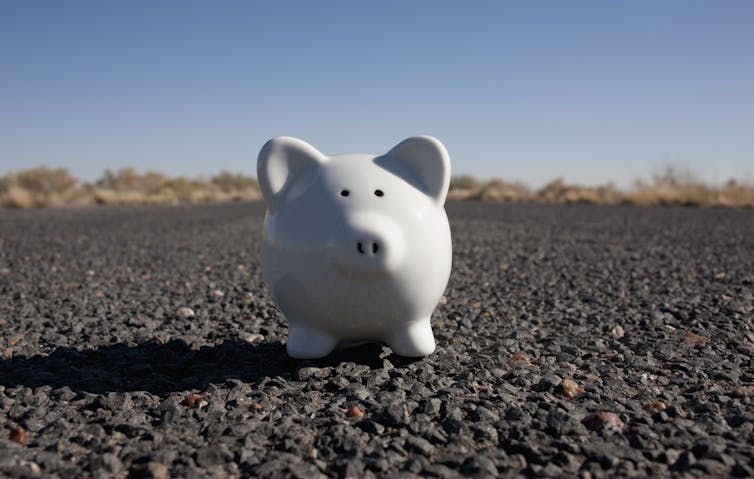
It’s lonely out there. Winslow Productions via Getty Images
Why it matters
Young adults who were exposed to the financial system at an early age – for example, when a parent opens up their first savings account – are more likely to become financially literate. This is important because financial illiteracy leads to costly mistakes when navigating the intricacies of financial products. Our results highlight the importance of learning from interactions with local banks and developing a credit history at a young age.
How we do our work
In this particular study, we looked at bank deserts in a setting with particularly scarce access to financial services: Native American reservations. A 2001 study of financial access on reservations found that only half of reservations had a bank within 30 miles. Though a recent analysis shows that access to banking on reservations has improved, someone living in a reservation must travel an average of more than 12 miles to reach their nearest bank branch.
For our study, we used Equifax credit bureau data to observe credit outcomes for people who grew up in Native American bank deserts and compared them with those who were raised on reservations with a branch on site. While merely living on a reservation has been linked to poverty and negative consequences for individuals later in life, we found that at least for credit outcomes it was the lack of banking that really mattered.
We also surveyed nearly 1,000 Native Americans to understand how bank deserts affected their attitudes toward finance. We learned that Native Americans who grew up in bank deserts had worse financial literacy and were less trusting of bankers. These differences led young people to develop worse credit histories, a disadvantage that lasts a lifetime.
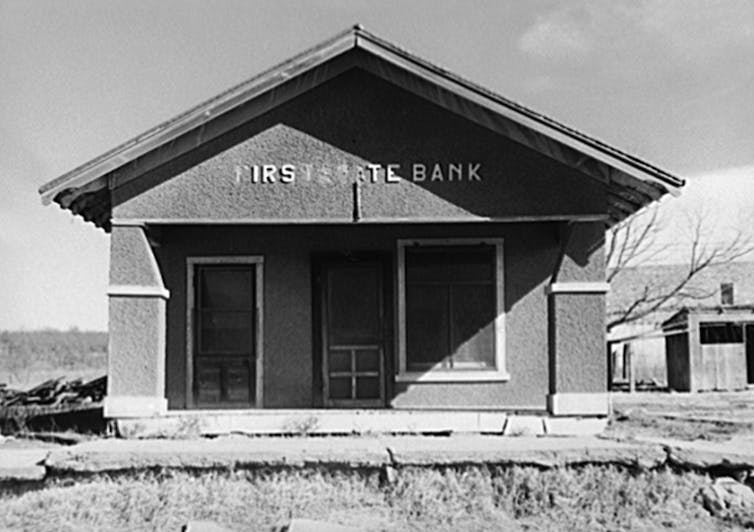
A deserted bank building in the oil ghost town, Slick, Okla., in 1940. Russell Lee/Underwood Archives/Getty Images
What still isn’t known
An important question that still hasn’t been answered is whether technology can help solve the problem. Online banking has expanded significantly, with numerous apps that make it easier to manage one’s finances without stepping foot in a branch. In theory, this could extend financial access to people in bank deserts. However, we found that bank deserts have long lasting effects despite the recent proliferation of online banking, suggesting that online banking does not fully replace having a local bank nearby.
What else is happening
Our research on Native American bank deserts is related to ongoing policy research that seeks to understand how banking can be sustained on reservations. Though we focus on how people are affected by lack of access to finance, there are also important gaps for small businesses that need credit to grow their businesses.
What’s next
I am generally interested in understanding how households access and use credit. My latest research studies how receiving large cash windfalls from the discovery of shale natural gas affects households’ access and use of credit. Payments from shale natural gas discoveries can frequently exceed US$100,000. We hope to understand how this money affects debt repayment and self-employment outcomes for households.
[Expertise in your inbox. Sign up for The Conversation’s newsletter and get a digest of academic takes on today’s news, every day.]
Tony Cookson, Associate Professor of Finance, University of Colorado Boulder
This article is republished from The Conversation under a Creative Commons license. Read the original article.


