


from the St Louis Fed
— this post authored by Alexander Monge-Naranjo, Research Officer and Economist, and Qiuhan Sun, Research Associate
Since the early 1980s, the U.S. economy has exhibited deficits in its trade balance (the difference between total export and total imports) and in its current account (the trade balance plus net income and direct payments to American owned factors abroad minus foreign-owned factors in the U.S.). These imbalances have been persistent, have grown over time and have been the subject of significant media coverage, political messaging and extensive works and analyses in academic and policy research.

Interestingly, U.S. imbalances in total trade do not take place only with the emergence of newly industrialized countries. Other examples include:
- Europe and Japan since World War II
- South Korea and other southeastern Asian countries since the 1980s
- China since the 2000s
An important factor behind the global expansion and redirection of trade has been the drastic reductions in the cost of trading goods across countries. The reductions in trading costs have been driven by the widespread use of containers and other transportation and communication technologies and also by the more liberal trade policies around the globe.
All in all, most countries have seen substantially reduced costs for transporting their produced goods around the world. With lower transportation and logistical costs, the deep factors that drive comparative advantage of countries (i.e. the ratio between costs and productivity) have a larger impact in the observed trade of countries.
Along with the global expansion of trade of the last 50 years, the figure below shows that the U.S. has exhibited a large deficit in the balance in the international trade of goods. This deficit has often been linked to an acceleration in the contraction of the U.S. manufacturing sector.
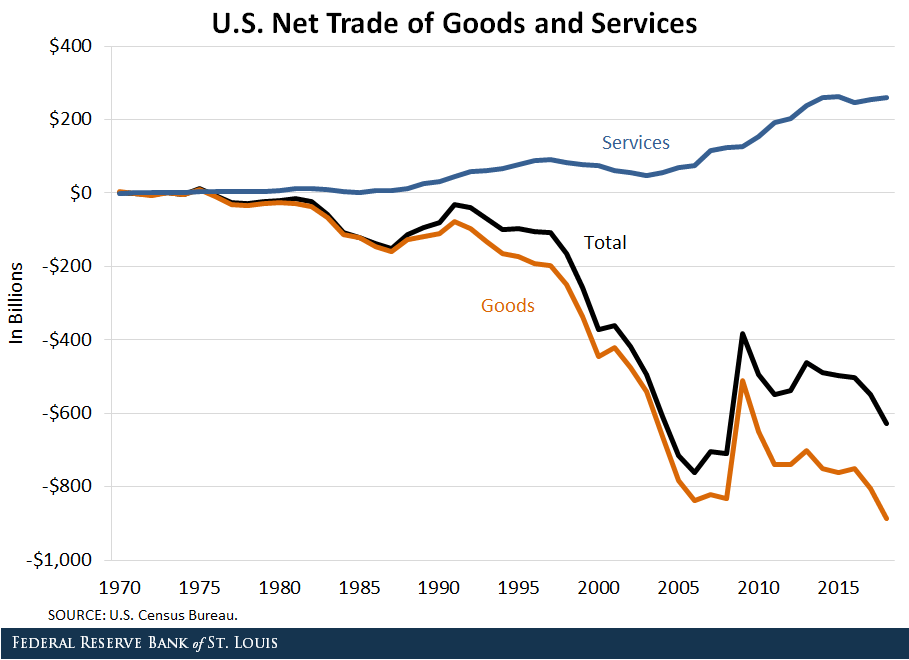
Interestingly, the pendulum may be now swinging in the opposite direction. Since the mid-1990s, information and communication technologies have been increasingly impacting international trade in services. The figure clearly shows that U.S. net trade in services has increased substantially over the last five years. In 2018, the surplus in services was $260 billion, which greatly reduced the overall deficit of the U.S., relative to the large negative balance in the trade of goods alone.
The U.S. economy remains the technological leader in many service sectors, most notably finance, insurance, education, IT, health, design, marketing, engineering, and many areas of research and development. Thus, it is only natural to expect that communication and information technology allowing services to be provided across countries more effectively would lead to the comparative advantage of the U.S. creating positive balances in its overall net trade of services.
Additional Resources
- On the Economy: How Open Are Countries to Trade?
- On the Economy: Historical U.S. Trade Balance and Industrialization
Source
https://www.stlouisfed.org/on-the-economy/2020/february/us-rise-trading-services
Disclaimer
Views expressed are not necessarily those of the Federal Reserve Bank of St. Louis or of the Federal Reserve System.


