


from the Congressional Budget Office
The Department of the Navy’s current aviation fleet consists of about 4,000 aircraft. Approximately 1,400 are fixed-wing fighter/attack aircraft, another 1,350 are helicopters or tiltrotor aircraft, and 750 are training aircraft. The remainder is surveillance, communication, cargo, or utility aircraft. In this report, CBO projects the costs that the Department of the Navy – which comprises the Navy and the Marine Corps – would incur to maintain the size and composition of that force through 2050.

The projections are based on the assumption that the department will implement its currently planned aircraft procurement programs and replace aircraft for which it has not yet specified plans at the end of their typical service life. The projections do not take into account the costs of development, operation and maintenance, modifications, or personnel associated with aircraft.
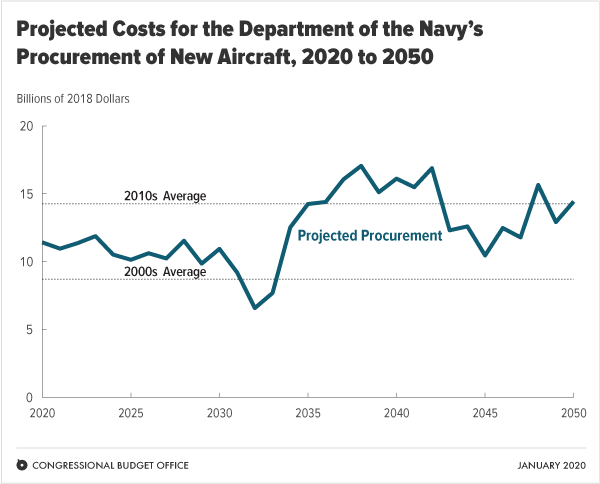
CBO projects that purchasing new aircraft to maintain the current size of the naval aviation fleet would cost the federal government about $380 billion (in 2018 dollars) from 2020 to 2050. According to CBO’s findings:
- Annual costs for procuring new aircraft through 2030 would average about $11 billion, an amount similar to the average since 2000. Costs would drop temporarily after 2030 as several large programs – the MV-22B tiltrotor, the CH-53K helicopter, and the F-35B/C fighters – began to wind down or ended. That would mark the completion of a nearly total replacement of the fleet over the past 30 years.
- Costs would rebound in the mid-2030s as the next cycle of replacement started, including initial purchases of aircraft to replace the F/A-18E/F and EA-18G fighters and early-production MV-22Bs. Costs would average about $14 billion per year from 2034 through 2050.
- The replacement of fighter/attack aircraft would represent the largest fraction of overall costs from 2020 through 2050, totaling about $190 billion, roughly half of the total for all aircraft.
CBO’s projections of procurement schedules and costs are based on documents from the Department of Defense (DoD), such as Selected Acquisition Reports (SARs) submitted to the Congress or other publicly articulated plans. When such information was not available (for example, for programs far into the future), CBO based its projections of procurement schedules and costs on the estimated retirement ages and costs of the aircraft being replaced. Some of those estimates are based on the costs of aircraft procured by other military services or on commercial aircraft costs. When a replacement aircraft is expected to have increased capability, CBO’s estimates reflect the cost of that increase.
As with any 30-year budget projections, CBO’s estimates are subject to several sources of uncertainty. In particular, the size and composition of the naval aviation force may change in unanticipated ways as a result of advances in technology, budgetary constraints, or changes in the national security environment. Even at the individual aircraft level, paths different from those projected by CBO could be adopted. For example, specific plans for replacing the F/A-18E/F fighters, MV-22B tiltrotors, and eventually, the F-35B/C fighters in production today have not yet been developed. Policymakers could decide to replace those aircraft with more or less expensive options than CBO assumed or to not replace them at all.
Although CBO’s projections address changes in the Department of the Navy’s aviation fleet through 2050, the agency formed no judgment about whether the aircraft procurements in its analysis are necessary or appropriate. Nevertheless, cost projections of long-range procurement plans are useful because they can assist the Congress, the Department of Defense, and the Department of the Navy in setting budgets for procuring aircraft. They can also help decisionmakers identify important future issues – when many programs might need procurement appropriations at the same time, for example, or when to extend the service life of certain aircraft – and give them adequate time to address those issues.
Data and Supplemental Information
Related Publications
An Analysis of the Navy’s Fiscal Year 2020 Shipbuilding Plan
October 8, 2019
The Cost of Replacing Today’s Army Aviation Fleet
May 10, 2019
The Cost of Replacing Today’s Air Force Fleet
December 11, 2018
CBO’s Interactive Force Structure Tool
August 15, 2018
The U.S. Military’s Force Structure: A Primer
July 29, 2016
Source


