


from the St Louis Fed
— this post authored by Maximiliano Dvorkin, Economist, and Asha Bharadwaj, Research Associate
Industrial robots are fully autonomous machines that can be reprogrammed to perform several manual tasks.[ 1] In this post, we discuss the rising deployment of industrial robots in industries around the world.

Robot Usage around the World
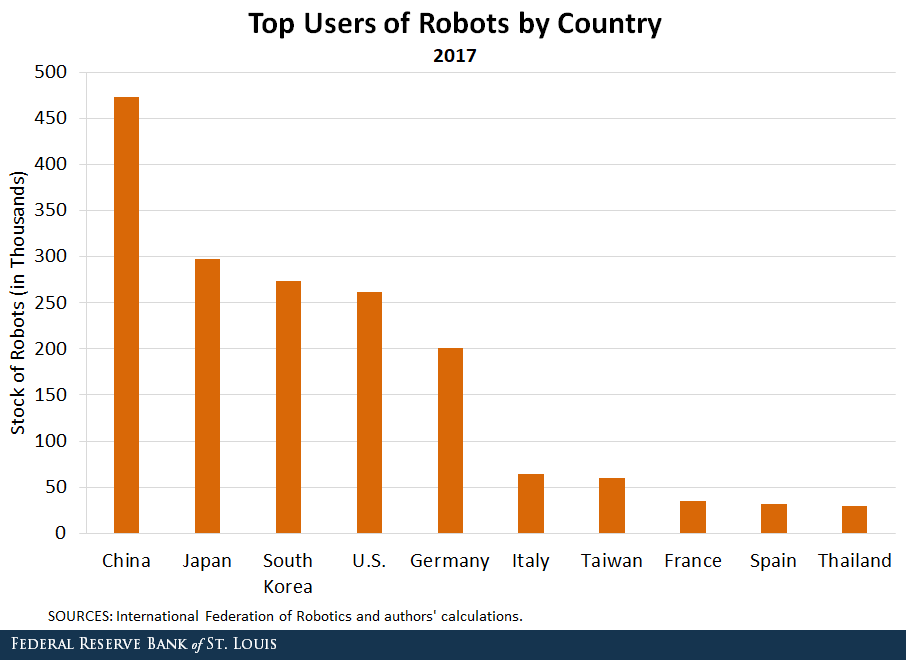
In 2017, nearly 2 million industrial robots were in use around the world, up nearly 280% since 1993. The use of robots has more than doubled in the last 20 years in most advanced economies. The top users of industrial robots in 2017 were China, Japan, and South Korea, using nearly 50% of the world’s stock of robots. European nations were also significant users of industrial robots in 2017, with Germany employing around 200,000 robots.
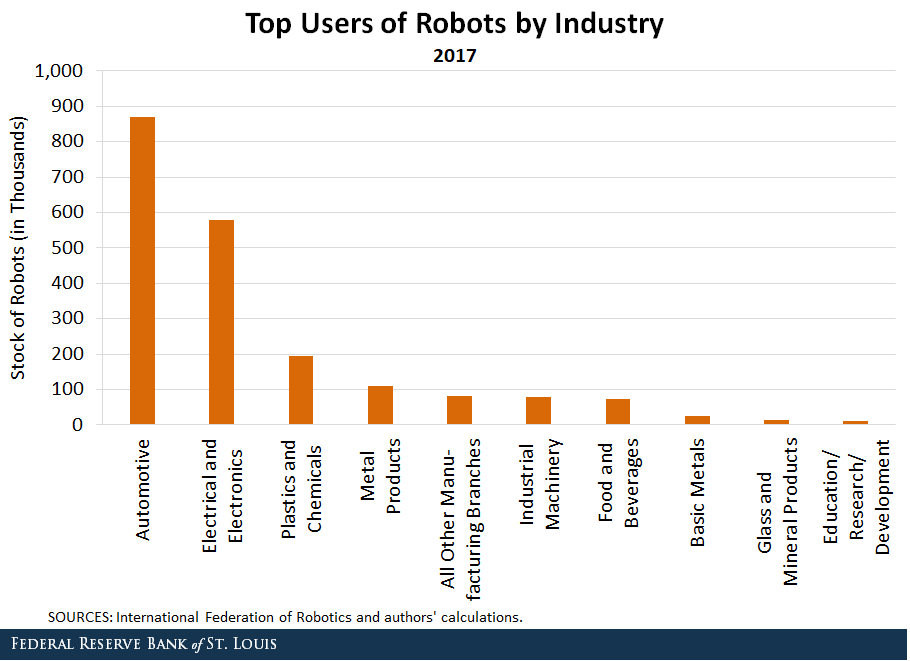
Regarding industries, the highest usage of industrial robots in 2017 belonged to the automotive industry – which employed about 42% of all robots – followed by the electrical and electronics industry at 28%.*
Thus, industries around the world are adopting robots at a rapid pace. It is natural, then, to wonder about the impact on the labor market. While there is no definitive answer, one way to think about this is by looking at the effects of robots on employment, specifically routine manual employment.
Routine occupations – including manual occupations like construction and transportation and cognitive occupations like sales and office occupations – are most susceptible to automation, and economists often cite automation as one of the causes for “job polarization.”[2]
In a recent article, we examined the implications of automation for local labor markets in the U.S.[3] We found that the larger increase in the use of robots in some areas may be reducing the number of people employed in routine manual occupations relative to areas with a smaller increase in the use of robots.
While our earlier analysis gives us an idea about the local effects of automation on employment, it would be interesting to address the aggregate effects of industrial robots in future work.
* The “Top Users of Robots by Industry” chart was initially published with incorrect numbers on the y-axis – indicating the stock of robots by industry – and has been updated. The relative sizes of stocks among industries, the rank of industries by the number of robots, and the text of the blog post were not affected.
Notes and References
1 For instance, technologies like tractors or elevators are not industrial robots since they only perform specific tasks and require some degree of human intervention.
2 Dvorkin, Maximiliano A.; and Shell, Hannah. “The Growing Skill Divide in the U.S. Labor Market.” On the Economy blog, May 18, 2017.
3 Bharadwaj, Asha; and Dvorkin, Maximiliano A. “The Rise of Automation: How Robots May Impact the U.S. Labor Market.” Regional Economist, Second Quarter 2019.
Additional Resources
- Timely Topics: How Advancing Automation May Affect Occupations
- On the Economy: Does Automation Affect Employment and Income Inequality?
- On the Economy: Most Jobs Face Automation in Next 20 Years
Source
https://www.stlouisfed.org/on-the-economy/2019/november/robots-affecting-local-labor-markets
Disclaimer
Views expressed are not necessarily those of the Federal Reserve Bank of St. Louis or of the Federal Reserve System.


