


from the St Louis Fed
The use of automation has been steadily growing in recent years, which raises a question about automation’s impact on the demand for certain types of jobs.

A recent article in the Regional Economist examined the expanding presence of robots – a key type of automation – in the workplace. St. Louis Fed Economist Maximiliano Dvorkin and Research Associate Asha Bharadwaj discussed how this may be affecting the U.S. labor market.
The authors noted that there has been a decline of U.S. middle-skill occupations (e.g., manufacturing jobs), even as there has been growth in both high- and low-skill occupations (e.g., managerial jobs on one end and home aide jobs on the other).
Economists, who coined the term “job polarization” to describe this process, have argued that “the most likely drivers of job polarization are automation and offshoring because both these forces lower the demand for middle-skill occupations relative to the rest,” the authors wrote.
Shifting U.S. Job Market
The authors presented two categories to help classify occupations as “types” of work:
- Whether jobs involve routine tasks or nonroutine tasks
- Whether jobs use mostly cognitive skills or manual skills (brain vs. brawn)
They then analyzed the evolution of employment across the following types of work:
- Nonroutine cognitive, which includes management, professional and related occupations
- Nonroutine manual, which includes service occupations related to assisting or caring for others, such as health care support, food preparation and serving, and cleaning
- Routine cognitive, which includes sales and office occupations
- Routine manual, which includes construction, transportation, production, and repair occupations
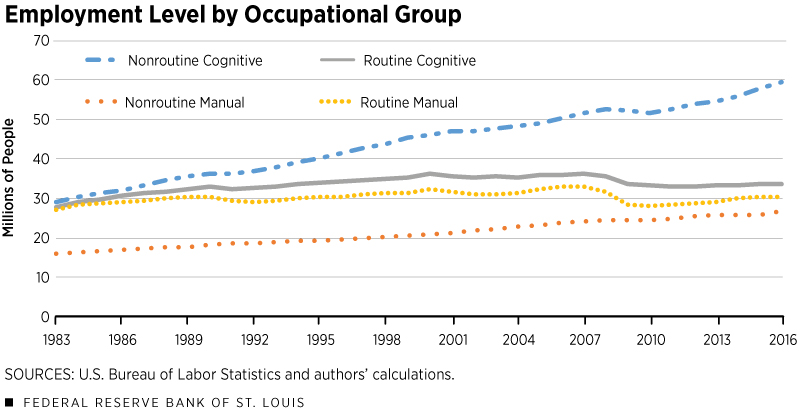
As the figure below shows, “employment in nonroutine occupations, both cognitive and manual, has been increasing steadily for several decades, while employment in routine occupations has been mostly stagnant or even declining,” they wrote.
To examine the possible impact of automation on job polarization, the authors looked at a specific type of automation – robots used in industrial automation applications.
“Industrial robots are fully autonomous machines that do not require any human intervention and can be reprogrammed to perform several manual tasks,” Dvorkin and Bharadwaj wrote. “For instance, technologies like tractors or elevators are not industrial robots since they are able to perform only specific tasks and require some degree of human intervention.”
Where Are the Robots?
The rise of the robot isn’t just a phenomenon in the United States. Analyzing data from the International Federation of Robotics (IFR), the authors show the use of robots is growing in other advanced industrial economies.
In fact, the stock of industrial robots per thousand workers is higher in Germany and Italy than in the U.S., as seen in the figure below. (The authors also calculated the stock for France and an average for Spain, the U.K. and Sweden.)
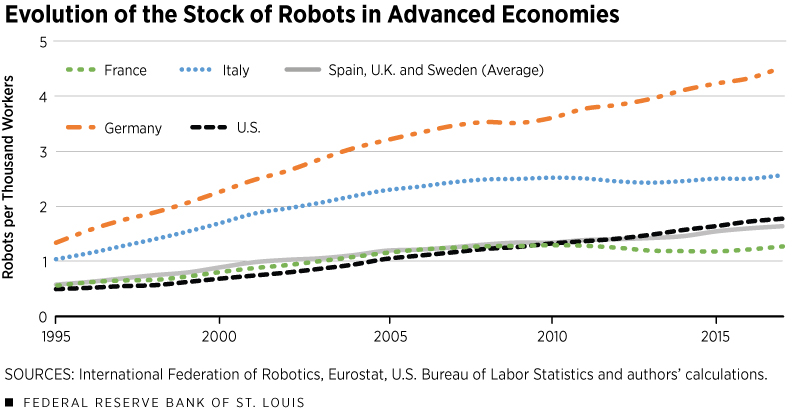
“France and the average of the countries Spain, the U.K. and Sweden were ahead of the U.S. in the late 1990s and early 2000s, but in the last decade, it seems that the U.S. has overtaken these countries,” Dvorkin and Bharadwaj wrote.
The use of industrial robots also isn’t uniformly distributed among different industries within manufacturing, according to their analysis. (See figure below.)
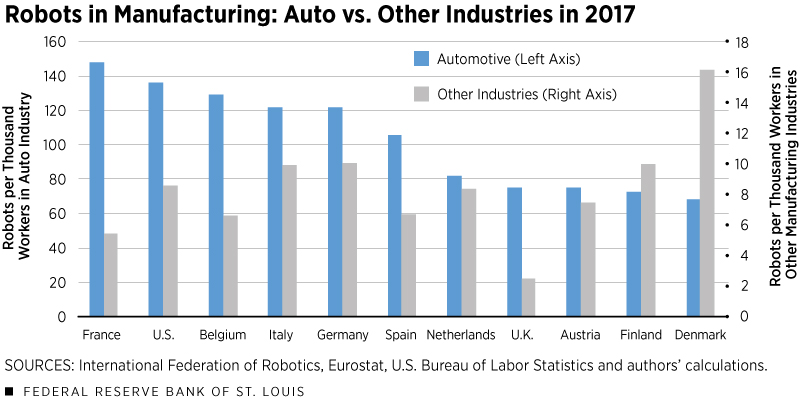
“Clearly, the automotive industry is by far the largest user of robots, in the U.S. as well as in other advanced countries around the world,” they wrote. “For instance, in 2014, the automotive industry accounted for around 54% of the total U.S. stock of robots. For Germany, the share was higher, at around 60%.”
The next post in this series will examine how the growing presence of robots may have affected local labor markets in the U.S.
Additional Resources
- Regional Economist: The Rise of Automation: How Robots May Impact the U.S. Labor Market
- On the Economy: Changing Labor Market Leads to Job Polarization
- On the Economy: Does Automation Affect Employment and Income Inequality?
Note
This post is the first in a two-part series on the impact of robots on the workplace and the labor force.
Source
https://www.stlouisfed.org/on-the-economy/2019/november/rise-robots-workplace
Disclaimer
Views expressed are not necessarily those of the Federal Reserve Bank of St. Louis or of the Federal Reserve System.


