


Written by rjs, MarketWatch 666
 Here are some selected news articles from the week ended 18 August 2019.
This article is a feature every Monday evening on GEI.
Please share this article – Go to very top of page, right hand side, for social media buttons.
OPEC reports July’s oil output was 2 million barrels per day short of demand; DUCs down most in 33 months as fracking at a 54 month high
Oil prices managed to end with a small increase in a week of volatile trading after Trump blinked and delayed the tariffs that he had imposed on China that had sent the markets spiraling lower over the past two weeks…after falling 8% into a bear market on Trump’s tariff threats before recovering more than 6% to close at $54.40 a barrel last week, prices of US crude for September delivery overcame fears of a global economic downturn that had pushed prices down to $53.54 early on Monday and moved higher near the close, ending with a gain of 43 cents at $54.93 a barrel, as signals that Kuwait & the Saudis would continue to reduce global supplies supported an afternoon rally…oil prices then shot up more than 4 percent on Tuesday after Trump bowed to recession fears and said he would delay the tariffs on China he’d announced just a dozen days earlier, with the September oil contract ending $2.17 higher at $57.10 a barrel, the biggest one day price jump so far this year…however, oil prices reversed on Wednesday and erased Tuesday’s gains in falling nearly 6% to $53.97 a barrel after overnight industry reports of a surprise crude and gasoline supply increase and shrinking German GDP data were followed by the EIA’s report that crude inventories had indeed increased, before prices steadied in the afternoon to end at $55.23 a barrel, still a loss of $1.87 on the day…oil prices continued sliding on recession fears and Chinese trade threats on Thursday as Trump’s weakness in delaying the tariffs was mocked in the Chinese press, with US crude closing down 1.4% at $54.47 a barrel even as Brent, the international oil benchmark, ended 2.4% lower at $58.05 a barrel…but oil prices rebounded with the markets on Friday after data showed an unexpectedly large increase in US retail sales, but the gains were capped by an OPEC report warning of slowing economic growth ahead, with oil prices settling 40 cents higher at $54.87 a barrel…with Friday’s small gain, oil prices managed to eke out a 0.7% increase for the week, their first weekly gain in three…
Natural gas prices also managed to end with a small increase, mostly on the back of what was considered a bullish storage report…after falling for a fourth week in a row and hitting a 39 month low last week, natural gas contracted for September delivery fell 1.4 cents to $2.105 per mmBTU on Monday, despite forecasts that the remainder of August would be warmer and see greater demand than the same period of a year ago…but prices rose 4.2 cents on the same forecast on Tuesday, and then slipped back four-tenths of a cent on Wednesday in a continuation of the volatility as prices tested multi-year lows over the previous two weeks…however, prices jumped nearly 13 cents with the release of the storage report on Thursday and ended the day 8.9 cents higher at $2.232 per mmBTU…however, with the weak storage build dismissed as being due to pipeline issues, gas prices fell back 3.2 cents to end the week at $2.200 per mmBTU, still a gain of 8.1 cents, or 3.8% for the week, the first increase in 5 weeks…
The natural gas storage report for the week ending August 9th from the EIA indicated that the quantity of natural gas held in storage in the US increased by 49 billion cubic feet to 2,738 billion cubic feet by the end of the week, which meant our gas supplies were 357 billion cubic feet, or 15.0% more than the 2,346 billion cubic feet that were in storage on August 9th of last year, while still 111 billion cubic feet, or 3.9% below the five-year average of 2,849 billion cubic feet of natural gas that have been in storage as of the 9th of August in recent years….this week’s 49 billion cubic feet injection into US natural gas storage was significantly below the 57 billion cubic feet injection predicted by analysts surveyed by S&P Global Platts, while it matched the average 49 billion cubic feet of natural gas that have been added to gas storage during the first full week of August over the past 5 years, the 20th such average or above average storage build in the last 22 weeks…however, the 1,560 billion cubic feet of natural gas that have been added to storage over the 20 weeks of this injection season has now fallen behind the record 1572 billion cubic feet of natural gas that were injected into storage over the same 20 weeks of the 2014 natural gas injection season, but still remains well above the other years on record…
The Latest US Oil Supply and Disposition Data from the EIA
US oil data from the US Energy Information Administration for the week ending August 9th indicated that because our refinery throughput fell while an increase in our oil imports partially offset an increase in our oil exports, we had surplus oil to add to storage for the 2nd week in a row…..our imports of crude oil rose by an average of 566,000 barrels per day to an average of 7,714,000 barrels per day, after rising by an average of 485,000 barrels per day over the prior week, while our exports of crude oil rose by an average of 818,000 barrels per day to an average of 2,683,000 barrels per day during the week, which meant that our effective trade in oil worked out to a net import average of 5,031,000 barrels of per day during the week ending August 9th, 252,000 fewer barrels per day than the net of our imports minus exports during the prior week…over the same period, the production of crude oil from US wells was reported to be unchanged at 12,300,000 barrels per day, so our daily supply of oil from the net of our trade in oil and from well production totaled an average of 17,331,000 barrels per day during this reporting week..
meanwhile, US oil refineries were reportedly processing 17,302,000 barrels of crude per day during the week ending August 9th, 475,000 fewer barrels per day than the amount of oil they used during the prior week, while over the same period the EIA reported that a net of 225,000 barrels of oil per day were being added to the supplies of oil stored in the US….hence, this week’s crude oil figures from the EIA appear to indicate that our total working supply of oil from net imports and from oilfield production was 196,000 barrels per day less than what was reportedly added to storage and what our oil refineries reported they used during the week…to account for that disparity between the apparent supply of oil and the apparent disposition of it, the EIA inserted a (+196,000) barrel per day figure onto line 13 of the weekly U.S. Petroleum Balance Sheet to make the reported data for the daily supply of oil and the consumption of it balance out, essentially a fudge factor that they label in their footnotes as “unaccounted for crude oil”… (for more on how this weekly oil data is gathered, and the possible reasons for that “unaccounted for” oil, see this EIA explainer)….
further details from the weekly Petroleum Status Report (pdf) indicated that the 4 week average of our oil imports rose to an average of 7,138,000 barrels per day last week, which was still 12.0% less than the 8,116,000 barrel per day average that we were importing over the same four-week period last year…the 225,000 barrel per day increase in our total crude inventories was all added to our commercially available stocks of crude oil, while the amount of oil stored in our Strategic Petroleum Reserve remained unchanged…this week’s crude oil production was reported to be unchanged at 12,300,000 barrels per day even though the rounded estimate of the output from wells in the lower 48 states rose by 100,000 barrels per day to 11,900,000 barrels per day because a 20,000 barrels per day decrease to 433,000 barrels per day in Alaska’s oil production lowered the final rounded national production total by 100,000 barrels per day (EIA”s math, not mine)…last year’s US crude oil production for the week ending August 3rd was rounded to 10,900,000 barrels per day, so this reporting week’s rounded oil production figure was 12.8% above that of a year ago, and 45.9% more than the interim low of 8,428,000 barrels per day that US oil production fell to during the last week of June of 2016…
meanwhile, US oil refineries were operating at 94.8% of their capacity in using 17,302,000 barrels of crude per day during the week ending August 9th, down from 96.4% of capacity the prior week, but still a refinery utilization rate that is typical for mid summer….however, the 17,302,000 barrels per day of oil that were refined this week were 3.8% below the record 17,981,000 barrels of crude per day that were being processed during the week ending August 10th, 2018, when US refineries were operating at 98.1% of capacity….
with the big decrease in the amount of oil being refined, gasoline output from our refineries was somewhat lower, decreasing by 218,000 barrels per day to 10,203,000 barrels per day during the week ending August 9th, after our refineries’ gasoline output had increased by 5,000 barrels per day the prior week….even so, this week’s gasoline production was just fractionally below the 10,234,000 barrels of gasoline that were being produced daily over the same week of last year….at the same time, our refineries’ production of distillate fuels (diesel fuel and heat oil) fell by 209,000 barrels per day to 5,077,000 barrels per day, after our distillates output had increased by 122,000 barrels per day the prior week….but with this week’s decrease, our distillates production was 4.9% less than the 5,337,000 barrels of distillates per day that were being produced during the week ending August 10th, 2018….
Our supply of gasoline in storage at the end of the week fell for the sixth time in 9 weeks and for the 19th time in twenty-five weeks, decreasing by 1,412,000 barrels to 233,760,000 barrels during the week to August 9th, after our gasoline supplies had risen by 4,437,000 barrels over the prior week….our gasoline supplies also decreased this week because the amount of gasoline supplied to US markets increased by 282,000 barrels per day to 9,932,000 barrels per day, and because our imports of gasoline fell by 412,000 barrels per day to 805,000 barrels per day, while our exports of gasoline fell by 324,000 barrels per day to 453,000 barrels per day…after this week’s decrease, our gasoline supplies remained fractionally higher than last August 10th’s inventory level of 233,128,000 barrels, and are still roughly 4% above the five year average of our gasoline supplies at this time of the year…
With the decrease in our distillates production, our supplies of distillate fuels fell for the 13th time in the past 22 weeks, decreasing by 1,938,000 barrels to 135,513,000 barrels during the week ending August 9th, after our distillates supplies had increased by 1,529,000 barrels over the prior week…our distillates supplies decreased this week because our imports of distillates fell by 127,000 barrels per day to 126,000 barrels per day while our exports of distillates rose by 186,000 barrels per day to 1,621,000 barrels per day, and while the amount of distillates supplied to US markets, a proxy for our domestic demand, decreased by 27,000 barrels per day to 3,859,000 barrels per day….but even after this week’s inventory decrease, our distillate supplies were still 5.1% higher than the 128,989,000 barrels of distillates that we had stored on August 10th, 2018, while still around 3% below the five year average of distillates stocks for this time of the year…
Finally, with the decrease in our refinery throughput, our commercial supplies of crude oil in storage rose for the second time in nine weeks but for the seventeenth time in 30 weeks, increasing by 1,580,000 barrels, from 438,930,000 barrels on August 2nd to 440,510,000 barrels on August 9th…after that increase, our crude oil inventories were roughly 3% above the five-year average of crude oil supplies for this time of year, and were about 32% higher than the prior 5 year (2009 – 2013) average of crude oil stocks for the 2nd Friday of August, with the disparity between those comparisons arising because it wasn’t until early 2015 that our oil inventories first rose above 400 million barrels…since our crude oil inventories had generally been rising since this past Fall up until the most recent 9 weeks, after generally falling until then through most of the prior year and a half, our oil supplies as of August 9th were still 6.4% above the 414,194,000 barrels of oil we had stored on August 10th of 2018, but at the same time were 5.6% below the 466,492,000 barrels of oil that we had in storage on August 11th of 2017, and 10.2% below the 490,461,000 barrels of oil we had in commercial storage on August 12th of 2016…
OPEC’s Monthly Oil Market Report
This week we’re also going to review OPEC’s August Oil Market Report (covering July OPEC & global oil data), which was released on Friday of this past week and is available as a free download, and hence it’s the report we check for monthly global oil supply and demand data…the first table from this monthly report that we’ll look at is from the page numbered 60 of that report (pdf page 70), and it shows oil production in thousands of barrels per day for each of the current OPEC members over the recent years, quarters and months, as the column headings indicate…for all their official production measurements, OPEC uses an average of estimates from six “secondary sources”, namely the International Energy Agency (IEA), the oil-pricing agencies Platts and Argus, the U.S. Energy Information Administration (EIA), the oil consultancy Cambridge Energy Research Associates (CERA) and the industry newsletter Petroleum Intelligence Weekly, as a means of impartially adjudicating whether their output quotas and production cuts are being met, to thus avert any potential disputes that could arise if each member reported their own figures…
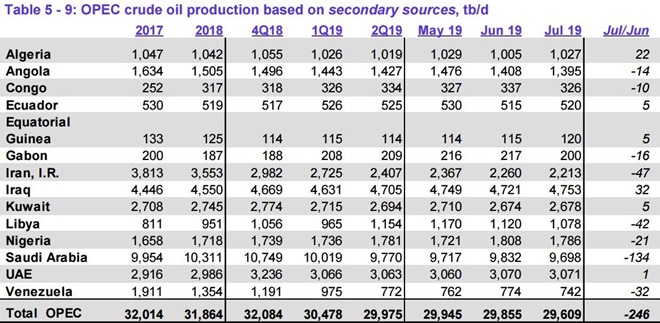
As we can see from the table of oil production data (above), OPEC’s oil output fell by 246,000 barrels per day to 29,609,000 barrels per day in July, from their revised June production total of 29,855,000 barrels per day…however that June figure was originally reported as 29,830,000 barrels per day, so that means their production for July was actually a 221,000 barrel per day decrease from the previously reported production figures (for your reference, here is the table of the official June OPEC output figures as reported a month ago, before this month’s revisions)…
The Saudi’s 134,000 barrel per day output cut made up the lion’s share of OPEC’s July decrease. but most other OPEC members also cut their output proportionately as well…however, that relatively small 32,000 barrels per day increase in the output from Iraq that you see above means they are well over thei output allocation as originally determined for each OPEC member after their December 7th, 2018 meeting, when OPEC agreed to cut 800,000 barrels per day as part of a 1.2 million barrel per day cut agreed to with Russia and other oil producers, and which were extended at their July 1st meeting a a little over a month ago…in addition, despite the small decrease in July output from Nigeria, their output also remains well above quota, as can be seen in the table of OPEC production allocations we’ve included below:
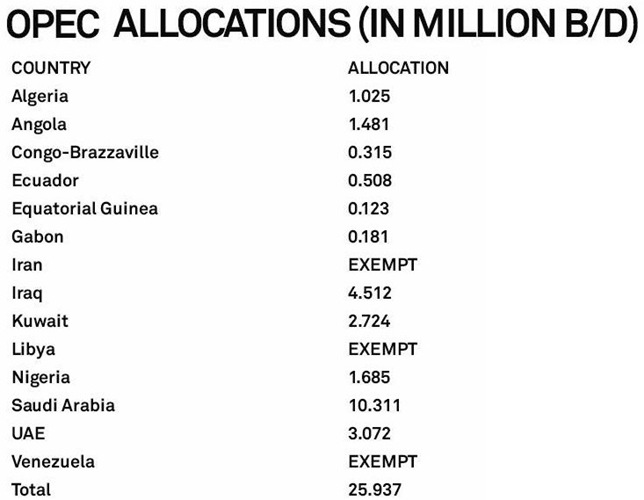
The table above came from a February 6th post on Saudi cuts and OPEC allocations at S&P Global Platts, and it shows average daily production quota in millions of barrels of oil per day for each of the OPEC members as was agreed to at their December 2018 meeting and has now been extended through March 2020 as of their recent meeting….note that Venezuela and Iran, whose oil exports are being sanctioned by the Trump administration, and Libya, which has been beset by a civil war, are exempt from any production quotas, and that among them only Libya has been producing a bit more than they did in the 4th quarter of 2018, which you can see in the third column of the OPEC production table above…
The next graphic (below) from the report that we’ll include shows us both OPEC and world oil production monthly on the same graph, over the period from August 2017 to July 2019, and it comes from page 61 (pdf page 71) of the August OPEC Monthly Oil Market Report….on this graph, the cerulean blue bars represent OPEC oil production in millions of barrels per day as shown on the left scale, while the purple graph represents global oil production in millions of barrels per day, with the metrics for global output shown on the right scale…
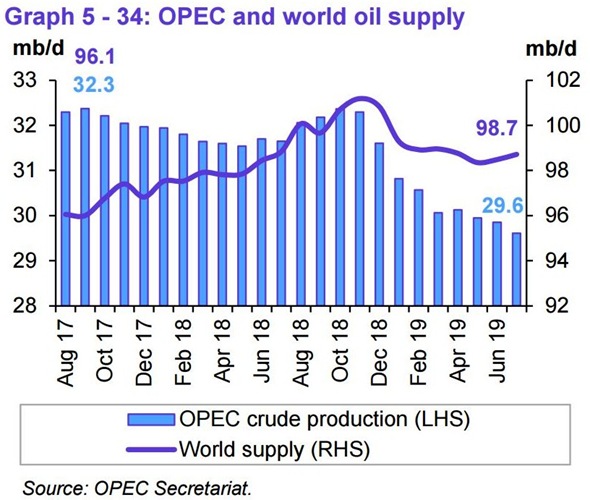
Despite the big decrease in OPEC’s production from what they produced a month ago, their preliminary estimate indicates that total global oil production still rose by 0.23 million barrels per day to 98.71 million barrels per day in July, an increase that came after June’s total global output figure was revised down by 80,000 barrels per day from the 98.56 million barrels per day global oil output that was reported a month ago, as non-OPEC oil production rose by a rounded 480,000 barrels per day in July after that revision, with higher oil production from Canada, Norway, the UK, Australia, India, Brazil and Azerbaijan the major reasons for the non-OPEC output increase in July…. the 98.71 million barrels per day produced globally in July was also 0.71 million barrels per day, or 0.7% higher than the revised 98.39 million barrels of oil per day that were being produced globally in July a year ago (see the August 2018 OPEC report (online pdf) for the originally reported July 2018 details)…with the decrease in OPEC’s output, their July oil production of 29,609,000 barrels per day slipped to 30.0% of what was produced globally during the month, down from the revised 30.3% share they contributed in June….OPEC’s July 2018 production was reported at 32,323,000 barrels per day, which means that the 13 OPEC members who were part of OPEC last year, excluding Qatar from last year’s total and new member Congo from this year’s, are now producing 2,424,000 fewer barrels per day of oil than they were producing a year ago, when they accounted for 32.9% of global output, with a 1,524,000 barrel per day drop in output from Iran, a 689,000 barrel per day decrease in the output from Saudi Arabia, and a 534,000 barrel per day decrease in the output from Venezuela from that time more than offsetting the year over year production increases of 414,000 barrels per day from Libya, 197,000 barrels per day from Iraq, and 112,000 barrels per day from the Emirates…
Despite the 230,000 barrels per day increase in global oil output that was seen during July, there was still a large shortfall in the amount of oil being produced globally during the month, as this next table from the OPEC report will show us…
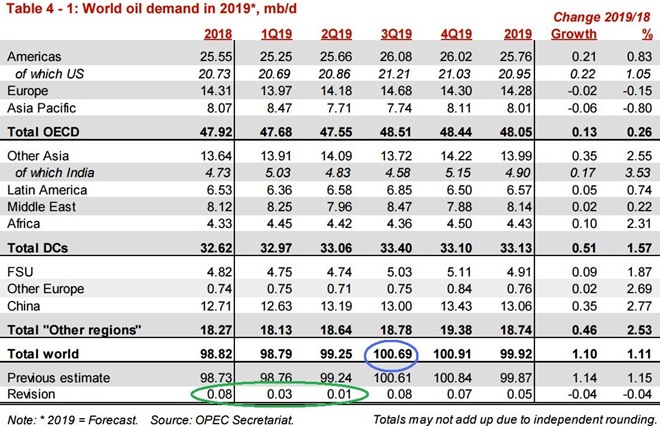
The table above came from page 33 of the August OPEC Monthly Oil Market Report (pdf page 43), and it shows regional and total oil demand in millions of barrels per day for 2018 in the first column, and OPEC’s estimate of oil demand by region and globally quarterly over 2019 over the rest of the table…on the “Total world” line in the fourth column, we’ve circled in blue the figure that’s relevant for July, which is their revised estimate of global oil demand during the third quarter of 2019…
OPEC has estimated that during the 3rd quarter of this year, all oil consuming regions of the globe will using 100.69 million barrels of oil per day, which was revised from their estimate of 100.61 million barrels of oil per day for the 3rd quarter a month ago….meanwhile, as OPEC showed us in the oil supply section of this report and the summary supply graph above, OPEC and the rest of the world’s oil producers were still only producing 98.71 million barrels per day during July, which means that there was a shortfall of around 1,980,000 barrels per day in global oil production when compared to the demand estimated for the month…
In addition, the downward revision of 80,000 barrels per day to June’s global output that’s implied in this report, combined with the 10,000 barrels per day upward revision to 2nd quarter demand that we’ve encircled in green, means that the 680,000 barrels per day shortfall that we had previously figured for June based on last month’s figures would now be revised to a deficit of 790,000 barrels per day….likewise, the 10,000 barrels per day upward revision to 2nd quarter demand would mean that we’d have to revise our global oil deficit for May to 1,160,000 barrels per day, and revise our global oil deficit for April to 1,030,000 barrels per day…hence, for the 2nd quarter as a whole, the world’s oil producers were producing 937,000 barrels per day less than what was needed…
Note that in green we’ve also circled an upward revision of 30,000 barrels per day to first quarter demand…that means that the global oil surplus of 190,000 barrels per day we had previously figured for March would have to be revised to a global oil surplus of 160,000 barrels per day…similarly, the 640,000 barrel per day global oil output surplus we had for February would now be a 610,000 barrel per day global oil output surplus, and the 550,000 barrel per day global oil output surplus we had for January would be revised to a 520,000 barrel per day oil output surplus..
The green ellipse above also highlights that OPEC has revised 2018’s oil demand 80,000 barrels per day higher…when demand for 2018 was last revised in April, we recomputed our 2018 figures and figured that for all of 2018, global oil demand exceeded production by roughly 18,040,000 barrels…this revision means that the 2018 shortfall was 80,000 barrels per day higher, or a total shortfall of roughly 47,240,000 barrels of oil for the year as a whole..
This Week’s Rig Count
The US rig count rose for the first time in a dozen weeks and for just the 3rd time in the past half year during the week ending August 16th, but still remains 13.7% lower year to date….Baker Hughes reported that the total count of rotary rigs running in the US rose by 1 rig to 935 rigs this past week, which was still down by 122 rigs from the 1057 rigs that were in use as of the August 17th report of 2018, and less than half of the shale era high of 1929 drilling rigs that were deployed on November 21st of 2014, the week before OPEC announced their attempt to flood the global oil market…
The count of rigs drilling for oil increased by 6 rigs to 770 rigs this week, which was still 99 fewer oil rigs than were running a year ago, and quite a bit below the recent high of 1609 rigs that were drilling for oil on October 10th, 2014…at the same time, the number of drilling rigs targeting natural gas bearing formations decreased by 4 rigs to 165 natural gas rigs, a 16 month low for gas rig activity and down by 21 rigs from the 186 natural gas rigs that were drilling a year ago, and way down from the modern era high of 1,606 rigs targeting natural gas that were deployed on August 29th, 2008…in addition, a rig classified as miscellaneous was shut down this week, leaving none such operating, down from the 2 “miscellaneous” rigs that were drilling a year ago…
The rig count in the Gulf of Mexico was up by 2 to 25 rigs this week, as two more rigs began operating off the shore of Louisiana…that brought the offshore Louisiana count up to 25, making for a net increase of 6 Gulf of Mexico rigs from the 19 rigs that were deployed in the Gulf in the same week a year ago, when 17 rigs were drilling in Louisiana waters and two were deployed offshore from Texas…in addition, there continues to be two rigs deployed off the coast of the Kenai Peninsula in Alaska this week, same number as were drilling off the Alaskan shore a year ago, for a total US offshore rig count of 27, up from the total of 21 offshore rigs that were deployed a year ago…in addition to those offshore, southern Louisiana also saw the startup of a rig drilling through an inland body of water, the first such in 4 weeks, but still down from the 2 ‘inland waters’ rigs active in southern Louisiana a year ago
The count of active horizontal drilling rigs was down by 2 to 815 horizontal rigs this week, which was the least horizontal rigs deployed since February 2nd, 2018 and hence a new 18 month low for horizontal drilling…it was also 107 fewer horizontal rigs than the 922 horizontal rigs that were in use in the US on August 17th of last year, and also well down from the record of 1372 horizontal rigs that were deployed on November 21st of 2014…on the other hand, the directional rig count was up by 3 to 68 directional rigs this week, but those were down by 2 from the 70 directional rigs that were operating during the same week of last year… meanwhile, the vertical rig count was unchanged at 52 vertical rigs this week, and those were down by 13 from the 65 vertical rigs that were in use on August 17th of 2018…
The details on this week’s changes in drilling activity by state and by major shale basin are included in our screenshot below of that part of the rig count summary pdf from Baker Hughes that shows those changes…the first table below shows weekly and year over year rig count changes for the major oil & gas producing states, and the second table shows the weekly and year over year rig count changes for the major US geological oil and gas basins…in both tables, the first column shows the active rig count as of August 16th, the second column shows the change in the number of working rigs between last week’s count (August 9th) and this week’s (August 16th) count, the third column shows last week’s August 9th active rig count, the 4th column shows the change between the number of rigs running on Friday and the number running before the equivalent weekend of a year ago, and the 5th column shows the number of rigs that were drilling at the end of that reporting week a year ago, which in this week’s case was the 17th of August, 2018…

As you can see by the state table above, this week’s one rig increase masked a lot of changes around the country…we’ll start by looking at Texas, where we find 4 rigs were shut down in Texas Oil District 8, which would be the core Permian Delaware, while the rig counts in Texas Oil Districts 7C and 8A, the Permian Midland, were unchanged…that means that the 2 rig increase in New Mexico included one rig in the western-most reaches of the Permian Delaware, and one rig in a basin not tracked separately by Baker Hughes…the 3 rig increase in Louisiana can be accounted for by the 2 added Gulf of Mexico rigs in the state waters, and the inland waters rig start-up we mentioned earlier….for natural gas, the 4 rig decrease in West Virginia’s Marcellus, was completely offset by a 4 rig increase in Pennsylvania’s Marcellus, leaving the Marcellus rig count unchanged…meanwhile, the 3 rigs that were pulled out of Ohio included two natural gas rigs that had been operating in the Utica shale, and the “miscellaneous’ rig that had been drilling a shallow well in Sandusky county…in addition, a natural gas rig was shut down in the Cana Woodford of Oklahoma, where 2 new oil rigs started drilling at the same time, leaving the Cana Woodford with one natural gas rig and 45 drilling for oil…finally, the last natural gas rig that was shut down came out of a basin not tracked separately by Baker Hughes, which could have been anywhere, but which most likely seems to have been pulled out of Oklahoma, given an otherwise unexplained two rig decrease in the state outside of the Cana Woodford…
DUC well report for July
Monday of this past week saw the release of the EIA’s Drilling Productivity Report for August, which includes the EIA’s July data for drilled but uncompleted oil and gas wells in the 7 most productive shale regions…for the fifth month in a row, this report showed a decrease in uncompleted wells nationally in July, as drilling of new wells decreased and completions of drilled wells increased slightly….while there continued to be an increase of newly drilled but uncompleted wells (DUCs) in the Permian basin of western Texas and New Mexico, the other regions all saw decreases in their DUC inventory, more than offsetting the Permian increases…for the 7 sedimentary regions covered by this report, the total count of DUC wells decreased by 100 wells, the largest decrease in 33 months, from a revised 8,208 DUC wells in June to 8,108 DUC wells in July, which still represents a 14.0% increase from the 7,114 wells that had been drilled but remained uncompleted as of the end of July a year ago…the decrease occurred as 1,311 wells were drilled in the 7 regions that this report covers (representing 87% of all U.S. onshore drilling operations) during July, down by 31 from the 1,342 wells drilled in June and the lowest in 15 months, while 1,411 wells were completed and brought into production by fracking, an increase of 19 well completions from the 1,392 completions seen in June and a 54 month high for fracking…at the July completion rate, the 8,108 drilled but uncompleted wells left at the end of the month represent a 5.7 month backlog of wells that have been drilled but are not yet fracked, down from a 6.0 month backlog a year ago…
Both oil producing regions and natural gas producing regions saw DUC well decreases in July, with only the predominantly oil Permian showing an increase…the number of DUC wells left in the Oklahoma Anadarko decreased by 32, from 936 at the end of June to 904 DUC wells at the end of July, as 124 wells were drilled into the Anadarko basin during July while 156 Anadarko wells were being fracked….at the same time, the drilled but uncompleted well count in the Niobrara chalk of the Rockies’ front range decreased by 23 to 422, as 178 Niobrara wells were drilled in July while 201 Niobrara wells were completed….meanwhile, DUC wells in the Bakken of North Dakota fell by 18, from 693 DUC wells at the end of June to 675 DUCs at the end of July, as 106 wells were drilled into the Bakken in July, while 124 of the drilled wells in that basin were being fracked…in addtion, DUC wells in the Eagle Ford of south Texas decreased by 13, from 1,517 DUC wells at the end of June to 1,504 DUCs at the end of July, as 190 wells were drilled in the Eagle Ford during June, while 203 already drilled Eagle Ford wells were completed..
Among the natural gas producing regions, the drilled but uncompleted well count in the Appalachian region, which includes the Utica shale, fell by 16 wells, from 438 DUCs at the end of June to 422 DUCs at the end of July, as 123 wells were drilled into the Marcellus and Utica shales during the month, while 139 of the already drilled wells in the region were fracked…in addition, the natural gas producing Haynesville shale of the northern Louisiana-Texas border region saw their uncompleted well inventory decrease by 7 wells to 182, as 46 wells were drilled into the Haynesville during July, while 53 Haynesville wells were fracked during the same period….
On the other hand, the Permian basin of west Texas and New Mexico saw its total count of uncompleted wells rise by 9, from 3,990 DUC wells at the end of June to 3,999 DUCs at the end of July, as 544 new wells were drilled into the Permian, but only 535 wells in the region were fracked…….thus, for the month of July, DUCs in the five oil basins tracked by in this report (ie., the Anadarko, Bakken, Niobrara, Permian, and Eagle Ford) decreased by a net of 77 wells to 7,504 wells, while the uncompleted well count in the natural gas basins (the Marcellus, Utica, and the Haynesville) decreased by 23 wells to 604 wells, although as the report notes, once into production, more than half the wells drilled nationally will produce both…
Pipeline study finds no significant impact on forest: Columbia Gas would replace lines in Wayne National Forest — An objection period has opened for a proposed pipeline replacement through Wayne National Forest. Called Buckeye Xpress Project, it would Columbia Gas’s 20-inch natural gas lines in southeast Ohio with 36-inch gas lines. The project includes approximately 12.6 miles of pipeline construction and approximately 10.2 miles of pipeline decommissioning in the Wayne National Forest Ironton Ranger District.On Monday, the USDA Forest Service’s Eastern Region Acting Regional Forester Robert Lueckel has released a draft decision notice that the pipeline would have no signiØcant impact on the forest, based on an environmental assessment done by the Federal Energy Regulatory Commission. “The intended decision is for lands subject to issuance of a special use permit (SUP) and authorizes Columbia to occupy NFS lands for 4.1 miles (about 88 acres) of the R-801 which cross the WNF’s Ironton Ranger District in Gallia and Lawrence Counties, Ohio. The R-801would also affect 8.5 miles (about 157 acres) of easement lands,” Lueckel said. Columbia Gas’s proposed project is to construct 66.1 miles of new 36-inch diameter natural gas pipeline, replacing and expanding existing pipelines and related facilities in parts of Lawrence, Vinton, Gallia, and Jackson counties. Columbia Gas holds private easement rights for most of the route through the Wayne National Forest. Objections may be submitted by electronically through an on-line submission form (https://cara.ecosvstemmanagement.org/Public//Commentlnput?project=54536 (https://cara.ecosvstem-management.org/Public//Commentlnput?project=54536)). Objections can be mailed to USDA Forest Service, ATTN: Objection Reviewing OfØcer, 1400 Independence Ave. SW, Mailstop 1104, Washington, DC 20250. Objects must be sent by sent by Sept. 24.
Poll: Broad support for Wolf’s plan to tax gas drillers to pay for infrastructure upgrades – A new poll from Franklin and Marshall College finds widespread support among Pennsylvania voters for Governor Tom Wolf’s plan to pay for infrastructure upgrades by taxing natural gas drilling companies.The poll shows more than two-thirds of respondents either “strongly” or “somewhat” favor Wolf’s Restore PA plan.The proposal calls for $4.5 billion in infrastructure initiatives over four years, funded by a severance tax on natural gas – a tax paid based on how much gas is produced from wells. It would target things like mitigating flooding, addressing blight and expanding broadband access.Berwood Yost directs the Center for Opinion Research at Franklin and Marshall, and says the support goes across different demographic and ideological groups.“I’m not really surprised,” he said. “Given that we’re marrying two topics together things we generally know people support – infrastructure improvements and natural gas taxes.”
Wolf spokesman J.J. Abbott said the poll is a validation of the broad support behind the governor’s plan.
A Giant Factory Rises to Make a Product Filling Up the World: Plastic – – The 386-acre property looks like a giant Lego set rising from the banks of the Ohio River. It is one of the largest active construction projects in the United States, employing more than 5,000 people. When completed, the facility will be fed by pipelines stretching hundreds of miles across Appalachia. It will have its own rail system with 3,300 freight cars. And it will produce more than a million tons each year of something that many people argue the world needs less of: plastic. As concern grows about plastic debris in the oceans and recycling continues to falter in the United States, the production of new plastic is booming. The plant that Royal Dutch Shell is building about 25 miles northwest of Pittsburgh will create tiny pellets that can be turned into items like phone cases, auto parts and food packaging, all of which will be around long after they have served their purpose. The plant is one of more than a dozen that are being built or have been proposed around the world by petrochemical companies like Exxon Mobil and Dow, including several in nearby Ohio and West Virginia and on the Gulf Coast. And after decades of seeing American industrial jobs head overseas, the rise of the petrochemical sector is creating excitement. On Tuesday, President Trump is scheduled to tour the Shell plant. “Where we are coming from is that plastic, in most of its forms, is good and it serves to be good for humanity,” said Hilary Mercer, who is overseeing the construction project for Shell. The boom is driven partly by plastic’s popularity as a versatile and inexpensive material that keeps potato chips fresh and makes cars lighter. But in parts of the Appalachian region, the increase is also being fueled by an overabundance of natural gas. This is a place where, right now, plastic makes sense to many people. To the labor union gaining new members. To the world’s third-largest company struggling with low oil prices. And to the former government officials who, in seeking to create jobs, offered Shell one of the largest tax breaks in state history.But any short-term good could have long-term costs.Shell says much of the plastic from the plant can be used to create fuel-efficient cars and medical devices. But the industry acknowledges that some of the world’s waste management systems are unable to keep up with other forms of plastic like water bottles, grocery bags and food containers being discarded by consumers on the move.Studies have detected plastic fibers everywhere – in the stomachs of sperm whales, in tap water and in table salt. A researcher in Britain says plastic may help define the most recent layer of the earth’s crust because it takes so long to break down and there is so much of it.“Plastic really doesn’t go away,” said Roland Geyer, a professor of industrial ecology at the University of California, Santa Barbara. “It just accumulates and ends up in the wrong places. And we just don’t know the long-term implications of having all this plastic everywhere in the natural environment. It is like this giant global experiment and we can’t just pull the plug if it goes wrong.”
Mountains of plastic, rivers of radioactive waste and billions of Chinese dollars: Inside Trump’s plan to save Appalachia – – One thing you learn traveling through the Upper Midwest is that the various components of the oil and gas industries – the pipelines, the storage wells – often have gorgeously evocative names: Mountain Valley, Falcon, Plains, Atlantic Sunrise. These names are a kind of beautification project, like trees planted to obscure a municipal dump. A plant in Pennsboro, W.Va., called Clearwater treats fracking wastewater, which can remain radioactive even after treatment. Skyhawk is the soaring name given to a smoothed-over patch of gravel at 67657 Clark Road in St. Clairsville, Ohio. On an overcast day last spring, it was nothing but an empty enclosure surrounded by heavy plastic fencing the height of a two-story building. Soon, the emptiness would be filled by wells that shoot high-pressure water and chemicals into the ground, forcing up reservoirs of natural gas and other valuable compounds. Skyhawk is a fracking pad. The effects of hydraulic fracturing – as fracking is formally known – on human health are not yet fully known, but what is known so far is not terribly encouraging. The process seems especially damaging to expectant mothers, as well as to young children, with a 2017 study linking pollution from fracking wells to poor brain development. Asthma is another possible problem. So is cancer. Only a few feet from Skyhawk’s edge stood another building, a low structure, with an outdoor area enclosed by chicken-wire fencing. Inside the fencing some plastic toys were visible. The building is home to Creative Learning Daycare and Preschool. “That wall isn’t going to stop s***,” says Bev Reed, activist from the Concerned Ohio River Residents. Fracking and its associated industries – some of which are potentially more hazardous to human health than fracking itself – have taken over Appalachia. A facility to handle fracking waste stands next to a school in Belmont, Ohio. A few miles away, on a ridge above town, a fracking well looms over an Amish homestead. Children play in its long, ominous shadow. To be an environmental activist in Appalachia has never been easy. Perhaps it has never been harder than in the age of Trump. “We’re surrounded,” concluded Reed, a taciturn woman in her 20s. On the hillside above Reed’s store, coal mine runoff trickling down the street was a disconcertingly bright orange, with streaks of equally disconcerting white.
Trump promotes Shell plant that will turn Marcellus gas into plastics – President Donald Trump showcased growing efforts to capitalize on western Pennsylvania’s natural gas deposits by turning gas into plastics, as he sought Tuesday to reinvigorate supporters in the manufacturing towns that helped him win the White House in 2016. Trump arrived in Monaca, about 40 minutes north of Pittsburgh, on Tuesday to tour Shell’s soon-to-be completed Pennsylvania Petrochemicals Complex. The facility, which critics claim will become the largest air polluter in western Pennsylvania, is being built in an area hungry for investment. “This would have never happened without me and us,” Trump said, speaking to a crowd of thousands of workers building the site, dressed in fluorescent orange and yellow shirts and vests. In fact, Shell announced its plans to build the complex in 2012, when President Barack Obama was in office. Trump’s appeals to blue-collar workers helped him win Beaver County, where the plant is located, by more than 18 percentage points in 2016, only to have voters turn to Democrats in 2018’s midterm elections. Today, Beaver County is still struggling to recover from the shuttering of steel plants in the 1980s that surged the unemployment rate to nearly 30%. Former mill towns like Aliquippa have seen their populations shrink, while Pittsburgh has lured major tech companies like Google and Uber, fueling an economic renaissance in a city that reliably votes Democratic. The region’s natural gas deposits had been seen, for a time, as its new road to prosperity, with drilling in the Marcellus Shale reservoir transforming Pennsylvania into the nation’s No. 2 natural gas state. But drops in the price of oil and gas caused the initial jobs boom from fracking to fizzle, leading companies like Shell to turn instead to plastics and so-called cracker plants – named after the process in which molecules are broken down at high heat, turning fracked ethane gas into one of the precursors for plastic.
Trump claims credit for Shell plant announced under Obama – (AP) – President Donald Trump sought to take credit Tuesday for a major manufacturing complex in western Pennsylvania in his latest effort to reinvigorate the Rust Belt support that sent him to the White House. He was cheered on by fluorescent-vest-clad workers who were paid to attend by Shell, their employer, which is building the facility.Despite Trump’s claims, Shell announced its plans to build the complex in 2012, midway through President Barack Obama’s term in the White House. The event was billed as an official White House event, but Trump turned much of it into a campaign-style rally, boasting of achievements he claims as president and assailing his would-be Democratic rivals for the 2020 election.”I don’t think they give a damn about Western Pennsylvania, do you?” he prodded the crowd. Trump was visiting Shell’s soon-to-be completed Pennsylvania Petrochemicals Complex, which will turn the area’s vast natural gas deposits into plastics. The facility is being built in an area hungry for investment and employment, though critics claim it will become the largest air polluter in western Pennsylvania. Trump contends that America’s coal, oil and manufacturing are reviving and he deserves the credit. He’s been focusing on his administration’s efforts to increase the nation’s dependence on fossil fuels in defiance of increasingly urgent warnings about climate change. And he’s embracing plastic at a time when the world is sounding alarms over its impact. “We don’t need it from the Middle East anymore,” Trump said of oil and natural gas, proclaiming the employees “the backbone of this country.” As for the new complex, he declared, “This would have never happened without me and us.”
Trump Promises More Big Energy Projects at Pennsylvania Plant – President Donald Trump told workers on Tuesday at a $6 billion petrochemicals plant being built in western Pennsylvania that more big U.S. energy projects were coming as his administration rolls back environmental regulations. “This is just the beginning,” Trump told workers wearing hard hats at Shell’s ethylene cracker plant in Beaver County, Pennsylvania. “My administration is clearing the way for other massive, multibillion-dollar investments.” He praised the Shell plant as part of “the revolution in American energy that’s helping make our economy the envy of the world” and said the project would have never happened without him, although its final permits were issued before he was elected in 2016. Last week, its Environmental Protection Agency, or EPA, unveiled a proposal that would limit the power of states to block pipelines and other energy projects, months after Trump ordered the agency to change a section of the U.S. Clean Water Act that states including New York and Washington have used to delay the building of pipelines and terminals. At the Shell plant, Trump apparently tried to take credit for a liquefied natural gas (LNG) plant, called Cameron LNG, he visited in May. Full approvals for that plant were made before Trump was elected. “We just did one in Louisiana, it’s a $10 billion plant,” Trump said. U.S. Energy Secretary Rick Perry, who accompanied Trump to the Shell plant, has embraced an up-to $10 billion Appalachian Storage and Trading Hub project to hold liquids from natural gas production. The project could help support the building of more petrochemical plants in West Virginia, Ohio and Pennsylvania, where a natural gas boom is at risk from falling prices. Regional officials hope to secure a $1.9 billion federal loan guarantee being considered by the Energy Department for the hub. But critics say that U.S. taxpayers would be on the hook if the project fails.
Trump’s visit to petrochemical plant shows a Democratic ‘blind spot’ on fossil fuels – President Trump is touring a petrochemical plant in western Pennsylvania Tuesday afternoon to tout booming U.S. energy production and its ties to the economy of a swing state whose Democratic leadership is more embracing of fossil fuels than the national party.While no one can guess how Trump will focus his visit, his allies say he has the opportunity to make the case for the growing demand for oil and gas for petrochemicals used in plastics, fertilizers, clothing, digital devices, and other everyday products, and how that contrasts with pledges from Democratic presidential candidates to phase out fossil fuels. “There is such a contrast for the president going out to celebrate the fact that petrochemicals are the building blocks of modern day life, versus the Democrats who want to shut that industry down,” said Mandy Gunasekara, a former senior EPA official in the Trump administration who now runs the Energy 45 Fund, a nonprofit organization supporting the president’s energy agenda.“It’s within the strategy of the Democrats to go after these plants because of their demand for fossil-based energy to do what they do,” Gunasekara told me in an interview.Demand for petrochemicals is booming: Petrochemicals derived from oil and gas are becoming the largest drivers of global oil demand, the International Energy Agency said in areport last year, outpacing demand from cars, planes and trucks. IEA projects that petrochemicals will account for more than a third of oil demand growth over the next decade, and nearly half of growth through 2050. Petrochemicals could consume an additional 56 billion cubic meters of natural gas by 2030, and 83 bcm by 2050, IEA said.The U.S. is poised to be a major part of serving that demand growth. It has become a low-cost location for chemicals production thanks to the shale gas revolution and is now home to around 40% of the global ethane-based petrochemical production capacity. Production of ethane, a byproduct of natural gas that can be made into polyethylene, a form of plastic, is projected to increase more than 20 times by the year 2025, according to the Department of Energy.
Explosion Sparks Calls for More Pipeline Scrutiny – – Environmental groups say an explosion earlier this week at a pump station along the Mariner East 2 gas pipeline highlights regulatory flaws and lack of oversight of the project. The explosion Monday last week at the Boot Road Pump Station shook homes and rattled windows half a mile away. Sunoco, owner of the pipeline, said it was a “backfire,” similar to a car backfiring, that there was no release of liquid and no danger to the public. But Joseph Minot, executive director and chief counsel at the Clean Air Council, calls Mariner East 2 the “poster child” for what’s wrong with the way the Commonwealth deals with pipelines. “The building out of natural gas infrastructure in Pennsylvania is not being monitored properly, it’s not being permitted properly, it’s not being regulated properly,” he states. Sunoco says the pipeline meets or exceeds both state and federal pipeline safety regulations. Minot points out that the cause and consequences of the explosion are still being investigated. Meanwhile, he contends regulators are telling residents that the gas infrastructure is good for the state, while leaving several important questions unanswered. “Does the pipeline benefit Pennsylvania?” Minot wonders. “Is the pipeline being done in a safe way? Does the pipeline protect communities and residents? None of that is being done in Pennsylvania.” Minot adds that pipeline construction has been halted several times by state authorities and drilling has resulted in mud spills and numerous citations for environmental violations. Less than a week earlier, a gas pipeline explosion in Kentucky killed one person and injured at least five others. Minot insists state agencies and the fossil fuel industry need to stop telling people that pipelines are a safe way to transport a highly explosive product.
PUC ordered Sunoco to produce its calculations on Mariner East blast zones — Pennsylvania’s Public Utility Commission demanded information from Sunoco Pipeline last year about what would happen if its Mariner East natural gas liquids pipelines failed, according to a newly discovered letter. The PUC wrote to Sunoco in February 2018 with a list of questions that included the company’s calculations on the immediate and delayed impacts of a pipeline failure, the number of people who would have to be evacuated, and the number of schools, hospitals and senior living facilities there.The regulator, which is jointly responsible for pipeline safety, also directed Sunoco to supply its emergency response plan for any such incident. “Include in the modeling the width and length of the evacuation zone and the estimated evacuation time frame,” said the letter, addressed to Albert Kravatz, a compliance specialist with Energy Transfer, Sunoco’s parent company. The letter was among thousands of documents produced by Sunoco for its defense of a case by the so-called Safety Seven, a group of Delaware and Chester County residents who are challenging the construction and operation of the pipelines before the PUC. The PUC did not say whether it had received the requested information, and did not respond in any way when asked to comment on the letter. The agency has been criticized by pipeline opponents for not doing its own assessment of the public-safety risks of running the highly volatile liquids pipelines through densely populated areas such as the two suburban Philadelphia counties. Critics of the project contend there could be mass casualties if there’s a leak or explosion of the colorless and odorless hydrocarbons that have been carried by the line since December 2018. Citizens’ groups like Del-Chesco United for Pipeline Safety have ridiculed Sunoco’s instructions to residents to simply walk away from any leak, and to avoid using possible ignition sources like cars or cell phones, saying residents can’t know there’s a leak if they can’t see or smell the gas and can’t use their phones. Delaware County Council voted to do its own risk assessment of the pipeline two days before this letter was sent to Sunoco. In a statement, Del-Chesco says the PUC letter shows how the agency has dragged its feet on assessing risk to the public. “This suggests two things: until then, the Commissioners had failed to fully recognize the risks associated with Mariner East,” read the statement. “The PUC depended on Sunoco to provide the technical expertise it lacks internally. These are both indications of serious deficiencies at the PUC.”
PennEast: Environmentalists step up opposition to natural gas pipeline – PennEast has officially resubmitted its application to the state Department of Environmental Protection for a permit to build its natural gas pipeline through Hunterdon County. The news of PennEast’s application sparked environmentalists opposed to the project to renew their calls for the state to deny the application. “There is compelling evidence that the PennEast pipeline is not needed, would irreparably harm protected waterways and wildlife, and be inconsistent with New Jersey’s clean energy goals,” Tom Gilbert, campaign director for New Jersey Conservation Foundation and ReThink Energy NJ, said in a statement. “NJDEP has all the evidence it needs to determine that this damaging project can’t meet the state’s stringent environmental regulations.” PennEast spokesperson Patricia Kornick said the Freshwater Wetlands Permit application is the result of “at least 246 professional engineers, environmental scientists and certified experts with more than 4,000 years of combined experience compiling the approximately 24,000-page technical application through on-the ground-analyses.” Kornick added that the application “reflects PennEast’s commitment to listening to suggestions, incorporating feedback and minimizing environmental impacts based on 31 meetings, 30 conference calls and 65 pieces of correspondence with the New Jersey Department of Environmental Protection over the last five years.” That, she said, has resulted in “a route in New Jersey that largely aligns with decades-old power lines and roadways to dramatically lower overall impacts. As a result, wetland impacts are reduced by nearly half, with a total project footprint reduced by more than 20%.” But environmentalists aren’t accepting those arguments. “We need DEP to reject the PennEast pipeline that would cut and ugly scar through the most scenic parts of the Delaware Valley and through an incredible amount of environmentally sensitive areas, critical drinking water, and historic properties,” Jeff Tittel, director of the New Jersey Sierra Club, said in a statement. “We also need to update the rules in place that make it easier to build pipelines. More importantly, we need Governor Murphy to put a moratorium on new fossil fuel projects.” “The law is on our side,” Gilbert said. “The facts are on our side. And the science is on our side. This project is not in the public interest.”
Lawmakers, advocates urge DEP to reject permits for PennEast pipeline – The battle is still brewing over the controversial PennEast Pipeline. Lawmakers and environmental advocates Tuesday called on the state Department of Environmental Protection to reject the permits needed to move forward with building the natural gas pipeline. The company submitted a new application to the DEP for environmental permits last week. Opponents say PennEast is seizing land from private homeowners and properties preserved by the state. The proposed pipeline would cut through parts of Hunterdon and Mercer counties. Members of New Jersey’s congressional delegation pushed back against the project, which they say won’t bring any benefit to the region. “The PennEast project has been determined unnecessary by every expert that has looked at it. It is not energy that New Jersey should be investing in and seeking,” said Congresswoman Bonnie Watson Coleman. “The natural beauty of this part of New Jersey is not something we can place a monetary value on,” said Congressman Tom Malinowski, “why would we spoil that for something that we do not need, that is only driven by the desire of one group of companies to make a profit?”
PennEast proposes measures to reduce disturbance at historic Native American sites – PennEast Pipeline has announced plans to minimize the impact of construction through three areas along the pipeline’s route in Pennsylvania found to contain evidence of early Native American habitation, with one site holding artifacts estimated to be about 7,000 years old. An internal memorandum filed by the Federal Energy Regulatory Commission Thursday cites a filing the pipeline company made with the Advisory Council on Historic Preservation. In the filing, PennEast said it would conduct a data recovery and analysis program, approved by the Pennsylvania State Historic Preservation Office, within the 50-foot-wide permanent pipeline easement at three Pennsylvania sites, in Northampton, Carbon, and Luzerne counties. The three sites included areas of potential historical effects encompassing about 1,588 acres. In Luzerne County, on a site measuring about five acres, preliminary studies found deeply buried evidence of Native American habitation dating back to between about 5500 and 5000 B.C. Wood charcoal found at the Carbon County site produced a radiocarbon date calibrated between 2133 and 1921 B.C., while the Northampton County site produced artifacts such as chipped stone tools and fire-cracked rock, evidence of habitation in the area. The developers of the about 116-mile pipeline, with about 78 miles of pipe in Pennsylvania and 38 miles in New Jersey, did not find any areas of historic concern along the New Jersey stretch of line. Potential types of disturbance from pipeline construction on the sites “will include ‘open-cut’ excavation of soils for pipeline construction and placement, the removal of topsoil in a 50-foot-wide permanent easement, as well as potential soil disturbance and compaction related to the movement of construction vehicles on the sites.”
New lawsuit filed over Mountain Valley Pipeline (AP) – Conservation groups have launched a new lawsuit aimed at the Mountain Valley Pipeline over its impacts on threatened and endangered species. The petition for review filed Monday with the 4th U.S. Circuit Court of Appeals in Richmond challenges an approval for the natural gas pipeline that was issued by the U.S. Fish and Wildlife Service. The lawsuit asks that the agency’s decision be vacated. The groups say the agency should have to re-evaluate the pipeline’s effects on wildlife, and they argue work should stop while that happens. The 4th Circuit recently tossed the same Fish and Wildlife sign-off for another large natural gas project, the Atlantic Coast Pipeline. A Fish and Wildlife spokeswoman says the agency doesn’t comment on active litigation. A pipeline spokeswoman couldn’t immediately be reached for comment.
Mountain Valley suspends work on pipeline -Developers of the Mountain Valley Pipeline have voluntarily suspended work on parts of the embattled project, three days after a lawsuit raised questions about its impact on endangered species. In a letter Thursday to the Federal Energy Regulatory Commission, Mountain Valley said the suspension covers “new activities” that could pose a threat to the lives of endangered bats and fish, or potentially destroy their habitat. Less clear was how much of the 303-mile natural gas pipeline will be affected. “MVP’s voluntary suspension is not a matter of miles, it is a matter of doing the right thing,” spokeswoman Natalie Cox said in an email. “The voluntary suspension pertains to areas along the route that may potentially have an impact related to the Endangered Species Act; however, MVP expects to continue with construction, where permitted, in other areas along the route,” she said. The move will have no “material impact” on the number of workers employed, she said, nor does it push back an expected completion date of mid-2020. Mountain Valley has already laid about 238 miles of pipe, it said in its letter to FERC. Still, significant stretches of the pipeline – where potential impacts to the Roanoke logperch, the candy darter, the Indiana bat and the northern long-eared bat have been identified – are affected by the shutdown. Most work will be halted on a 75-mile stretch, along watersheds in the counties of Giles, Craig, Montgomery, Roanoke, Franklin, and Pittsylvania. Another 20 miles, including some streams and rivers in West Virginia, are also included. Mountain Valley also said it would cease tree-felling in areas populated by endangered bats. But with the exception of a wooded slope in Montgomery County – where two tree-sitters have been blocking work on the pipeline since last September – nearly all of the trees the company had planned to cut are already gone. “It’s a little disingenuous for them to say they’re taking these precautions,” said Jared Margolis, a senior attorney for the Center for Biological Diversity, one of the environmental groups that filed Monday’s legal challenge. “Because, guess what, they’ve already cut down all the trees that had Indiana bats in them.”
Feds warn of unsafe construction on Atlantic Coast project — Federal regulators have found unsafe construction practices at work sites on the Atlantic Coast pipeline, spelling more trouble for a project that’s already facing setbacks in court.
Can the Appalachian Trail Block a Natural Gas Pipeline? – We’re at the Three Ridges Overlook, taking in the view of the Rockfish River Valley undulating to the east. Piney Mountain, blanketed in a green canopy of oaks and poplars, stares back at us from across the divide. This tranquil section of the iconic trail is the subject of a four-year legal battle that landed in June at the Supreme Court. It’s the spot where Dominion Energy wants to route the controversial Atlantic Coast Pipeline (ACP), a $7.5 billion, 600-mile, 42-inch-diameter pipe that will carry fracked natural gas from the depths of the Marcellus Shale in West Virginia. The pipeline would run up and over several mountain ranges to the Virginia coast and to eastern North Carolina.The stakes are high. The lawsuit over this section of the Appalachian Trail could determine the fate of some of the largest natural gas deposits in North America. In a landmark decision last December, the Fourth Circuit Court of Appeals in Richmond axed the project – for now. That court found that the entire Appalachian Trail from Georgia to Maine is part of the National Park System, blocking federal agencies from authorizing a pipeline crossing. The astonishing decision upended the U.S. natural gas industry and also jeopardizes other pipeline projects with proposed routes across the trail. Whether the pipeline construction ever goes forward ultimately hinges on the question of who has authority over the Appalachian Trail. If the Supreme Court declines to hear Cowpasture River Preservation Association v. U.S. Forest Service (an announcement is expected this fall), then the Fourth Circuit decision will stand, and the ACP will likely be doomed unless it gets a congressional exemption or Dominion chooses a costly new route. Both Dominion and the Trump administration petitioned the high court to hear the case, with Dominion charging that the Fourth Circuit turned the trail into “an impregnable barrier” that locks up abundant natural gas in the Midwest. (Full disclosure: I’m on the board of an environmental group, Virginia Conservation Network, that has opposed the Atlantic Coast Pipeline, but VCN is not a party to any of the pipeline litigation.)
Enbridge needs U.S. approval to restart natgas pipe after Kentucky blast – Reuters– Canadian energy company Enbridge Inc (ENB.TO) said it is working to meet the terms of an order from federal regulators so it can restart the part of its Texas Eastern pipeline in Kentucky that was damaged in a blast on Aug. 1 that killed one person. The U.S. Pipeline and Hazardous Materials Safety Administration (PHMSA) issued a corrective action order last week requiring the company to perform several tasks before the regulator will allow any flows through the blast site, near Danville, Kentucky. Enbridge said in a release on Friday it was “working diligently to comply with the requirements identified by the PHMSA, and to return to service two adjacent natural gas pipelines near the incident site that were taken out of service as a precautionary safety measure.” Texas Eastern has three lines between its Danville and Tompkinsville compressors in Kentucky that make up its 30-inch (76-centimeter) system. They are Lines 10, 15 and 25. The blast occurred on Line 15, which PHMSA said was constructed beginning in 1942. PHMSA said Enbridge could not restart Lines 10 and 25 without further investigation because the blast might have also damaged the lines. Enbridge did not estimate when it will restart Lines 10 and 25, but there will be no gas flows through the blast site through at least Aug. 16. Before restarting gas flows through the blast site, PHMSA said, Enbridge must uncover and inspect parts of the lines and perform mechanical and metallurgical testing, among other things. In addition to killing one person, the explosion injured at least six other people, destroyed multiple structures and caused a fire that damaged about 30 acres. PHMSA said the blast also released about 66 million cubic feet of gas, ejected a 30-foot (9.1 meter) section of Line 15 that landed about 460 feet from the failure site and resulted in a 50-foot long, 13-foot deep crater.
Trump administration moves to limit state powers to block pipelines, terminals (Reuters) – The Trump administration on Friday unveiled a proposal that would curb state powers to block pipelines and other energy projects, drawing praise from the oil industry but criticism from progressive states and Democratic lawmakers who said it would jeopardize water quality. The U.S. Environmental Protection Agency move comes four months after President Donald Trump ordered the EPA to change a section of the U.S. Clean Water Act that states like New York and Washington have used to delay pipelines and terminals. “When implemented, this proposal will streamline the process for constructing new energy infrastructure projects that are good for American families, American workers, and the American economy,” EPA Administrator Andrew Wheeler said in a news release announcing the move. The EPA’s proposal is centered on changes to Section 401 of the Clean Water Act, which allows states and tribes to block energy projects on environmental grounds, it said https://www.epa.gov/cwa-401. In its 163-page proposal, the EPA said a state or authorized tribe must act on a Section 401 certification request “within a reasonable period of time, which shall not exceed one year” and “must be limited to considerations of water quality.” Trump and EPA chief Andrew Wheeler have accused some states imposing lengthy delays for permits and of denying permits for reasons that go beyond water protection – such as climate change impacts. The administration has specifically criticized New York for its decision to delay and block an interstate gas pipeline, Williams Cos Inc’s Constitution line from Pennsylvania, saying it has created bottlenecks and supply disruptions. The American Petroleum Institute, which represents the oil and gas industry, said it was “pleased” by the proposal, calling it a “a well-defined timeline and review process.” But New York Governor Andrew Cuomo called the EPA’s proposal “hostile.” It is “a gross overreach of federal authority that undermines New York’s ability to protect our water quality and our environment,” he said in a statement.
New York issues redo of gas pipeline denial, but FERC order may void impact – – New York has again denied a water quality certification for the Northern Access 2016 gas pipeline project. But the action may be undercut by the fact that the Federal Energy Regulatory Commission in August 2018 already found New York’s review of the project waived because the state exceeded a Clean Water Act timeframe in which to act. Co-sponsored by National Fuel Gas Supply and Empire Pipeline, the 99-mile, 490 MMcfd pipeline could help boost production in western Pennsylvania and likely drive down net Canadian imports by increasing Northeast exports to eastern Canada by up to 350 MMcf/d, according to S&P Global Platts Analytics. Amid Northern Access delays, National Fuel has advanced several other expansion projects, including the under-construction Empire North expansion and the recently proposed FM100 Project, both also aimed at adding northeastern Pennsylvania takeaway capacity. National Fuel on Friday said it believed FERC’s prior orders finding the New York State Department of Environmental Conservation waived its authority to act take precedence and render the state’s new denial “ineffective and void.” “Once [NYSDEC’s] deadline to act passed, its subsequent actions (such as this new denial) are of no consequence,” said company spokeswoman Karen Merkel in an email. In a recent earnings call, David Bauer, CEO of parent National Fuel Gas, said that with positive court rulings, National Fuel “is in a position where we could apply for a notice to proceed in the near future,” but added, “we’re thinking this is really a longer-term project, likely in the 2022, 2023 timeframe.” In light of the new denial, Merkel said National Fuel is considering legal options and continues to work to “finalize the remaining federal authorizations to move this project forward.”
Charlton seeks more time to weigh in on LNG plant proposal – – Town officials, who have missed the deadline to file objections to the proposed $100 million project to site a liquid natural gas plant on Route 169, heard Monday they may not get a second chance. Liberty Energy Trust, operating under Northeast Energy Center LLC, seeks to construct a natural gas liquefaction plant on 12 acres at 304 Southbridge Road (Route 169), near Millennium Power. The company has applied for state Energy Facilities Siting Board approval to produce about 250,000 gallons of liquefied natural gas per day, store it in a 2 million-gallon tank, and load it into trucks. The company is also asking the state Department of Public Utilities to grant exemptions from Charlton zoning bylaws. The Charlton Planning Board, Zoning Board of Appeals and Board of Health have registered with the state as interveners. As such, they were required to hire legal representation and file their testimony by Aug. 5. Seemingly unaware of what was required, they collectively missed the deadline. Selectmen last week appointed members of the three boards and other town officials to an LNG Advisory Committee and appropriated $30,000 to hire legal counsel and consultants to intervene in the hearing. Selectmen increased that amount to $50,000 on Monday at a joint meeting with the LNG committee, and finance committee, and hired special legal counsel Miyares and Harrington LLP.
Hotter Weather Trends Push This August’s Projected Demand Total Above August 2018’s – Weather forecasts shifted in the hotter direction over the weekend, with more heat seen beyond this week in the eastern half of the nation. This pushed the forecast, which was already calling for well above normal demand, even farther above normal by a few Gas-Weighted Degree Days (our measure of national demand levels). In looking at the daily GWDD profile, virtually every day is above normal. It is now hot enough so that August 2019, based on our current projections, will wind up hotter in terms of total GWDDs than August 2018, which was a top 10 hot August in our historical dataset. Our clients were alerted to the hotter weekend risks back in our Friday afternoon “Pre-Close” Update, where we took a slightly bullish stance at least when looking exclusively at the weather factor. The weather cooperated, but that was not enough to lift natural gas prices higher. The September contract closed just about a penny and a half lower on the day.
New Week, Same Volatility In The World Of Natural Gas – In each of the last two mornings, we have seen natural gas prices make a move that seemed rather exaggerated, yesterday to the downside, and today to the upside. Neither move held, and we continue to see prices chop around in a tight range, with today’s close just a few ticks under yesterday’s. Rather unsurprisingly, the overall backdrop remains the same as it has been for nearly two weeks now, as we are stuck with above normal demand thanks to the hotter weather pattern, but faced with new highs in production, and lower LNG intake. On the weather side, one cannot deny the strength of the heat, keeping forecast Gas-Weighted Degree Days (GWDDs) well above normal. There are regional shifts as far as where the heat is focused, but as our forecast maps show, coverage of above normal temperature anomalies is plentiful in key areas. Weighing against the higher demand, we have seen new all-time highs in natural gas production in recent days. LNG intake remains depressed as well, for now. The end result has been an environment that has produced volatility as these bullish and bearish forces battle, but in the end, prices have struggled to really go anywhere for nearly two weeks now.
NYMEX September natural gas settles 8.9 cents higher on bullish storage report – The NYMEX September natural gas contract rose in Thursday trading on the back of a bullish storage report posted by the Energy Information Administration. The front-month contract settled at $2.232/MMBtu, 8.9 cents up from Wednesday’s settlement. The contract wandered in a range of $2.138-$2.267/MMBtu. “More people are thinking this is a really nice level to buy, if not for this month, then the next month,” “People are establishing a longer position in the latter months.” Click here for full-size graphic The EIA reported an estimated 49 Bcf injection into national gas stock for the week ended August 9, significantly below the 57 Bcf predicted by a consensus of analysts surveyed by S&P Global Platts. However, the injection was still 16 Bcf above the 33 Bcf at this time last year and 1 Bcf over the five-year average of 48 Bcf over the same period. The Midwest saw the largest increase in gas stock with 28 Bcf, according to the EIA. Working gas in storage sits at 2.74 Tcf, 15% above year-ago levels but at a 3.9% deficit to the five-year average, EIA data shows. Looking ahead, the most recent eight- to 14-day weather outlook from the National Weather Service predicts warmer-than-average temperatures for the Northeast and Midwest, which could support prices. The Northeast is forecast to experience a hot spell, with temperatures averaging 78.6 F over the upcoming week, 2.7 degrees higher than the 75.9 averaged over the same period last year, Platts Analytics data shows. US dry production is forecast to rise from Thursday’s 89.3 Bcf to an average of 89.7 Bcf/d over the next eight to 14 days, according to Platts Analytics.
Is Today’s Bullish EIA Report A Sign That The Game Has Changed In The Natural Gas Market? — The tendency for the weekly EIA reports to throw surprises at the natural gas market is duly noted, and today’s report did not disappoint in that regard, revealing that we injected only 49 bcf last week, well under our internal estimate as well as the market consensus. As a result, natural gas prices surged higher, testing the 2.25-2.27 resistance zone in the September contract before closing a little off those highs, but still up nearly 9 cents on the day. When comparing this number to the last 10 weeks, the tighter supply / demand balances reflected are quite noticeable. Looking at only this gas week in previous years, it does not look as tight, at first glance. Two things must be pointed out, however. One, the balances reflected are about on par with the same week last year. Two, and this is more important, this all occurred despite much lower LNG intake recently, including for the week reported. Obviously, one can infer an even stronger number had we been at “normal” LNG intake levels. So, what happened? Does this finally represent the paradigm shift in the natural gas market that bulls have been hoping and waiting for? First off, the week was a hotter one compared to normal in some key areas. This was the start of the strongest run of heat seen in Texas all summer long, which is one of the most important regions when it comes to natural gas usage. It is possible that the stronger heat there took more of a toll than standard supply / demand models indicated. Wind generation was also low for much of the week, promoting more use of natural gas in power generation. In our view, it is difficult to explain the miss solely with these weather factors, however. We did have the pipe explosion a couple of weeks ago in Kentucky, forcing the re-routing of gas through the region, which may have played a role in things as well. There are also rumors that there may have been some “line packing” into the Gulf Coast Express pipeline, expected to begin service over the next several weeks. All in all, this is an encouraging first sign of life for natural gas bulls, especially with LNG anticipated to return higher soon, but we must be cautious before declaring it a game changer. If this was simply related to pipeline issues, then nothing material has actually changed yet.
Michigan government officials comment on Enbridge’s Line 5 pipeline – After erosion created a large gap between one of two Line 5 pipelines in the channel linking Lakes Huron and Michigan, Enbridge says it wants to install more than 50 screw anchors. “There is a reason that this is so problematic, and that’s because the currents are so incredibly strong in the Straights.” Though the gap is 6 feet wider than allowed under a state easement, the company says the pipe’s integrity isn’t threatened. Attorney General Nessel disagrees. “It really goes to corroborate and solidify all my reasons that I had in the first place for wanting to ensure that Line 5 is eventually decommissioned.” “The attorney general is under some delusion,” said State Representative Beau Lafave, “Line 5 is where the Upper Peninsula gets 65% of its propane.” Line 5 carries 23 million gallons of crude oil and natural gas liquids daily. However if something does happen to the pipeline, the line could rupture, creating an oil spill. “Were talking about 40 million people losing their drinking water, hundreds and hundreds of miles of shoreline in Michigan that would be saturated with oil. It will be devastating to our state and we will absolutely never recover from it,” warns Attorney General Nessel. Lafave was quick to disagree saying, “We need the jobs we need the energy, we need the infrastructure. If Canada is willing to pay for it, I say let them do it.” “I have an obligation to this state and I have an obligation to protect the great lakes and I intend to do that. But in the meantime I’m going to make certain that the residents in the U-P are taken care of,” continued Attorney General Nessel. Nessel announced Thursday she filed a civil lawsuit with the Ingham County Circuit Court asking the court to find that Enbridge’s continued operation of the Straits Pipelines under the easement granted by the State in 1953 violates the public trust doctrine, is a common law public nuisance, and violates the Michigan Environmental Protection Act.
Michigan lawmakers ask to join legal fight between Enbridge, Nessel – The Michigan Legislature wants to enter the Line 5 legal fray between Attorney General Dana Nessel and Canadian oil company Enbridge Energy. House and Senate leaders asked a judge Thursday to let them to file a brief in support of the law they approved at the end of 2018 that allowed Enbridge to enter an agreement with the state to pay for and construct a $500 million tunnel to house its pipeline beneath the Straits of Mackinac. In March, Nessel opined the law was unconstitutional because its initial title did not match the eventual content of the bill. In June, Enbridge initiated legal action, asking the state Court of Claims to rule the agreement is valid and enforceable. In its proposed brief Thursday, the Michigan Legislature defended the law, noting it proceeded from “years of public discussion” about the pipeline, committee meetings on the bill, extensive media coverage of the bill’s evolution through the legislative process and eventual bipartisan support for the measure. “That the legislation changed in response to the comments received to incorporate suggestions on better ways to accomplish the same ends is undisputed, and an example of good democracy at work,” lawmakers said in their filing. Nessel’s “absurd assertion” that lawmakers didn’t understand the law they passed is an effort to obtain a “retroactive veto” and “would place a stranglehold on the Legislature’s ability to pass laws,” the brief said.
Hi-Crush to halt production in Whitehall; 35 to 40 people expected to lose their jobs – Hi-Crush announced plans Monday to halt production at its frac-sand operation in Whitehall, idling 35 to 40 workers at least through the end of the year. The company cites decreasing profitability for shipping sand. “The layoff is necessitated by unforeseeable business circumstances associated with decreased profitability in shipping sand from the company’s CN plants and the company’s responsibilities to its shareholders to operate cost effectively,” Hi-Crush announced in a statement to state and local officials. “Accordingly, the company has no choice but to halt production at its Whitehall plant. We are hopeful that the layoff is temporary but the duration is presently unknown. The company does not anticipate a change in conditions in the foreseeable future and expects the layoff to last through at least the end of 2019.”
Pacific Drilling Rig Lands US Gulf Work – Pacific Drilling on Tuesday released its updated fleet status report, which includes a bit of work in the U.S. Gulf of Mexico (GOM). Total S.A. has subcontracted Pacific Drilling’s ultra deepwater (UDW) drillship, the Pacific Khamsin, from Equinor for one well in the Gulf of Mexico. Drilling of the well is expected to begin March 2020 and run through July 2020, according to the fleet report, and will be at a dayrate of $252,000, which includes a base of $185,000 plus $67,000 for managed pressure drilling (MPD) and other integrated services. Equinor ASA has extended its contract with the Pacific Khamsin for two remaining option wells at escalating dayrates. The dayrate for the first well is $227,000 (base $175,000 plus $52,000 for MPD and other integrated servcies). The contract begins November 2019 and the first well is expcted to be concluded in Feb. 2020. Chevron Corporation’s contract for the ultra deepwater (UDW) drillship, Pacific Sharav, in the GOM has been extended to January 2020 for one additional firm well set to start in September 2019. It also includes three additional option wells with dayrates escalating above the first well’s rate of $175,000.
Coast Guard responds to oil spill in Cox Bay in Breton Sound – The Coast Guard is responding to a report of an oil spill in Cox Bay, Louisiana, Thursday. Watchstanders from Coast Guard Sector New Orleans received a report from the Louisiana Oil Spill Coordinator’s Office at 8:52 a.m. of an oil discharge in Cox Bay in Breton Sound, Louisiana. The owner of the flow line, Time Energy, reports that the source of the leak has been secured. An Incident Management Division Team from Coast Guard Sector New Orleans visited the site Friday to begin coordinating the response. OMI Environmental Solutions, the contracted oil spill response organization, has put out approximately 300 feet of boom around the impacted area. A MN-65 Dolphin Helicopter aircrew from Coast Guard Air Station New Orleans conducted an overflight and observed a 200-yard by 30-foot unrecoverable oil sheen emanating from the marsh surrounding the discharge source. An estimated 200-foot by 600-foot area of marshland has been impacted. Time Energy is working with the Coast Guard and state agencies to mitigate environmental damage. The cause of the incident is under investigation.
Another Death in Louisiana’s Cancer Alley Brings Environmental Activists Together to Honor One of Their Own – On August 7, after Geraldine Mayho’s funeral, her body was laid to rest in the St. James Catholic Cemetery in southern Louisiana, across the street from a cluster of oil storage tanks. The tanks are like those that surround the Burton Lane neighborhood in St. James where she had lived, and are emblematic of the type of polluting industry she spent her last years rallying against. I met Mayho in 2017. She showed me suitcases and boxes she kept packed and waiting in her living room, in case she could find a way to afford to move. She was aware that the nearby oil storage tanks often leak the carcinogen benzene as well as other air pollutants, and with more petrochemical plants being built nearby, she desperately wanted out of the neighborhood. At that point, Mayho’s health was already compromised by her sensitivity to chemicals, a medical issue one of her doctors outlined in a letter two decades earlier. Today, less than three miles away from her home, the Chinese chemical giant Yuhuang Chemical is developing a $1.85 billion methanol facility, and other petrochemical plants are seeking permits to join the area, where the oil and gas industry has long had a presence. With these new developments looming over her, Mayho had constant anxiety about the toxic environment in which she lived her final years. She never was able to move out. Mayho died on July 28 at age 76 from pneumonia following a stroke. A retired custodial worker from the St. James School District, she became an outspoken environmental activist in the years preceding her death.
Report: Supply glut could force some petrochemical projects to close by mid-2020s A glut of new supply could put several ethylene projects at risk of closing in the next decade, an updated analysis from the energy research firm Wood Mackenzie finds.Dozens of new ethylene related projects are planned in the Gulf Coast and internationally in Asia, Europe and Middle East totally about 68 million metric tons of new capacity over the next five years. Global demand for ethylene and petrochemicals is expected to grow in the coming decades, but analysts are warning that there could be too much ethylene capacity flooding the markets at once in the mid-2020s.That could collapse ethylene margins and put older, less-advantaged projects at risk of closure. Wood Mackenzie estimates that 80 percent of new capacity additions will open in around the same two year time period between 2022 to 2024. That is “expected to push the ethylene industry into bottom-of-the-cycle conditions by the mid-2020s. This follows a recent period of peak operations and profitability,” notes Patrick Kirby, Wood Mackenzie Principal Analyst, in a new market analysis.Kirby said that the supply-demand imbalance “highlights the need for some capacity closures across the various regions as the industry grapples with the extended and pronounced margin pressure the downturn will bring – aggravated by rising crude and liquid feed costs.” Ethylene and polyethylene form the building blocks for plastics and are key drivers for the petrochemical boom in the Gulf Coast, where manufacturers can access relatively cheap supplies of natural gas liquids used to produce ethylene. Other chemical markets that could be at risk include propylene and butadiene, which “are similarly expected to enter their respective downcycles due to the increased investment landscape,” Kirby said. That could mean propylene and butadiene related units also face similar downward pressures on margins and likely won’t produce above-average economics during the same mid-2020s time frame.
Exclusive: EPIC Midstream ships first crude on new Permian pipeline to Gulf Coast – (Reuters) – EPIC Midstream Holdings Inc on Thursday began shipping crude oil on its 400,000 barrel per day (bpd) pipeline from the Permian Basin to the U.S. Gulf Coast, pushing Midland crude prices higher, traders said. Terminal operator Moda Midstream LLC confirmed it would be accepting the Permian crude from the EPIC line at its facility in Ingleside, Texas, by Friday. Oil prices in Midland, the heart of the Permian shale field, rallied to 50 cents per barrel over U.S. crude futures. San Antonio-based EPIC is the second pipeline operator this year to open a major line from the top U.S. oil field to the Corpus Christi, Texas, area. It followed the start of initial operations on Plains All American Pipeline LP’s 670,000 bpd Cactus II this week. The new pipeline will help alleviate a crude oil bottleneck that has weighed on prices in the Permian of West Texas and New Mexico for more than a year. Crude inventories in West Texas rose last week to almost 20.5 million barrels, utilizing more than 60% of the region’s storage capacity monitored by market intelligence firm Genscape. Midland crude prices firmed this week to as much as 50 cents per barrel above U.S. crude on Thursday, as shippers bid up barrels to fill the new pipelines. A year ago, it had traded around an $18.25 per barrel discount.
Second oil terminal proposed for Harbor Island – Another company wants to build a crude oil terminal on Harbor Island in Port Aransas. This project is being proposed by Houston-based Axis Midstream. According to a public notice from the U.S. Army Corps of Engineers, the company wants to build a series of facilities and pipelines to store, transport and load crude oil into vessels. The project would impact several Coastal Bend towns and waterways including Taft, Gregory, Ingleside, Aransas Pass and Port Aransas. The terminal on Harbor Island would be built on land about a half-mile south of the ferry landing. Two ship berths are also planned at that location. There are also two proposed pipeline bundles of fiber optic cables, gas and crude oil. One of them would connect the staging facility in Aransas Pass to the Harbor Island loading terminal. Port Aransas mayor Charles Bujan says that route would go directly across Redfish Bay, which is a popular area for fishing. That’s just one of the city’s concerns. Bujan says the Port Aranasas city attorney, along with Dr. Greg Stunz from the Harte Research Institute at Texas A&M-Corpus Christi, are preparing formal comments to oppose the Axis Midstream project. He adds that everyone involved with both proposed projects for Harbor Island are being reminded that they have to obtain a city permit for any building on land inside Port A’s city limits. If they don’t comply, Bujan says the city will issue cease and desist orders that will be informed by Port Aransas police.
The race to build offshore oil export terminals – A glut of oil is headed to the Gulf Coast in the months and years ahead, triggering a race among a growing number of entrants to build deepwater crude export terminals in the Gulf of Mexico to ship most of that oil to foreign markets. Companies have proposed at least eight offshore oil-export terminals – many requiring billions of dollars in investment – that would stretch from off the coast of Brownsville to southeastern Louisiana and take advantage of a new flood of crude from the booming Permian Basin as several pipelines connecting West Texas and the Gulf Cast near completion. Two key factors are driving the rush to build offshore terminals: All that oil has to go somewhere, and increasingly crowded ports in Houston and Corpus Christi can’t efficiently load the biggest supertankers. “The congestion is shifting from the Permian Basin to the Gulf Coast,” said Sandy Fielden, director of oil and products research at the investment research firm Morningstar. “There’s lots of traffic that these offshore terminals can sort of bypass.” Energy analysts expect only two or three of the eight proposals to get built, but the long list of potential projects is a response to the limitations of Gulf Coast ports, which aren’t deep enough to completely fill the world’s largest crude tankers. The constraints are particularly exasperating for Corpus Christi, which has pipelines from the Permian coming online now through early next year, carrying up to 2.5 million barrels of additional crude per day. The Port of Corpus Christi has worked for years to acquire federal funding to deepen its channel while proposing an export terminal near Port Aransas. In the meantime, other parties have proposed deepwater terminals farther off the coast. But these projects, which would require miles of underwater pipelines, are at least three years away from completion, slowed by environmental reviews and other issues, including the need to move cautiously since a pipeline or tanker accident could trigger a major Gulf oil spill. That translates into a short-term glut of Gulf Coast oil and distressed prices starting this year and worsening in 2020, Fielden said. All of this proposed growth is the result of the shale oil boom in the Permian Basin. The Permian is producing close to 4.4 million barrels of oil per day – more than one-third of the nation’s record production – making it the most prolific oilfield in the world. At the beginning of this decade, the Permian wasn’t even producing 1 million barrels daily.
Sanchez Energy Files for Ch. 11 Bankruptcy -Houston-based Sanchez Energy Corporation has filed for reorganization under Chapter 11 of the U.S. Bankruptcy Code in the U.S. Bankruptcy Court for the Southern District of Texas, the company announced Sunday. The decision comes after Sanchez enlisted advice from a restricting firm in Dec. 2018 to explore strategic alternatives. Sanchez Energy said it has received commitments from senior leaders for $175 million in new financing, of which $25 million will be used to repay borrowings and replacement of a letter of credit which is currently outstanding.Last month, New York-based private equity firm Apollo Global Management LLC was reportedly considering buying some of Sanchez’s debt.“Sanchez Energy has assembled a high-quality asset base and has substantial liquidity to continue operating safely and efficiently, while we maintain productive relationships with our business partners and midstream counterparties,” Sanchez CEO Tony Sanchez, III, said in a company statement. “Over the last year, we have taken proactive steps to address the challenging oil and natural gas price environment, including stabilizing our production profile, improving our capital efficiency and reducing our overall cost structure. Undergoing a financial restructuring through a voluntary process represents the next phase for Sanchez Energy, as we work with our creditors on a plan to right-size our balance sheet, further invest in our assets and generate long-term value for our stakeholders.”Sanchez also expressed that he was confident in the company’s future. Sanchez has long-term debt of $2.4 billion, according to its first quarter 2019 earnings report.
Energy’s Dumb Money May Be Wising Up – When the market doesn’t go your way, there’s a certain deflective comfort to be found in blaming the market. The slump in energy stocks has spurred some talk of getting out of public markets altogether – even as one company, Saudi Aramco, is apparently considering finally taking a giant plunge into them. Conflicting signals, yes, but united in one important aspect. Harold Hamm, CEO of fracker Continental Resources Inc., was asked on the latest earnings call what value there was in the company remaining public. The stock has fallen by more than half since last October to about $30, while the consensus target is about $51, according to figures compiled by Bloomberg. Hamm responded he didn’t see a lot of value in it “in today’s market,” and the analyst commiserated on the herd’s apparent short-sightedness, saying “there’s clearly something broken there.” Over in the power sector, Vistra Energy Corp.’s CEO, Curtis Morgan, fielded a similar question for similar reasons. While professing “faith” in public markets, he added that going private must be considered if the stock’s perceived discount doesn’t ultimately close. There are specific reasons why this question was asked of these two companies. Hamm owns almost 77% of Continental anyway, so the free float is currently valued at just $2.8 billion. Vistra, meanwhile, has private equity deep in its DNA, being one piece resulting from the 2007 buyout of TXU Corp. and run by an alumnus of Energy Capital Partners LLC. Public markets aren’t paragons of rationality, with the wisdom of the crowd repeatedly giving way to the mania of the mob. But it’s tough to argue the market is “broken” here. After all, if it’s irrational now, then wasn’t that also the case five years ago, when Continental traded at about $80 just as oil prices began to slip? Recall the company sold its hedging book around that time, ditching its insurance against an oil crash, with Hamm in November 2014 telling, coincidentally, the same analyst: … We feel like we’re at the bottom rung here on the [oil] prices and we’ll see them recover pretty drastically, pretty quick. Clearly, there isn’t a public-market monopoly on getting stuff wrong. Continental and Vistra have sold off for similar and quite rational reasons. Oil and gas prices are in the tank, and forecasts for Continental’s earnings take their cue from that. Similarly, as expectations of a hot and profitable summer in the Texas power market have cooled off, so Vistra’s stock has dropped with power futures.
Houston energy employees are about to miss out – Texas’ energy sector is slowing down. Energy companies’ profits profits plunged last quarter, prices for crude are stuck in the $50-$60 per barrel range, petrochemical prices have been falling since 2018 and the Permian rig count keeps declining.As concerns about slowing global demand for oil keep crude prices suppressed, and Wall Street demands more efficient spending by producers, Texas’ energy slowdown is beginning to show up in hiring numbers.That’s a problem for Houston energy employees, who have still yet to fully recover from the last oil bust, which ended in 2016 and cost the region tens of thousands of jobs. Houston’s oil and gas extraction sector used to employ around 56,000 people in 2014. Now it employs around 38,800 – a decline of about 30 percent.Of course, to some extent, oil and gas employment is unlikely to ever return to the level it maintained at the height of the last boom in 2014, when oil prices topped $100 a barrel. But, even with the latest fracking boom, Houston workers keep getting left out.Wages and salaries in Houston are rising at just half the national rate while significantly lagging the increases in other metropolitan areas, and economists say the culprit is the local energy sector. Too many people were laid off in 2016, and not enough firms in Houston are hiring, which means employers don’t have to pay much to find workers. The health of Houston’s energy sector trickles out to the rest of Houston, and well, wages and salaries increased just 1.5 percent in the region over the past year, compared to 3 percent nationally, according to the Labor Department. It appears that the burst of hiring and increases in pay brought to West Texas by the fracking boom never quite made its way to the Houston headquarters. Companies added staff throughout the Permian Basin instead, Midland now enjoys the lowest unemployment rate in the U.S. and workers are paid the highest average wage of any metro area in the state. After all this employment growth, the boom is now beginning to subside, and employment throughout most of Texas’ mining sector, dominated by oil and gas, has recently declined.
Battle Emerges Over Nuclear Waste in America’s Oil Patch – WSJ A plan to build two big nuclear-waste storage facilities in the heart of the most important U.S. oil field is igniting a fight between frackers and the atomic-energy industry. The Nuclear Regulatory Commission is considering proposals to put up to 210,000 tons of nuclear waste – including the most dangerous high-level waste – at two sites in the Permian Basin, the booming oil-and-gas producing region along the Texas-New Mexico border.
Mexican energy policy reform is affecting the Texas oil and gas industry – Gov. Greg Abbott asked Mexican President Andres Manuel Lopez-Obrador to end a political stalemate that has left at least $3 billion of payments and contracts for several natural gas pipelines in limbo. “Mexico in 2013 basically opened up its energy sector to private participation,” said Guillermo Garcia Sanchez, professor of law and energy expert at Texas A&M University School of Law. “Suddenly, contractors in the U.S. could come do business in Mexico.”And they did. However, under the recent change in the Mexican administration, renegotiations are occurring, leading to this problem of payment to many Texas businesses. Garcia Sanchez explains how this process is affecting the oil and gas industry across the U.S. and especially in Texas. See the video player above for the full conversation.
Texas, Oklahoma Want More Say in Handling Fracking Wastewater – Texas and Oklahoma are seeking federal permission to regulate fracking wastewater under their own programs, raising concern among environmentalists who fear that oil and gas companies will eventually be allowed to discharge toxic chemicals into streams and rivers. The states, both big oil and gas producers, are asking the Environmental Protection Agency to delegate authority to them to administer programs governing the discharge of wastewater from drilling. The states say they can remove toxic chemicals and reuse or recycle the water, but environmental groups warn that the reuse and recycling technology touted by the states hasn’t been proven. The states are looking to take advantage of an ongoing EPA evaluation of wastewater management practices, which includes the circumstances under which fracking waste may be discharged into rivers. Fracking, or hydraulic fracturing, uses high pressure to inject a liquid mix into rock to drill for oil or gas. Companies dispose of fracking waste by injecting it underground. That technique has caused problems in earthquake-prone Oklahoma, which has seen a decline in seismic activity since placing limits on wastewater disposal, according to the Petroleum Alliance of Oklahoma.Officials from both states said they’re moving along with their plans.
3.4-magnitude earthquake rattles part of northern Oklahoma – (AP) – No injuries were reported after a 3.4-magnitude earthquake shook a sparsely populated area of northern Oklahoma.The U.S. Geological Survey says the quake was recorded about 2:40 p.m. Tuesday about 8 miles (13 kilometers) south-southeast of Medford, about 93 miles (150 kilometers) north of Oklahoma City. It was recorded at a depth of about 4 miles (7 kilometers). No damage was immediately reported. Geologists say damage is unlikely in temblors below magnitude 4.0. Thousands of earthquakes in Oklahoma have been linked to underground injection of wastewater from oil and gas production. The USGS reports the number of magnitude 3.0 or greater earthquakes is on pace to decline for the fourth straight year after state regulators began directing producers to close some wells and reduce volumes in others.
Fracking has less impact on groundwater than traditional oil and gas production – Conventional oil and gas production methods can affect groundwater much more than fracking, according to hydrogeologists Jennifer McIntosh from the University of Arizona and Grant Ferguson from the University of Saskatchewan. “If we want to look at the environmental impacts of oil and gas production, we should look at the impacts of all oil and gas production activities, not just hydraulic fracturing,” said McIntosh, a University of Arizona professor of hydrology and atmospheric sciences. “The amount of water injected and produced for conventional oil and gas production exceeds that associated with fracking and unconventional oil and gas production by well over a factor of 10,” she said. McIntosh and Ferguson looked at how much water was and is being injected underground by petroleum industry activities, how those activities change pressures and water movement underground, and how those practices could contaminate groundwater supplies. While groundwater use varies by region, about 30% of Canadians and more than 45% of Americans depend on the resource for their municipal, domestic and agricultural needs. McIntosh and Ferguson found there is likely more water now in the petroleum-bearing formations than initially because of traditional production activities. To push the oil and gas toward extraction wells, the conventional method, known as enhanced oil recovery, injects water into petroleum-bearing rock formations. Saline water is produced as a by-product and is then re-injected, along with additional freshwater, to extract more oil and gas. However, at the end of the cycle, the excess salt water is disposed of by injecting it into depleted oil fields or deep into geological formations that don’t contain oil and gas. That injection of waste water has changed the behavior of liquids underground and increases the likelihood of contaminated water reaching freshwater aquifers. “There’s a critical need for long-term — years to decades — monitoring for potential contamination of drinking water resources not only from fracking, but also from conventional oil and gas production,” McIntosh said.
Former oil, natural gas executive to lead EPA region – A former secretary of the New Mexico Energy, Minerals and Natural Resources Department has been appointed to lead Region 6 of the U.S. Environmental Protection Agency. The selection of Ken McQueen was announced in a Aug. 5 press release from the EPA. The former oil and natural gas industry executive will oversee the agency’s work in Region 6, which includes Arkansas, Louisiana, New Mexico, Oklahoma, Texas and 66 tribal nations. EPA Administrator Andrew Wheeler said in the release that McQueen’s experience in public service and knowledge of natural resource issues make him “an excellent choice” to head the regional office. “I look forward to working with Ken to advance the agency’s mission and protect human health and the environment for our south central residents,” Wheeler said. Camilla Feibelman, director of Sierra Club’s Rio Grande Chapter, denounced McQueen’s appointment in a press release from the environmental group. “Putting an oil and gas executive like Ken McQueen in charge of our drinking water and the air our children breathe is a dangerous mistake. McQueen has repeatedly proven he will put the interests of oil and gas companies before our health and the bountiful resources that make New Mexico and Southwest unique,” Feibelman said.
Oil and gas emissions ‘not acceptable,’ says Colorado air quality regulator – Colorado air quality regulators are ramping up efforts to slash planet-warming and ozone-forming emissions from oil and gas operations. On Monday, the state Air Pollution Control Division laid out a broad plan for how it wants to incrementally cut the release of methane, a greenhouse gas, and volatile organic compounds, which contribute to ground-level ozone, from oil and gas wells, storage tanks and transmission pipelines. The potential rules could require oil and gas companies to check and repair methane leaks more frequently, obtain permits during the first 90 days of drilling, monitor methane emissions continually and report emissions directly to the state, among other potential requirements. Emissions from oil and gas wells account for about 12 percent of the state’s total release of greenhouse gases, according to the state’s best estimate, which it has acknowledged is flawed. But the industry is the top producer of volatile organic compounds along the Front Range, a region that has failed to comply with federal air quality standards for more than a decade. When volatile organic compounds mix with nitrogen oxides and sunlight, it can produce ozone. Several counties across the Front Range score an “F” by the American Lung Association for unhealthy ozone levels, which can exacerbate respiratory health issues like asthma.
Weld County launches first-of-its-kind oil and gas department – As cities and counties around Colorado continue revamping their regulations for energy extraction – with more than half a dozen communities already having suspended drilling while they do so – Weld County is making it loud and clear that it plans to put no impediments in the way of industry.On Monday, this county northeast of metro Denver will open a first-in-Colorado local oil and gas department to process drilling permit applications and regulate well pads throughout the mineral-rich region.The Weld County Oil and Gas Energy Department will boast 12 employees, including a director, an oil and gas planner and permitting and enforcement officers.“It’s a one-stop shop,” Weld County Commissioner Barbara Kirkmeyer said of the new department. “It’s so operators know exactly where they need to go so we can expedite oil and gas development in the county.” Weld County accounts for nearly nine of every 10 barrels of oil produced in the state – Colorado pumped 167 million barrels of oil from its shale formations in 2018 – and nearly 60 percent of the county’s assessed property value comes from the energy sector. Kirkmeyer expects the new department to handle around 2,000 applications for well permits a year. Lynn Granger, executive director of the Colorado Petroleum Council, applauded the new department.“The opening of their county energy department is a positive step forward, suggesting a desire to ensure a streamlined and orderly process for developing oil and gas resources,” she said in a statement
Interior rolls back endangered species protections, in boon for oil companies – – The Trump administration rolled back longstanding federal protections for wildlife under threat of extinction Monday, in a move that could expand oil and gas drilling and other development across America’s wilderness. More than 40 years after Congress passed the Endangered Species Act, Interior Secretary David Bernhardt and Commerce Secretary Wilbur Ross said the changes were necessary to make more efficient and transparent a bureaucratic process that oil companies, ranchers and other industries have long complained about. “The revisions finalized with this rule-making fit squarely within the President’s mandate of easing the regulatory burden on the American public, without sacrificing our species’ protection and recovery goals,” Ross said in a statement. Among the changes made was a reduction in the frequency with which federal officials must consult with state and environmental groups in allowing development on habitat housing endangered wildlife. Also, the requirements for land to be designated “critical habitat” for an endangered species will be more rigorous, and species listed as threatened will no longer enjoy the same protections as endangered species. Attorneys General in California and Massachusetts, along with conservation groups, said they plan to file lawsuits challenging the legality of such moves when the Trump administration files the final rule in the federal register in the weeks ahead. “These changes crash a bulldozer through the Endangered Species Act’s lifesaving protections for America’s most vulnerable wildlife,” Noah Greenwald, the Center for Biological Diversity’s endangered species director, said in a statement. “For animals like wolverines and monarch butterflies, this could be the beginning of the end.” The Interior Department will also begin publishing the economic impact of listing endangered species – though officials said their own decision making would remain limited to the scientific record. In May the United Nations published a report warning that close to 1 million species of plants and animals are at risk of going extinct within decades due to factors including marine pollution, climate change and deforestation. The listing of species as endangered has long been a contentious process in the American West, where oil and gas drillers have been forced to scale back or abandon projects all together over possible damage to wildlife. Tensions came to a head in 2016 when the Obama administration proposed a plan to protect 67 million acres for the greater sage grouse.
EPA Plans to Rewrite Clean Water Act Rules to Fast-Track Pipelines — The Trump administration is proposing changes to federal regulations that could fast-track the approval of natural gas pipelines and other energy infrastructure. Environmental advocates say the move will weaken the ability of states and tribes to protect their waters.The proposed changes to Clean Water Act permitting rules, announced Friday by the U.S. Environmental Protection Agency, would limit the amount of time states and tribes can take to review new project proposals to a “reasonable period” of no more than one year, with the definition of “reasonable period” left to federal agencies to determine and the clock starting from the inital request for a permit, with no pauses or restarts.It also would limit states to considering only water quality and allow the federal government to override states’ decisions to deny permits for projects in some situations.”This proposed rule change would hobble the most important tool that states have to protect significant waters, from prized trout streams to essential drinking water sources,” said Bradley Campbell, president of the Conservation Law Foundation. States need time and access to information to properly analyze the potential water quality impacts of proposed infrastructure projects, particularly pipelines. “Putting limitations on that and the types of information they can consider is a problem,” said Matthew Gravatt, deputy legislative director for the Sierra Club. Gravatt said the changes also would limit states’ authority to protect their waterways from effects such as erosion and sedimentation by restricting their permit decisions to only considering the potential for discharges into the water from a point source. When Washington state rejected a water quality permit for a coal terminal in 2017, it cited several environmental repercussions of the project, including air pollution and the findings in an environmental impact statement that included climate change. The proposed rule changes follow an executive order President Donald Trump issued in April directing his administration to accelerate and promote the construction of pipelines and other energy infrastructure. Specifically, Trump directed the EPA to propose revisions to the rules for permits issued under Section 401 of the Clean Water Act, which gives states and some tribes the authority to assess the potential impact infrastructure projects might have on rivers and other navigable waters within their borders.
Judge bars Trump from taking energy panel’s advice(AP) – A judge barred the Trump administration on Tuesday from acting on the recommendations of an energy advisory panel that was created to make it easier to extract fossil fuels from public lands and waters.U.S. District Judge Donald Molloy sided with a Montana-based conservation group that alleged the Royalty Policy Committee had been established in violation of public transparency laws.The committee was disbanded without explanation in April when its two-year charter expired. Created in 2017 by then-Interior Secretary Ryan Zinke, the Royalty Policy Committee attracted sharp criticism from conservationists and others who said its membership was stacked in favor the energy industry.In a 28-page ruling, Molloy said a lawsuit from the Western Organization of Resource Councils that challenged the creation of the panel “identified a gaping hole in government accountability.”The 20-member panel was supposed to find ways to remove barriers to drilling and mining while making sure taxpayers aren’t shortchanged by energy companies. It included industry executives; officials from energy states such as Texas, Wyoming and North Dakota; academics and at least one industry consultant.Molloy noted that none of the members was from an environmental organization.“While the agency can point to a group of members with diverse interests, it does not explain why certain groups were omitted or included,” he said. Critics said that resulted in one-sided recommendations that favored industry and weakened environmental protections. Those included calls to speed up oil and gas lease sales in the Arctic, hasten approvals for new drilling and allow coal companies to largely self-determine the value of fuel they sell on the export market.
Montana judge to take up Keystone pipeline flap in fall (AP) – A Montana judge won’t take up the latest dispute between the Trump administration and environmental groups over the proposed Keystone XL oil pipeline until this fall. U.S. District Judge Brian Morris scheduled a hearing for Oct. 9 on the groups’ request to block President Donald Trump’s new permit allowing the pipeline to be built across the U.S.-Canada border. Justice Department attorneys also will present their argument at the hearing to dismiss the lawsuit challenging Trump’s issuing of the permit in March. Trump signed the new permit after Morris blocked construction of the 1,184-mile (1,900-kilometer) pipeline from Canada to Nebraska in a ruling that said officials had not fully considered oil spills and other impacts. The plaintiffs accuse Trump of signing the new permit to get around Morris’ previous order.
Landowner asks US Supreme Court to review pipeline dispute (AP) – A North Dakota landowner is asking the U.S. Supreme Court to take up his challenge of an energy company taking some of his land for a proposed natural gas pipeline near Minot. Montana-Dakota Utilities seeks to build a 3,000-foot-long (915 meters) pipeline to service a BNSF Railway facility. MDU needed eminent domain to cross private land, but a North Central district judge ruled in 2018 that harm to private landowner Lavern Behm outweighed any public benefits from the pipeline. The North Dakota Supreme Court reversed that this spring, ruling that the lower court misapplied state law when it decided that a taking was not necessary for a public use. The U.S. Supreme Court takes up only a tiny fraction of the petitions it receives each term.
Volume of natural gas flaring hits record in North Dakota – (AP) – Regulators say the volume of natural gas flared in June reached an unprecedented level due to shutdowns of several natural gas processing facilities and pipelines The Bismarck Tribune reports that the amount of natural gas burned off as a byproduct of oil production during June jumped 155 million cubic feet per day, to 687 million cubic feet per day. Statewide, companies flared 24% of all gas produced, or double the 12% target. North Dakota set an oil production record in June at 1.42 million barrels per day. Department of Mineral Resources Director Lynn Helms says July flaring numbers could still be high, but they could improve in August and later in the year as more pipelines and processing plants come online. ‘
Brine spill contained on well site near Williston (AP) – The North Dakota Oil and Gas Division says a recent brine spill was contained on a well site near Williston.The release happened Friday about 9 miles (14 kilometers) west of Williston. Equinor Energy LP reported Monday that 14,070 gallons of brine were released because of a piping connection leak. All of the brine has been recovered. A state inspector has been to the site and will monitor any additional cleanup.
Oil spill in Snake River linked to turbine at dam – – As much as 300 gallons of oil may have leaked into the Snake River from a power-generating turbine at Lower Monumental Dam. The Army Corps of Engineers reported the suspected spill this week, but it’s unclear when it happened. The Army Corps disclosed the incident to regulators and the environmental group Columbia Riverkeeper under the terms of a 2014 settlement agreement. Columbia Riverkeeper had sued to stop oil releases from the eight dams on the lower Snake and Columbia rivers. The group issued a statement calling the most recent disclosure the latest in a series of spills that highlight the threat posed by the four aging Snake River dams. The Corps reported that 200 to 300 gallons of unspecified “turbine oil” may have leaked from a turbine shaft at Lower Monumental, about 40 miles northeast of the Tri-Cities. The Washington Department of Ecology confirmed it was also notified of the potential spill, which will be confirmed once the Army Corps takes an inventory of oil in the turbine.
Emails Show FBI and Police Are Monitoring Oregon Anti-Pipeline Activists – The FBI and several other law enforcement agencies have been keeping tabs on pipeline opponents in southwest Oregon, according to documents obtained by the Guardian. Opponents of the natural gas pipeline project have been monitored for years and information about the activists has been shared between law enforcement agencies and even with non-government firms, includingOff The Record Strategies – an anti-environmental public relations agency that helped craft a message against the Standing Rock activists opposing the Dakota Access Pipeline two years ago, according to theGuardian. The Jordan Cove energy project in question is owned by Canadian energy company Pembina and includes a 232-mile pipeline that would carry hydraulic fractured, or fracked, natural gas from Canada and the Rockies to the port of Coos Bay in Oregon, as the Guardian reported. The opponents of the $10 billion project are various grassroots organizations; including property rights advocates, Native American tribes and climate crisis activists, as Oregon Public Broadcasting (OPB) reported. The activists say they are troubled that they are being tracked while exercising their first amendment right to assemble and petition peacefully. Despite their concerns, the Trump administration has insisted that the Jordan Cove pipeline is one of its top infrastructure priorities. OPB reported that the Coos County Sheriff’s Office monitored activists and gave its findings to the South Western Oregon Joint Task Force, a group formed by the sheriff’s office to facilitate sharing information between several agencies. The Guardian uncovered an email distribution list for the taskforce that included addressees in the FBI, the Bureau of Land Management, the Department of Justice, the National Forest Service, Oregon state police, and various Oregon municipal police and sheriffs departments. However, there are some recipients who do not have a government position, such as Mark Pfeifle, the CEO of the political consultancy Off The Record Strategies. The emails circulated by the task force include activists’ social media posts, emails and rally announcements, according to the Guardian.
Shale Bloodbath Continues: Continental Loses Half Its Market Value In 10 Months – Continental Resources has lost around US$15 billion of its market capitalization since October 2018 – more than half of its market value that now stands at around US$12 billion, in the latest sign that investors and the market are not favoring U.S. shale producers, which have been setting production records by outspending their cash flows.At the beginning of October last year, Continental Resources had a market capitalization of around US$26-27 billion. As of August 6, 2019, the market value of the oil producer founded by shale pioneer Harold Hamm had fallen to US$12.67 billion.The oil price slump in the fourth quarter of 2018 and the investors’ now finite patience with shale producers not turning in cash flows have combined to punish the stocks of many big and small U.S. oil drillers in recent months, including the shares of Continental Resources.Since early October last year, the S&P index of independent explorers has also performed very poorly, losing 51 percent, according to Bloomberg estimates. The poor stock performance prompted a question at Hamm on Continental’s Q2 conference call on Tuesday, with Bank of America Merrill Lynch analyst Doug Leggate asking the management: “what is the value of Continental being a public company?” Continental’s Chairman and CEO Hamm took the question and answered this:“Let’s talk about the value of being public. In today’s market, we don’t see a lot of value in it.” “We think as long as the value is not reflected in the stock, we ought to be buying it back. And that’s what we’re doing. And that’s what we’ll continue to do,” Hamm added. As early as at the beginning of this year, it was Hamm who made a “wild guess” that U.S. shale production growth could slow by as much as 50 percent year on year in 2019. While U.S. shale production is booming and the Permian continues to set new production records, the pace of growth is slowing as many companies have recently scaled back production growth targets while investors and bankers continue to be skeptical about the shale industry’s returns.
Fracking Boom in U.S. and Canada Largely to Blame for Global Methane Spike, Study Finds – New research by a scientist at Cornell University warns that the fracking boom in the U.S. and Canada over the past decade is largely to blame for a large rise in methane in the earth’s atmosphere – and that reducing emissions of the extremely potent greenhouse gas is crucial to help stem the international climate crisis. Professor Robert Howarth examined hydraulic fracturing, or fracking, over the past several decades, noting the fracking boom that has taken place since the first years of the 21st century. Between 2005 and 2015, fracking went from producing 31 billion cubic meters of shale gas per year to producing 435 billion cubic meters.Nearly 90 percent of that fracking took place in the U.S., while about 10 percent was done in Canada.The fracking method was first used by oil and gas companies in 1949, but Howarth concluded that fracking done in the past decade has particularly contributed to the amount of methane in the atmosphere. As Kashmira Gander wrote in Newsweek: While methane released in the late 20th century was enriched with the carbon isotope 13C, Howarth highlights methane released in recent years features lower levels. That’s because the methane in shale gas has depleted levels of the isotope when compared with conventional natural gas or fossil fuels such as coal, he explained. “The methane in shale gas is somewhat depleted in 13C relative to conventional natural gas,” Howarth wrote in the study, published Wednesday in the journal Biogeosciences. “Correcting earlier analyses for this difference, we conclude that shale-gas production in North America over the past decade may have contributed more than half of all of the increased emissions from fossil fuels globally and approximately one-third of the total increased emissions from all sources globally over the past decade.” “The commercialization of shale gas and oil in the 21st century has dramatically increased global methane emissions,” he added. Other scientists praised Howarth’s study on social media. […] In addition to being the second-biggest contributor to the climate crisis after carbon dioxide, methane has been known to cause and exacerbate health issues for people who live in areas where large amounts of the gas is present in the environment. Chest pains, bronchitis, emphysema and asthma can all be caused or worsened by high levels of methane. The process of fracking has also been linked to pollution in drinking water. The Trump administration has no plans to reduce the amount of fracking that is taking place in the U.S. – rather, President Donald Trump has moved to open up public lands to gas and oil companies looking to purchase leases for fracking.
EPA may roll back methane rules. Will states fill the gap? — A Trump administration plan to replace Obama-era methane standards for the oil and gas industry could leave behind a patchwork of state regulations and voluntary goals to rein in emissions from one of the most potent greenhouses gases. But analysts say the hodgepodge of existing efforts likely will fall far short in cutting methane emissions to levels needed to meet climate goals. EPA is expected to release its draft rule replacement on the Obama-era curbs on methane in the coming months, and some say it may not target the greenhouse gas directly (Greenwire, Aug. 12). That could put the spotlight on the half-dozen energy-producing states with methane regulations on the books, if EPA dials back its focus on natural gas in updates to the 2016 New Source Performance Standards. Several major oil and gas companies have also announced voluntary plans to cut their emissions and pressed the Trump administration to regulate methane. But two of the biggest oil- and gas-producing states, Texas and North Dakota, don’t have rules on methane emissions. About half of U.S. oil comes from those two states, and Texas alone produces a fourth of the nation’s gas. And the oil companies haven’t always lived up to their promises. Sarah Smith, who leads a team at the Clean Air Task Force that focuses on minimizing emissions of pollutants like methane, said that if federal rules around methane go away, oil and gas equipment would largely go unregulated.”That would be truly disastrous for communities and for the climate,” Smith said. The regulatory outcome is significant because methane, the main ingredient in natural gas, traps far more heat than carbon dioxide when it’s released in the atmosphere, and it’s responsible for as much as a fourth of human-caused global warming. Last year, the Intergovernmental Panel on Climate Change said that methane might have to be reduced 35% below 2010 levels by midcentury to hold temperature rise at 1.5 degrees Celsius. “If companies aren’t being held accountable through a regulatory structure that’s comprehensive and evenly applied, then we don’t have the guarantees of the reductions that we need to make a difference for the climate,”
Trump Aims to End Methane Curbs Oil Companies Want — The Trump administration is readying a plan to end direct federal regulation of methane leaks from oil and gas facilities, even as some energy companies insist they don’t want the relief. A draft proposal from the Environmental Protection Agency would prevent the federal government from directly targeting that potent greenhouse gas as it restricts emissions from oil wells and infrastructure, despite fears that time is running out to avert catastrophic consequences of climate change. The White House is finishing its review of the EPA plan, which was described by people familiar with the matter who asked not to be named ahead of a formal announcement that is expected within weeks. The proposal threatens to undermine the oil industry’s sales pitch that natural gas is a climate-friendly source of electricity — a cleaner-burning alternative to coal that can help power an energy-hungry world for decades to come. Dozens of oil companies have made voluntary pledges to keep methane in check, and some have warned the Trump administration that federal regulation specifically targeting it is essential for natural gas to maintain that reputation. “Stakeholder confidence in natural gas is hanging by the thread, and the EPA is pulling out the scissors with this methane rollback,” said Ben Ratner, a senior director with the Environmental Defense Fund’s energy innovation arm. More than 60 oil and gas companies have made voluntary commitments to pare emissions of methane, the chief ingredient of natural gas, though some of them insist federal regulation is still essential for the highly fragmented industry. For instance, BP Plc and Royal Dutch Shell Plc executives said in March that they favor federal regulation of the oil industry’s methane emissions, with BP asserting in an opinion piece that voluntary actions by a handful of companies “are not enough to solve the problem.” “Industry gets it,” said David Hayes, a former Interior Department official who leads the State Energy and Environmental Impact Center at New York University School of Law. “They recognize that this is a tremendous liability.”
Bleak Financial Outlook for US Fracking Industry – In early 2018 when major financial publications like the Wall Street Journal were predicting a bright and profitable future for the fracking industry, DeSmog began a series detailing the failing business model of fracking shale deposits for oil and gas in America.Over a year later, the fracking industry is having to reckon with many of the issues DeSmog highlighted, in addition to one new issue – investors are finally giving up on the industry. Billionaire oil CEO Harold Hamm – who has been touted as a “Shale King” – made comments this week reflecting how weak investment interest is in oil and gas fracking, going so far as to say that it wasn’t worth being a publicly traded company. “In today’s market, we don’t see a lot of value in it,” he said on his company’s earnings call.A similar sentiment has appeared in The Financial Post, which this week reported how “unloved” by investors the Canadian tar sands industry – which DeSmog also has highlighted as a financial disaster – currently is.“General investors are saying, ‘To heck with energy,’” After years of patience as the fracking and tar sands industries continued to pile up losses, investors are understandably tired of losing money. 2019 was supposed to be the year that shale oil and gas producers finally reined in spending, with the goal of funding all new development from free cash flow. And just like every other year, it didn’t take long for those plans to unravel.An analysis of 40 U.S. shale oil companies by Rystad Energy, an independent research organization in Norway, revealed how badly things had gone in the first quarter of 2019: “The gap between capex [capital expenditures] and CFO [cash flow from operating activities] has reached a staggering $4.7 billion. This implies tremendous overspend, the likes of which have not been seen since the third quarter of 2017.” In other words, the capital expenditures, or money spent drilling oil, outpaced the cash flow from operating activities, or the money made by selling oil, by nearly $5 billion, in the first quarter of 2019 alone. And the announcement of second quarter results brought no better news, with many shale companies suffering major drops in value.
The wheels come off shale oil — A flurry of coverage about the gloom and outright calamity in the shale oil business appeared last week. Low prices continue to dog the industry. But so does lack of investor interest in financing loss-making operations for yet another season. Plunging stock prices portend more bankruptcies if circumstances don’t change. I received considerable pushback last January when I asked whether U.S. shale oil had entered a death spiral. The almost constant refrain of the cheerleaders for the shale oil industry has been that increasing production demonstrates there is something wrong with my analysis and that of others who have been skeptical of the industry’s claims. We skeptics have certainly been wrong about how long the boom could go on. We could not fathom why investors kept funneling capital into businesses that were consistently consuming it with no hope of ever providing a long-term return. So far this summer season we have heard two unthinkable utterances come from shale oil industry executives. The first linked above was that the industry has destroyed 80 percent of the capital entrusted to it since 2008. This came from a CEO no longer in the industry. The second, however, came from one of the largest players in the Permian Basin, the hotbed of shale oil activity. Pioneer Natural Resources CEO Scott Sheffield said that the industry is running out of so-called Tier-1 acreage. That’s oil-speak for “sweet spots.” Those are the circumscribed areas in shale deposits within which extraction costs are low enough to justify drilling. Outside the sweet spots there is oil, but it is much more costly to extract. The industry at one time likened shale oil production to a manufacturing operation, claiming the one could drill practically anywhere in a shale deposit and get oil out profitably. Now, just two years ago the same Scott Sheffield mentioned above compared the Permian Basin to Saudi Arabia. To be fair to Mr. Sheffield, his job is to attract investors so he can drill more wells. So, I fault mostly the investors for not looking carefully at the economics of shale oil which have been free cash flow negative for the industry as a whole for almost a decade. In the case of shale oil, the financials were published quarterly by the publicly traded companies for all to see. And, the wealth extracted by company managements could be calculated practically to the penny. So, why didn’t investors understand what they were looking at? One possible explanation comes from an oil company executive who explained to me way back in 2009 that oil and gas companies often promote themselves as so-called “asset plays” to investors. They drill a lot of very marginal prospects to get reserves on their books and then tout the growth in their reserves. But much of those reserves will never be exploited at a profit. They are essentially a mirage.
Oil and Gas Sector’s Total Contract Value Surges – The global oil and gas industry’s total contract value increased by 79 percent from the first to the second quarter of 2019, according to data and analytics company GlobalData. This value reached $42 billion in 2Q, compared to $23.4 billion in 1Q, despite a slight decline in the number of contracts from 1,453 in 1Q to 1,283 in 2Q, GlobalData highlighted. The increase in contract value was largely driven by engineering, procurement and construction contracts in the midstream sector, according to GlobalData, which drew attention to deals such as Bechtel’s $9.57 billion agreement with NextDecade and Saipem, McDermott International and Chiyoda – CCS JV’s $8 billion contract with Anadarko Petroleum. The upstream sector saw 71 percent, or 858, of the total contracts awarded in 2Q and the midstream and downstream/petrochemical sector recorded 245 and 100 contracts during the period, respectively, the data and analytics company noted. Operation and Maintenance (O&M) represented 60 percent of the total contracts in 2Q, followed by contracts with multiple scopes – such as construction, design and engineering, installation, O&M, and procurement – which accounted for 12 percent, GlobalData revealed. Europe was said to have seen 37 percent, or 471, of the total contracts in 2Q, followed by North America, which was said to have accounted for 33 percent, or 421. GlobalData describes itself as the “gold standard” data provider to the world’s largest industries. The company was formed in 2016 following the consolidation of several data and analytics providers.
.


