


from Lakshman Achuthan, Co-Founder and Chief Operations Officer of ECRI
De-globalization is deepening, and its roots run much deeper than the trade war. In fact, it was early 2016 when we explained that de-globalization had been going on for years. While ECRI does not offer policy prescriptions, de-globalization has important implications, and reports from sources ranging from the Council on Foreign Relations to the Bank for International Settlements have since echoed our findings.

To reiterate, there are cyclical and structural components to globalization. ECRI’s measure of globalization is the difference between the growth rates of world trade and GDP (chart), which experiences cyclical swings associated with global growth cycles. This is because, during an upturn in global growth, global trade growth tends to outstrip global GDP growth, while the opposite is true during a global growth downturn.
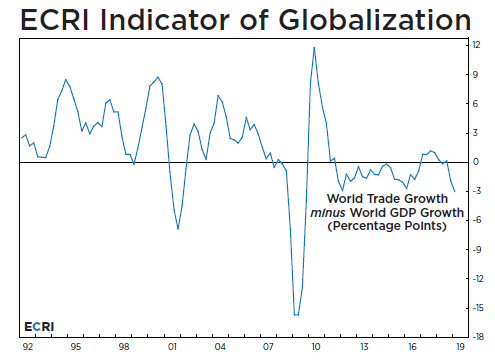
Quite separately, structural globalization or de-globalization occurs when this measure is substantially positive or negative, respectively, for extended periods. A wave of structural globalization dominated the 1990s and early 2000s, boosted by the 1994 North American Free Trade Agreement (NAFTA) and China’s 2001 entry into the World Trade Organization, unleashing what we dubbed “the globalization tsunami” at the time. The cyclical component of global trade overwhelmed structural globalization only around recessions, with our globalization measure going deep into negative territory around the 2001 U.S. recession and the Global Financial Crisis (GFC).
Since the GFC, however, structural de-globalization has emerged as the dominant force, as our measure has been almost exclusively negative since 2011, with a brief foray into positive territory due to the cyclical upturn in global growth around 2017 – which we correctly forecast in 2016.
As the ongoing cyclical global growth downturn has taken hold, de-globalization has expanded sharply, subsequently being exacerbated by the trade war. In turn, our globalization measure has plunged to its lowest reading since the GFC, and its worst reading on record away from recessions.
However, the pains of de-globalization are not shared equally. Exports account for only 12% of GDP in the U.S., and less than 20% of GDP in the major Asian economies of China, Japan and India. Meanwhile, in the Eurozone, exports account for roughly 30% of GDP in France, Italy and Spain, and a whopping 50% of German GDP.
Therefore, in the longer run, the ebb tide of globalization is more likely to leave the major European economies high and dry, while hurting, but not wrecking, the big Asian economies, and posing a modest headwind to U.S. growth. And, as de-globalization predates the trade war, any resolution to the trade war may offer a relatively small boost, but not enough to offset structural de-globalization.
Click here to review ECRI’s recent real-time track record.
For information on ECRI professional services please contact us.
Follow @businesscycle on Twitter and on LinkedIn.


