


Written by Econintersect
Early Bird Headlines 26 April 2019
Econintersect: Here are some of the headlines we found to help you start your day. For more headlines see our afternoon feature for GEI members, What We Read Today, published Monday, Wednesday and Friday, which has many more headlines and a number of article discussions to keep you abreast of what we have found interesting.

Please share this article – Go to very top of page, right hand side for social media buttons.
​Global
- Mainland China shares fall amid broad decline in Asian stocks (CNBC) Shares in Asia mostly declined on Friday after the Dow Jones Industrial Average dropped more than 100 points overnight. Mainland Chinese shares declined on the day. The U.S. dollar index was steady at 98.102 after touching lows around 98.0 yesterday. Brent crude futures were at $74.24 per barrel at 0829 GMT, down $0.11. U.S. West Texas Intermediate (WTI) crude futures were at $64.96 per barrel, down $0.25. Spot gold was up 0.4% at $1,281.69 per ounce, as of 0813 GMT. The metal has risen 0.5% so far this week, and is poised for its first gain since the week ended March 22.

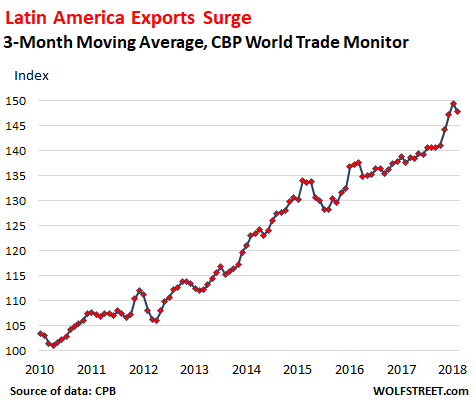
- LATAM Trade is Strong (Wolf Street) In contrast to weakening trade in Asia (see article under China, Latin American Trade has been booming.
U.S.
- How the Obama White House engaged Ukraine to give Russia collusion narrative an early boost (The Hill) As Donald Trump began his meteoric rise to the presidency, the Obama White House summoned Ukrainian authorities to Washington to coordinate ongoing anti-corruption efforts inside Russia’s most critical neighbor. The January 2016 gathering, confirmed by multiple participants and contemporaneous memos, brought some of Ukraine’s top corruption prosecutors and investigators face to face with members of former President Obama’s National Security Council (NSC), the FBI, State Department and Department of Justice (DOJ).
The agenda suggested the purpose was training and coordination. But Ukrainian participants said it didn’t take long – during the meetings and afterward – to realize the Americans’ objectives included two politically hot investigations: one that touched Vice President Joe Biden’s family and one that involved a lobbying firm linked closely to then-candidate Trump.
- Rod Rosenstein fires back at critics over Mueller report (Sydney Morning Herald) US Deputy Attorney-General Rod Rosenstein has hit back hard against politicians and the press, and warned that hacking and social media manipulation are “only the tip of the iceberg” when it comes to Russian efforts to influence American elections. Speaking at the Public Servants Dinner of the Armenian Bar Association, Rosenstein unleashed his sharpest critique yet of those who have attacked his handling of Special Counsel Robert Mueller’s investigative report into Russian election interference and President Donald Trump’s conduct. Rosenstein said:
“The bottom line is, there was overwhelming evidence that Russian operatives hacked American computers and defrauded American citizens, and that is only the tip of the iceberg of a comprehensive Russian strategy to influence elections, promote social discord, and undermine America, just like they do in many other countries.”
- Bernie Sanders booed as Democratic hopefuls try to woo women of color (The Guardian) Bernie stumbled in addressing a question about violence against women and was poorly recieved at this conference. Several other candidates had a warm but not rapturous reception or displayed patchy performances at times, but Sanders by far elicited the most disapproval.
EU
- Coal Phase-Out Plan in the EU (Twitter) Click on tweet for animation (GIF).

UK
- Brexit: Irish backstop could undermine EU standards, report says (The Guardian) It is a dastardly trap, designed to lock freedom-loving Britain into the European Union’s protectionist customs union: that is the argument against the so-called backstop, cited by hardline Brexit advocates as the main reason why they have thrice voted down Theresa May’s deal with the European Union.
But as the dust settles after months of chaos in Westminster, suspicions are growing on the other side of the Channel that the backstop could in fact be the very opposite: a brilliant deception device constructed by crack UK negotiators, which would allow a more reckless British prime minister to undermine the EU’s green and social standards while still keeping access to the European single market.
Germany
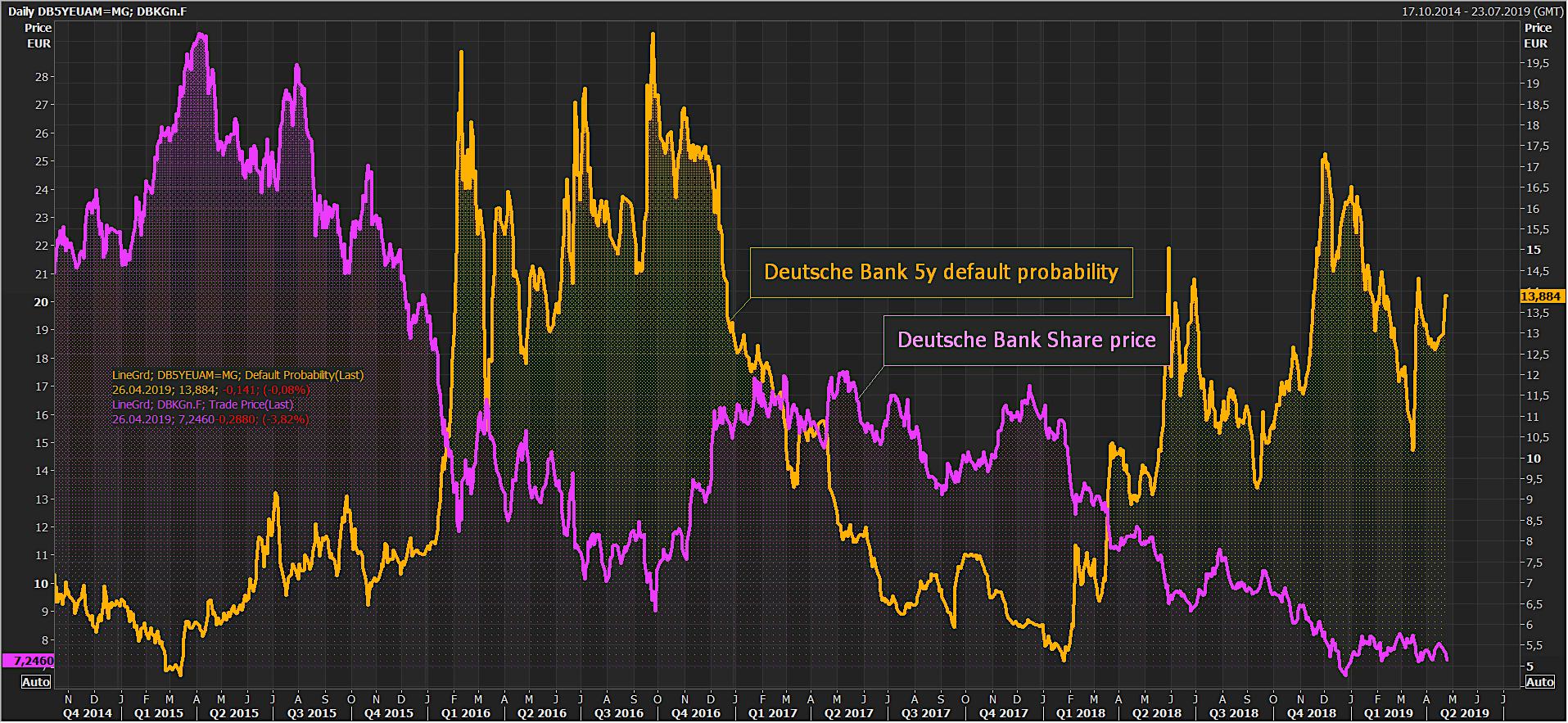
- Deutsche Bank Troubles Mount (Twitter)
Saudi Arabia
- Trump has just taken the biggest economic gamble of his presidency (Sydney Morning Herald) Hat tip to Steve Keen. Donald Trump’s double strangulation of Iran and Venezuela is reducing spare capacity in the global oil markets to wafer-thin levels very fast. If anything goes wrong in the geopolitical cauldron of world energy over the next six months, we will discover whether Saudi Arabia really is capable of cranking up an extra 2 million barrels a day of crude.
What we learnt from the rare glimpse of Saudi Aramco’s books this month is that the legendary Ghawar field is badly depleted. It cannot pump more that 3.8m barrels a day. This is a first-order shock. The company has always asserted with magisterial confidence that it can produce 5m barrels a day without difficulty.
Sri Lanka
- Sri Lankan police hunt 140 people believed linked to Islamic State after Easter bombings (Reuters) Sri Lankan police are trying to track down 140 people believed linked to Islamic State, which has claimed responsibility for the Easter Sunday suicide bombings of churches and hotels that killed 253 people, President Maithripala Sirisena said on Friday.
Japan
- Japan expands the hunt for F-35 jet that went missing during exercise (Reuters) Japan expanded its search for a missing F-35 stealth fighter on Thursday with a maritime survey vessel joining a navy ship and a U.S. Navy salvage team is expected in the area in coming days, a Japanese air force spokesman said. The U.S. has security concerns if the missing plane were to fall into the wrong hands.
North Korea
- North Korean leader warns of a return to tension, blames U.S. ‘bad faith’ (Reuters) North Korean leader Kim Jong Un told Russian President Vladimir Putin peace and security on the Korean peninsula depended on the United States, warning that a state of hostility could easily return, North Korean media said on Friday.
China
- China’s Rural Banks are in Trouble (The Daily Shot)China’s rural banks are struggling with non-performing loans (NPL).

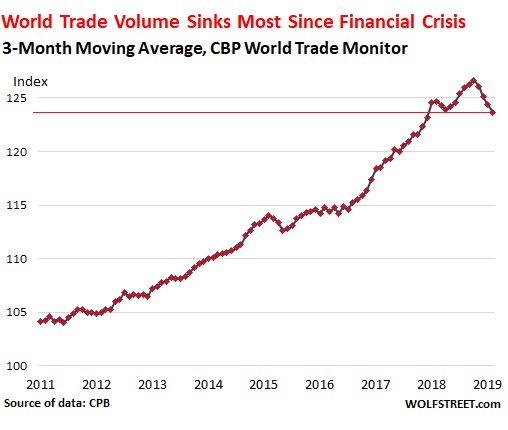
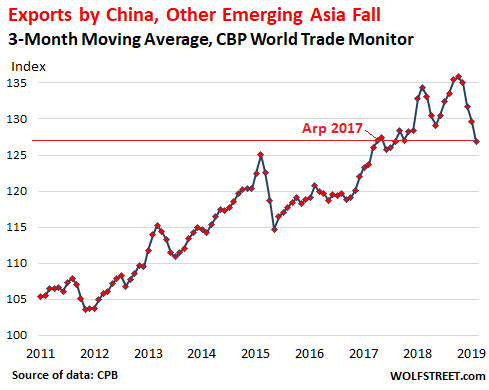
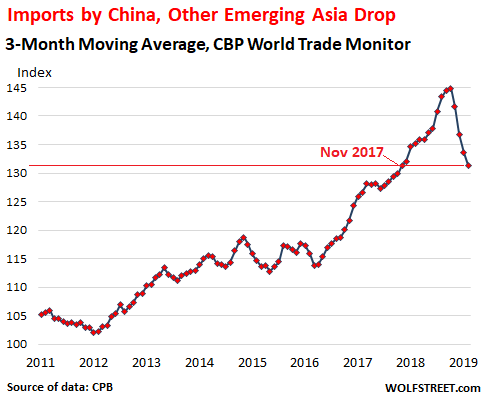
- China, Other Emerging Asia Sink World Trade (Wolf Street) World trade volume, which had been growing at a strong pace last year, peaking at 5.6% year-over-year growth in October, started turning down in November, and by February – according to the Merchandise World Trade Monitor, released today by CPB Netherlands Bureau for Economic Policy Analysis – it was down 3.4% from the peak in October and down 1.1% from February a year earlier.
The less volatile three-month moving average sank for the fourth month in a row, and is down 2.4% from the October peak and down about 1% from a year earlier. This kind of decline in world trade just hasn’t happened since the Global Financial Crisis
Mexico
- More than 1,000 migrants break out of southern Mexico detention centre (The Guardian) More than a thousand migrants broke out of a detention centre in southern Mexico on Thursday evening, authorities said, in a fresh sign of how a surge in arrivals has stretched the country’s resources to the limit. More than half of the roughly 1,300 migrants later returned to the Siglo XXI facility in the border city of Tapachula in Chiapas state, but about 600 are still unaccounted for, the National Migration Institute said in a statement.
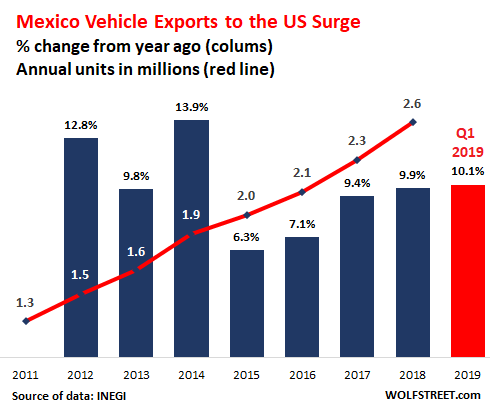
- US Auto Imports from Mexico Surge 10% in Q1 to New Record, Despite Dropping Sales in the US (Wolf Street) Of the 4 million new vehicles sold in the U.S. in the first quarter, 16% were assembled in Mexico.
It’s all about “trucks”: 63% of these vehicles were “trucks” – pickups, SUVs, crossovers, and minivans. This Q1 surge in exports to the US comes despite the 3.2% decline in auto sales in the US.
In the last eight years, Mexico’s auto exports to the US have doubled, from 1.3 million in 2011 to 2.6 million in 2018, at annual growth rates between 6.3% and 13.9%.
.


