


from The Conversation
— this post authored by Christian B. Miller, Wake Forest University
As Americans begrudgingly work through their taxes this year, many could be facing a moral struggle about whether to be honest or not. They might be thinking about exaggerating that donation to Goodwill, or not reporting that side job, among other things.

Please share this article – Go to very top of page, right hand side, for social media buttons.
It is true that each year many people do cheat on their taxes. According to findings released by the IRS in 2016, tax evasion costs the federal government over US$450 billion each year.
As a philosopher whose research focuses on character and ethics, I can say that there isn’t much controversy that cheating, in most situations, is morally wrong – and that includes cheating on one’s taxes.
So, how can we stay honest this tax season?
We want to consider ourselves honest people
First let’s dive into the recent psychological research on cheating.
Researcher Lisa Shu and her colleagues published a study in 2011 in which participants were given a test with 20 problems for which they would be paid $0.50 per correct answer. Their answers were checked by a person in charge, and they were paid accordingly.
This part of the experiment was pretty straightforward.
But then they changed the setup a bit. The participants were told that they would be the ones grading their answers with no one checking on them. The incentive and the test remained the same. They were also told that their paperwork would be shredded and they could report their own “scores.”
Here’s the difference it made in what people ended up doing: In the first setup where there was no opportunity to cheat, participants averaged about eight correct answers. In the second setup where there was ample opportunity to cheat, the number of “correct” answers jumped all the way to 13.22.
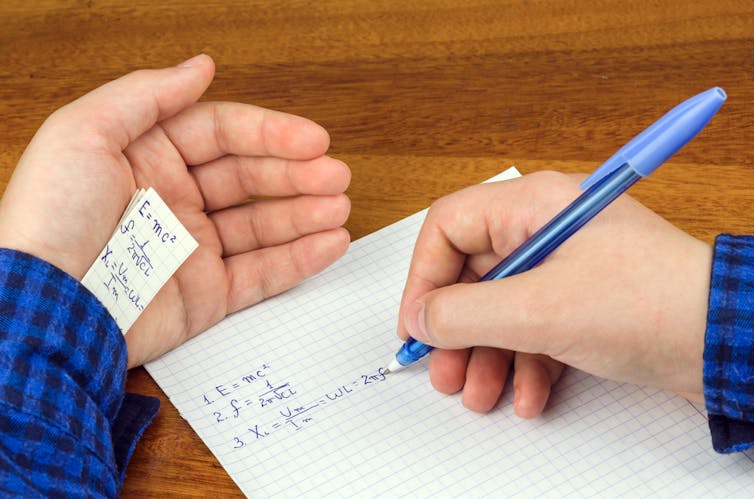
Researchers have found that moral reminders can stop people from cheating. Roman Pelesh/Shutterstock.com
This finding and other published results like them, provide an important lesson about the psychology of cheating: When people think they can get away with cheating, and they also think it would be worthwhile to cheat, they are often motivated to do so.
But that is not all the research has to offer. Using the same basic framework as Shu’s study, other research has added some interesting variations. For instance, participants in another study were first asked to recall as many of the Ten Commandments as they could before they took the test. In another variation, the participants were college students who first had to sign their school’s honor code before they began.
Researchers found the average number of problems solved was essentially the same as when participants had no opportunity to cheat and their answers were graded by someone else.
Psychologists have provided an explanation for what is happening here. While people often want to cheat in certain cases if it would benefit them, they also want to think of themselves as honest. What the honor code and the Ten Commandments did in the experiments was to serve as moral reminders of the importance of being honest.
Other studies of cheating have found that even more subtle reminders can be effective. In one such study, cheating continued even when the instructions said, “Please don’t cheat. … Even a small amount of cheating would undermine the study.” However, when researchers changed the wording for a second group, people did not cheat. This group was told: “Please don’t be a cheater. … Even a small number of cheaters would undermine the study.”
The switch to “cheater” called to mind how the participants wanted to think of themselves as honest. Most fascinating of all, psychologists stopped study participants from cheating simply by having them sit in front of a mirror.
When given a moral reminder, it is hard for most people to cheat.
What can you do to stay honest

How can you stay honest? Natee Meepian/Shutterstock.com
Coming back to the tax season, the question is how we can stay honest. Based on the research mentioned here, I want to suggest three practical steps:
Use tangible moral reminders. They can be as simple as a Post-it note on your computer to be honest. One could also read a passage from a religious text or a different source of moral inspiration.
If possible, do your taxes with someone else that you trust. With that accountability, it is a lot harder to give into temptation to cheat. We want to think of ourselves as honest, and we also want other people to think of us as honest too.
Call upon role models. Try to imagine what your moral heroes in life would tell you to do if you are considering bending the truth to lessen your tax burden.
We shouldn’t cheat on our taxes, not because we necessarily care about the IRS, but because we care about being people of honesty and integrity.
Editor’s note: This piece is part of our series on ethical questions arising from everyday life. We would welcome your suggestions. Please email us at [email protected].
Christian B. Miller, A.C. Reid Professor of Philosophy, Wake Forest University
This article is republished from The Conversation under a Creative Commons license. Read the original article.


