


from the St Louis Fed
— this post authored by Kevin Kliesen, Business Economist and Research Officer
In January 2012, the Federal Open Market Committee (FOMC) adopted an inflation targeting approach as part of its Longer-Run Goals and Monetary Policy Strategy. Under this approach, the FOMC judged that an inflation rate of 2 percent, as measured by the price index for personal consumption expenditures (PCEPI). The FOMC judged this rate to be the longer-run rate most consistent with the Federal Reserve’s statutory mandate of promoting maximum employment, stable prices and moderate long-term interest rates.[ 1]

The Inflation Rate
Since then, inflation has averaged under 2 percent. From 2012 to 2017, the PCEPI increased by an average of 1.3 percent per year, with a low of 0.3 percent in 2015 and a high of 1.8 percent in 2012 and 2017.[2]
Moreover, in November 2018, the PCEPI is up 1.8 percent from a year earlier. (December data have been delayed because of the partial government shutdown.) Thus, it appears that inflation in 2018 will fall short of the FOMC’s inflation target for the seventh straight year.
The Unemployment Rate
Meanwhile, the unemployment rate has fallen sharply over the past seven years, from 8.3 percent in January 2012 to 4 percent in January 2019. Indeed, in early 2017 the unemployment rate fell below the Congressional Budget Office’s estimate of the economy’s natural rate of unemployment (4.6 percent), when the unemployment rate fell from 4.7 percent in February to 4.4 percent in March.
Many economists and policymakers expect the unemployment rate to continue to fall farther below the natural rate of unemployment – often called u-star, or u* – this year. For example, the FOMC’s Summary of Economic Projections released in December 2018 showed that the median FOMC participant projects that the unemployment rate will average 3.5 percent in the fourth quarter of 2019.
The Phillips Curve
For quite some time, many economists and policymakers have assumed that the unemployment rate relative to u*was a useful guide for assessing future inflation. This relationship is known as the Phillips curve, which posits that there should be an inverse relationship between inflation and unemployment.[3] In other words, as the unemployment rate falls further below u*, inflation should increase.
Many economists and forecasters rely on some version of the Phillips curve to forecast inflation. However, several recent papers by prominent academics – including a speech by Federal Reserve Chairman Jerome Powell – suggests that the Phillips curve relationship has broken down. That is, the slope of the Phillips curve is near zero.[4]
Other Approaches to Forecasting Inflation
But economists have long used other approaches to forecast inflation. Pure time series models, which rely on statistical relationships rather than theoretical constructs, are a common approach. Time series models have been shown to be as accurate as larger, more complex structural models.
One such time series model is the St. Louis Fed’s factor-augmented VAR (FAVAR) model.[5] The FAVAR is a big-data model because it forecasts headline PCEPI inflation over the next 12 months using approximately 100 economic and financial data series, including:
- Labor market and price series
- Well-known measures of inflation expectations
- Foreign price series
The chart below plots actual inflation from January 2018 to November 2018, along with monthly vintages of 12-month-ahead forecasts for PCEPI inflation since June 2018.
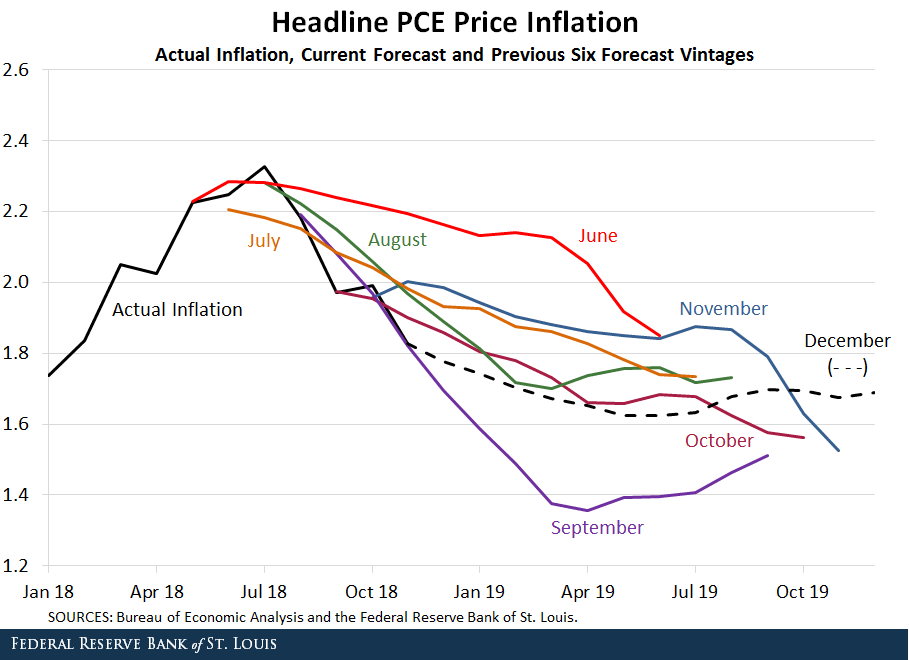
In January 2018, inflation was steadily rising, from 1.8 percent to its eventual peak of about 2.4 percent in July. In early August, the consensus of professional forecasters was that PCEPI inflation would moderate, but still average slightly more than 2 percent over the next four quarters (through the third quarter of 2019).[6]
However, the St. Louis Fed’s FAVAR model has been predicting a sharp slowing of inflation since the middle of 2018. For example, when the model was run in August, it was predicting that inflation would continue to slow and average less than 1.8 percent in third quarter of 2019, a marked contrast with the consensus of professional forecasters.
Current Inflation Forecasts
The latest forecast – which was made in December using the latest available observation for the PCEPI (November) – indicates that the model continues to expect below 2 percent inflation for all of 2019.
By contrast, the consensus of professional forecasters in November predicted that the headline PCEPI would increase 2.1 percent between the fourth quarter of 2018 and the fourth quarter of 2019. If the FAVAR forecast is realized, then inflation will have remained below the FOMC’s 2 percent target for the eighth consecutive year.
Notes and References
1 The Committee’s Statement on Longer-Run Goals and Monetary Policy Strategy is reaffirmed or amended each year and released at the conclusion of its first meeting of the year.
2 Annual inflation rates are based on percent changes from the fourth quarter of one year to the fourth quarter of the following year.
3 A more modern Phillips curve also employs a measure of inflation expectations.
4 Powell’s speech was “Monetary Policy and Risk Management at a Time of Low Inflation and Low Unemployment.” Kristin Forbes, economics professor at MIT’s Sloan School of Management, gave the 2018 Homer Jones Memorial Lecture, which cited several academic studies that document the flattening Phillips Curve.
5 VAR is an acronym for vector auto regression. For more details about the FAVAR model and approach, see the paper “A Measure of Price Pressures.”
6 The consensus of professional forecasters is the quarterly Survey of Professional Forecasterspublished by the Federal Reserve Bank of Philadelphia.
Additional Resources
- Review: A Measure of Price Pressures
- From the President: Three Themes for Monetary Policy in 2019
- On the Economy: Monetary Policy and Regional Inflation
Source
https://www.stlouisfed.org/on-the-economy/2019/february/inflation-forecasted-remain-two-percent-2019
Disclaimer
Views expressed are not necessarily those of the Federal Reserve Bank of St. Louis or of the Federal Reserve System.


