


from The Conversation
— this post authored by Caitlin Killian, Drew University
Nazma Khan, who immigrated to the United States from Bangladesh at age 11, faced years of shaming over wearing a headscarf in New York.

Please share this article – Go to very top of page, right hand side, for social media buttons.
So, in 2013, she started World Hijab Day – a day for both Muslim and non-Muslim women to experience wearing a headscarf.
Celebrated on Feb. 1, the day is an expression of solidarity and support for religious freedom.
As a scholar of Muslim immigrants, I have also long argued for women’s right to religious expression in their clothing choices. The hijab is not simply about religion – women wear it for a variety of reasons that can change, depending on the time and social context.
Is the veil an Islamic requirement?
Muslim religious writings are not entirely clear on the question of veiling.
Various passages in the Quran, the Muslim holy book, and the Hadiths, statements attributed to the Prophet Mohammad, make reference to veiling by the prophet’s wives. But scholars disagree about whether these statements apply only to the prophet’s wives or to all Muslim women.
According to some, the veil has been used as a way of curbing male sexual desire. Yet covering the head and body predated Islam. Jewish, Christian and Hindu women have also covered their head at various times in history and in different parts of the world.
Certainly, the headscarf is tied to religion. Many women who cover talk about it as a way demonstrating their submission to God and a constant reminder to hold fast to Islamic beliefs such as being honest and generous to those in need.
Asserting identity
However, there are other reasons for adopting the hijab.
French and British colonizers encouraged Muslim women to remove the veil and emulate European women. Consequently, in North African and Middle Eastern countries, the veil became a symbol of national identity and opposition to the West during independence and nationalist movements.
Today, some women wear the hijab to signal pride in their ethnic identity. This is more so for immigrants in Europe and the United States, where there has been an increase in Islamophobia.
In a Facebook post for World Hijab Day 2018 that went viral, Columbia College student Toqa Badran wrote,
“I wear this scarf because when I was a child I was socialized to be embarrassed, even ashamed, of my religion and my culture. I was told that to be a Muslim was to be a terrorist and that to be outwardly Muslim was to endorse violence and oppression … I understood that I would be unwelcome as long as I wore symbols of my heritage and chose to, in however modern a way, embrace my ancestors.”
Muslim African-American women in the U.S. sometimes wear a hijab to signal their religious affiliation. They also want to dispel the assumption that all African-Americans are Christians, and that only people with origins abroad can be Muslim. In fact, 13 percent of adult Muslims in the U.S are black Americans born in the country.
Different reasons for wearing a hijab
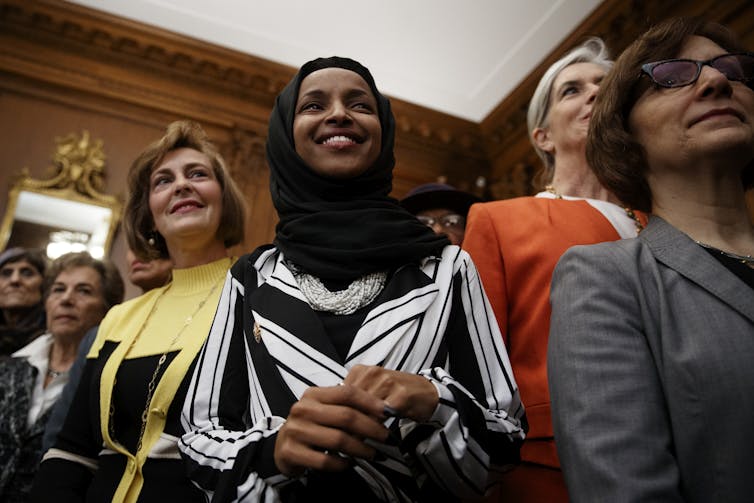
The newly elected Congresswoman Ilhan Omar wears a hijab. AP Photo/Carolyn Kaster)
For many other women, the headscarf has become a means of resistance to standards of feminine beauty that demand more exposure. Proponents of this view argue that removing clothing for the benefit of the male gaze does not equal liberation.
According to researchers, women in hijabs note that employers must interact with them based on their qualifications rather than their appearance and that, therefore, the hijab levels the playing field. In Western countries, however, women find that wearing a head covering makes it harder to get hired.
Finally, for some women, the headscarf is a convenience. It can reduce comments from others about women being out in public and lessen incidents of harassment on the street and at work.
Despite the multiple, complicated reasons behind wearing a hijab, there are those who routinely assert that women who wear a headscarf are necessarily oppressed.
Examples of hijab-wearing women in the government, such as newly elected Congresswoman Ilhan Omar, or athletes such as Olympian fencer Ibtihaj Muhammad, may help dispel these stereotypes.
Caitlin Killian, Professor of Sociology, Drew University
This article is republished from The Conversation under a Creative Commons license. Read the original article.


