


from the St Louis Fed
— this post authored by Subhayu Bandyopadhyay, Research Officer and Economist, and Asha Bharadwaj, Research Associate
Many Organization for Economic Cooperation and Development (OECD) nations have aging populations, with substantial fractions of their populations exceeding 55. As more of this population retires and people live longer on average, a corresponding number of younger people will have to move into the workforce to maintain a steady share of the working population for the entire nation.

This working-age population has to produce not only for themselves, but also for others, including the elderly and children. In this context, immigration can play a role, especially if the immigrants are of prime working and/or childbearing age:
- First, the immigrants can substitute for natives who are retiring from the workforce.
- Second, working-age immigrants are likely to have children, who can contribute to the future workforce of the nation.
Keeping these issues in mind, we examined the latest publicly available data (which were from 2013) for the proportion of foreign-born in OECD nations and the proportion of the population 55 years or older in these same nations.[1]
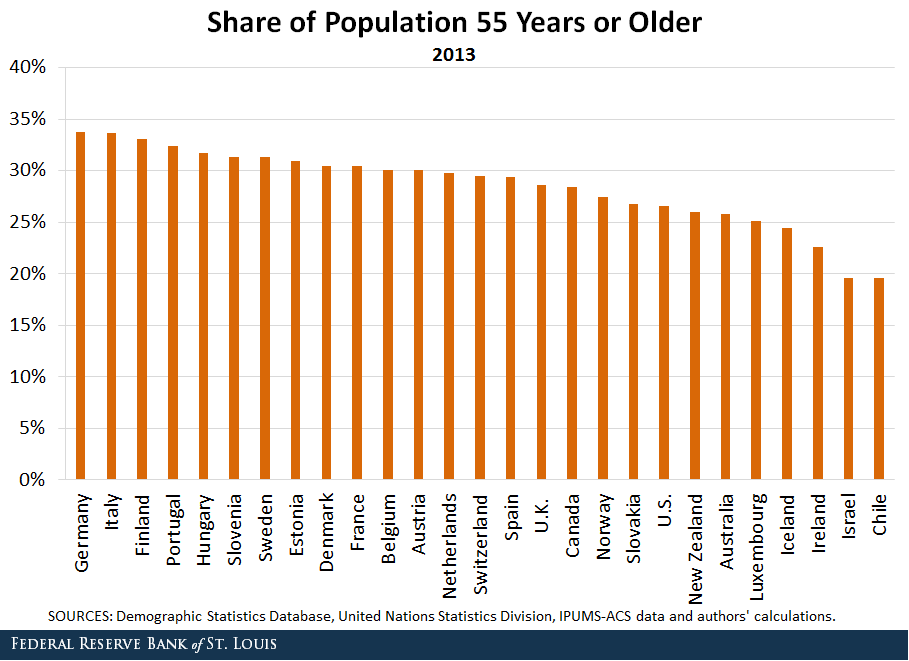
We observe from the figure above that two major European economies – Germany (33.8 percent) and Italy (33.7 percent) – are at the top of the list of aging populations. However, Germany and Italy are in the bottom half of the nations in the figure below, which shows the share of foreign-born in the same countries we observed in the previous figure.
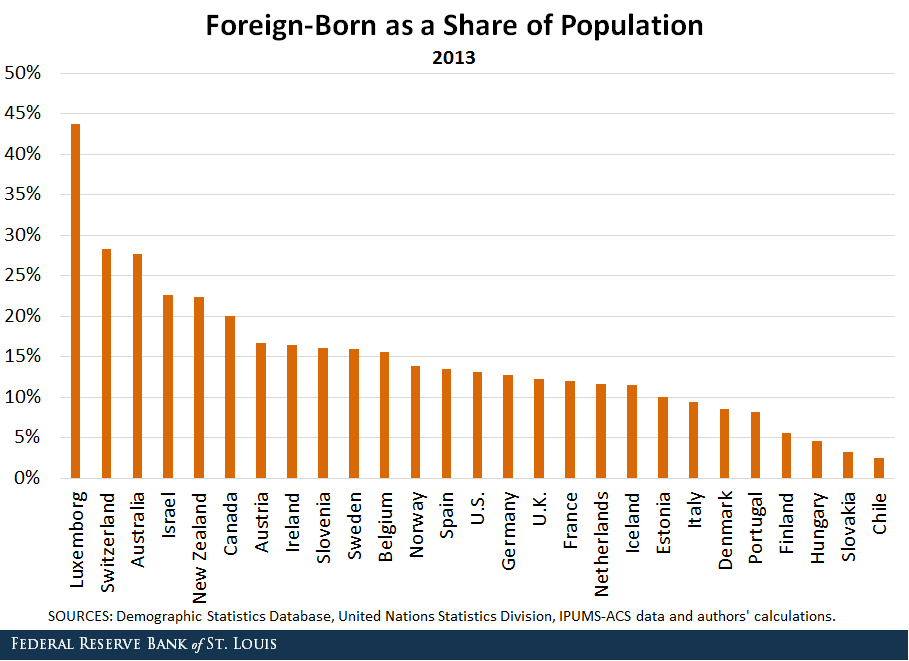
Such a switch in ranks between the two figures is true for most other nations in our sample as well.
Digging deeper, we found a 2015 OECD report that around 87 percent of the foreign-born in Italy in the years 2011-12 were in the prime workforce age group of 15-64 years.[2] This was around 23 percentage points higher than the corresponding proportion for the Italian natives. Similarly, for Germany, the percentage of foreign-born in the 15-64 year age group was around 83 percent, which was higher than the native-born proportion by around 20 percentage points.
Seen in this light, the age profiles of the foreign-born in Italy and Germany are suggestive of future benefits from the foreign-born population. Many factors – including education, tax and transfer policies – will determine the economic future of all these nations. Immigration and demographic changes that we discussed in this post will contribute their share to that future.
Notes and References
1 Data limitations required us to focus on 27 OECD nations.
2 Indicators of Immigrant Integration 2015: Settling In, OECD Publishing, 2015.
Additional Resources
- On the Economy: Immigration: Top Origin Nations and Top Destinations
- On the Economy: Today’s Immigrants Are More Educated than 50 Years Ago
- On the Economy: Does Immigration Affect Local Labor Markets?
Source
https://www.stlouisfed.org/on-the-economy/2018/december/immigrations-effect-future-workforces
Disclaimer
Views expressed are not necessarily those of the Federal Reserve Bank of St. Louis or of the Federal Reserve System.


