


from The Conversation
— this post authored by Loes van Dam, University of Essex
The sensation of sound occurs when the vibrations from sounds enter our ear and cause little hairlike structures – called hair cells – within our inner ear to move back and forth. The hair cells transform this movement into an electrical signal that the brain can use.

Please share this article – Go to very top of page, right hand side, for social media buttons.
How well a person can hear largely depends on how intact these hair cells are. Once lost, they don’t grow back – and this is no different for blind people. So blind people can’t physically hear better than others.
Yet blind people often outperform sighted people in hearing tasks such as locating the source of sounds. The reason for this emerges when we look beyond the sensory organs, at what is happening with the brain, and how the sensory information is processed by it.
Perception occurs when the brain interprets signals that our sensory organs provide, and different parts of the brain respond to the information arriving from different sensory organs. There are areas that process visual information (the visual cortex) and areas that process sound information (the auditory cortex). But when a sense like vision is lost, the brain does something remarkable: it reorganises the functions of these brain areas.
In blind people, the visual cortex gets a bit “bored” without visual input and starts to “rewire” itself, becoming more responsive to information from the other remaining senses. So blind people may have lost their vision, but this leaves a larger brain capacity for processing the information from other senses.
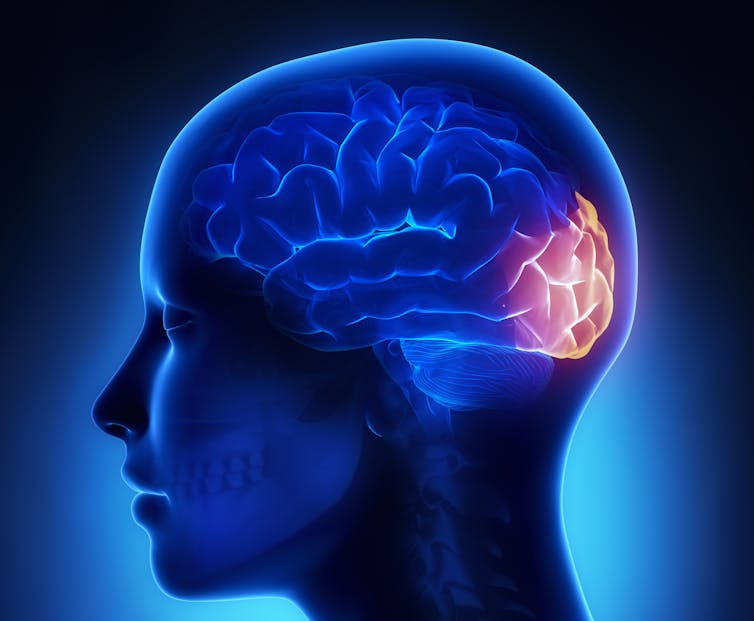
The visual cortex can rewire itself to respond to sounds or touch. Cliparea/Shutterstock
The extent of reorganisation in the brain depends on when someone loses their sight. The brain can reorganise itself at any point in life, including adulthood, but during childhood the brain is more able to adapt to change. This is because during childhood the brain is still developing and the new organisation of the brain does not have to compete with an existing one. As a result, people who have been blind from a very early age show a much greater level of reorganisation in the brain.
People who become blind early in life tend to outperform sighted people, as well as those who became blind later in life, in hearing and touch perceptual tasks.
Echolocation
The reorganisation in the brain also means that blind people are sometimes able to learn how to use their remaining senses in interesting ways. For example, some blind people learn to sense the location and size of objects around them using echolocation.
By producing clicks with their mouths and listening for the echoes, blind people can locate objects in their surroundings. This ability is tightly linked with the brain activity in the visual cortex. In fact, the visual cortex in blind echolocators responds to sound information in almost the same way as it does to visual information in the sighted. In other words, in blind echolocators, hearing has replaced vision in the brain to a very large extent.
But not every blind person is automatically an expert echolocator. Whether a blind person is able to develop a skill like echolocation depends on the time spent learning this task – even sighted people can learn this skill with enough training, but blind people will probably benefit from their reorganised brain being more tuned towards the remaining senses.
Blind people will also rely more on their remaining senses to do everyday tasks, which means that they train their remaining senses on a daily basis. The reorganised brain together with the greater experience in using their remaining senses are believed to be important factors in blind people having an edge over sighted people in hearing and touch.
Loes van Dam, Lecturer in Psychology, University of Essex
This article is republished from The Conversation under a Creative Commons license. Read the original article.


