


from The Conversation
— this post authored by Mark Bishop, University of Florida
Physical therapists help people walk again after a stroke and recover after injury or surgery, but did you know they also prevent exposure to opioids? This is timely, given we are in a public health emergency related to an opioid crisis.

Please share this article – Go to very top of page, right hand side, for social media buttons.
Many people addicted to opioids are first exposed through a medical prescription for pain. Opiate-based drugs provide relief for acute conditions, such as post-surgical pain.
Unfortunately, the effectiveness of opioids decreases after time, requiring higher doses of the drug for the same effects and, perhaps counter-intuitively, worsening pain in some people. Many people progress from this prescription to other opiate derivatives, including heroin and fentanyl. As a result, a growing emphasis has been placed on nonpharmacological alternatives to opioids.
I am a physical therapist and I have studied non-pharmacological methods of preventing the transition from acute to chronic pain. It’s an exciting time for the field, because practice and research are showing that physical therapy could diminish the need for opioids, and thus lower the risk of addiction.
Reducing initial exposures to opioids
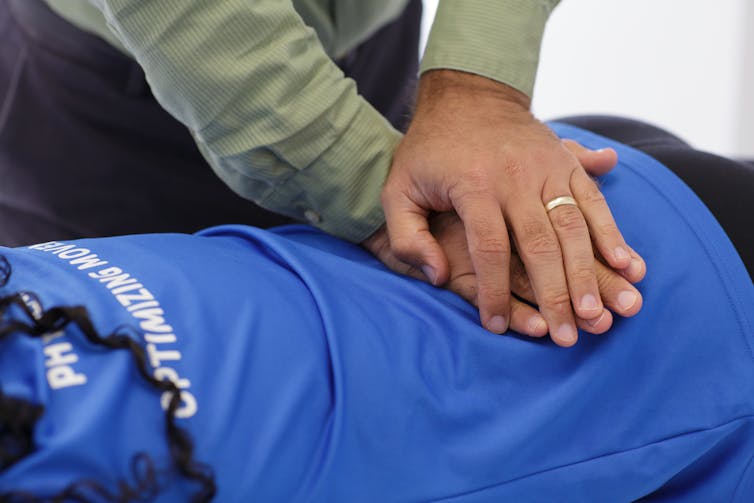
Part of the proposed solution to the opioid crisis is to limit new opioid exposures. Physical therapists are an important part of this process. And it is not just physical therapists who are saying this.
Mindy Miller/University of Florida Photography, CC BY-SA
A letter to the president from the Commission on Combating Drug Addiction and the Opioid Crisis stated, “individuals with acute or chronic pain must have access to non-opioid pain management options. Everything from physical therapy, to non-opioid medications, should be easily accessible as an alternative to opioids.” U.S. Surgeon General Jerome Adams echoed this call for alternative treatments, including physical therapists.
The Centers for Disease Control and Prevention also issued prescribing guidelines in 2016 that recommend physical therapists be considered a first-line treatment for people with chronic pain conditions.
Research supports these positions, including research papers studying opioid use for common musculoskeletal pain conditions like back, knee and neck pain.
These studies show quite convincingly that the probability of receiving a prescription for opioids is 89 percent lower for people seeing a physical therapist for pain. Seeing the physical therapist sooner, rather than later, makes this protective effect even greater.
Why don’t more people see a physical therapist?
People in pain can go directly to a physical therapist in every state. So why don’t more people to do this? The simple answer: time and money.
Steven George, the director of musculoskeletal research for the Duke Clinical Research Institute, recently wrote, “Our existing health care system is designed to treat pain through easily delivered products, like opioids, injections and surgery,” suggesting that alternatives are not as easily delivered.
Only about 10 percent of people who see a physician for back pain get referred to a physical therapist. Only 37 percent of those people actually go. The process to make an appointment can be lengthy and time-consuming, and insurance companies often slow down the process. Some HMO insurance plans require that physical therapy treatment be certified as medically necessary, or they will not pay. And, there’s another step: pre-authorization. This, too, delays the access to covered care even more. For a person in pain and in need of help, this is a deterrent. It’s much easier to ask for a pill.
Then there is the cost. Physical therapists are often classified as specialists, so co-payments may be as high as US$75 a visit. The average patient with back pain sees a physical therapist for seven visits. Even with insurance coverage, this episode of care still will cost the person over US$500 out of pocket compared to the cost of a single primary care visit and prescription. Several states, including Kentucky, have enacted laws limiting co-payment for many services. One of the recommendations from the President’s Commission was that alternatives to opioids, including physical therapy, should be adequately covered by payers. These recommendations have yet to be acted upon.
 So what does all of this mean for people in pain? First, seeing a physical therapist is effective for many pain conditions. Second, getting to a physical therapist sooner rather than later decreases the use of opioid medication. The current health care system must change in order for people in pain to access this safe and effective non-opioid alternative for pain management.
Mark Bishop, Associate Professor of Physical Therapy, University of Florida
This article was originally published on The Conversation. Read the original article.


