


from the St Louis Fed
— this post authored by Kevin L. Kliesen
The U.S. economy continues to expand at a rate that exceeds its potential rate of growth (somewhere around 2.25 percent). The consensus of professional forecasters is that above-trend growth, perhaps close to 3 percent, will persist over the remainder of 2018, likely leading to further reductions in the unemployment rate. However, inflation has rebounded modestly and is now at the 2 percent target rate of the Federal Open Market Committee (FOMC). Overall, the near-term outlook for the national economy appears solid.

Healthy Growth but Larger Budget Deficits
After increasing at a 3 percent annual rate over the second half of 2017, real gross domestic product (GDP) advanced at a 2.3 percent annual rate in the first quarter. Of note, business fixed investment continued to expand at a healthy rate, increasing at a rate of more than 6 percent for the fourth time in the past five quarters. Surveys of large and small businesses continue to show considerable optimism as a result of this year’s tax cuts and additional increase in federal government outlays. In response, most economists expected continued brisk growth of real personal consumption expenditures (PCE), which had advanced at a 3.1 percent annual rate over the second half of 2017. However, real PCE growth slowed sharply in the first quarter to the smallest increase in about five years (1.1 percent). This development has led some forecasters to wonder whether the expected boost to household expenditures from the tax cuts was too optimistic.
A key question in the outlook is whether the modest slowing in first-quarter consumption growth is temporary or whether it points to something more persistent. Overall, fundamentals suggest real PCE growth will probably rebound over the remainder of the year. Importantly, the demand for labor remains strong, helping to fuel solid gains in labor compensation. For example, the National Association for Business Economics (NABE) Business Conditions Survey released in May indicated that the wages and salaries net rising index (percentage of firms reporting rising wages less percentage reporting falling wages) posted its highest level on record (back to 1982).
Indeed, there were signs of a spring thaw in consumption spending, as real PCE increased at a robust 5.1 percent annual rate in March. With consumer spending likely to rebound, coupled with the still-healthy outlook in construction spending and some strengthening in U.S. exports, forecasters generally believe that real GDP growth will be modestly stronger over the final three quarters of the year.
Professional forecasters also expect some bump in government expenditures this year and the next from the Bipartisan Budget Act that was signed into law in February. However, the trade-off from lower taxes and increased government spending is an expected erosion in the budget outlook. In April, the Congressional Budget Office (CBO) released its Budget and Economic Outlook. In nominal dollar terms, the CBO projects that the federal budget deficit will average $1.2 trillion per year from fiscal years 2019 to 2028 (roughly 5 percent of nominal GDP).
Larger budget deficits, stronger economic growth and the FOMC’s plan to reduce the size of its balance sheet all suggest rising long-term interest rates over the near term.
Inflation Developments
All else equal, higher inflation will also increase interest rates. Inflation was stronger than expected in the first quarter. After increasing by 1.7 percent in December 2017 from a year earlier, the all-items PCE price index rose to 2 percent in March 2018 from a year earlier. Some of this firming reflects the recent run-up in crude oil prices, which have more than doubled since their recent low of just under $31 per barrel in February 2016. In addition, firms appear to be experiencing sizable materials cost pressures, as noted in the aforementioned NABE survey. With little discernible erosion in profit margins thus far in 2018, this finding suggests that many firms have begun passing along a portion of these increased costs to consumers.
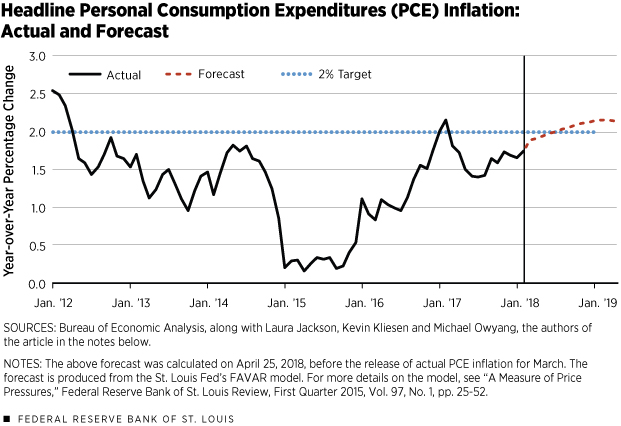
Although the St. Louis Fed’s inflation forecasting model projects a modest further increase in inflation over the near term, to about 2.25 percent in early 2019, the model continues to indicate a small probability (less than 10 percent) that headline inflation will accelerate past 2.5 percent over the next 12 months.
At this point, the most likely outcome for 2018 and 2019 is real GDP growth of between 2.5 percent and 3 percent, inflation close to the Fed’s 2 percent target – with perhaps some modest risk of an overshoot if crude oil prices continue to trend higher – and further declines in the unemployment rate.
Source
https://www.stlouisfed.org/publications/regional-economist/second-quarter-2018/economic-growth-solid-this-year
ABOUT THE AUTHOR
 Kevin L. Kliesen
Kevin L. Kliesen is a business economist and research officer at the Federal Reserve Bank of St. Louis. His research interests include business economics, and monetary and fiscal policy analysis. He joined the St. Louis Fed in 1988. Read more about the author and his research.
Brian Levine, a research associate at the Bank, provided research assistance.


