


from the St Louis Fed
— this post authored by YiLi Chien, Senior Economist, and Paul Morris, Senior Research Associate
On April 3, the U.S. government proposed imposing 25 percent tariffs on a list of products imported from China in an escalation of their ongoing trade conflict.[ 1] The next day, the Chinese government retaliated with a list of products from the U.S. that would potentially be subject to 25 percent tariffs.

The Peterson Institute for International Economics reported that the total value of U.S. exports subject to China’s retaliation reached $49.8 billion in 2017.[ 2]
Potential Labor Impact of China’s Tariff Retaliation
This blog post looks at the potential impacts of China’s retaliation on the U.S. labor market. We used the 2016 employment requirement matrix provided by the Bureau of Labor Statistics, which details employment generated directly and indirectly by a million dollars of production in a given industry.3 By using this matrix, we can calculate the number of jobs associated with production of the exports subject to retaliation.
The figure below gives an idea of the impact of China’s retaliation on employment in major industries.
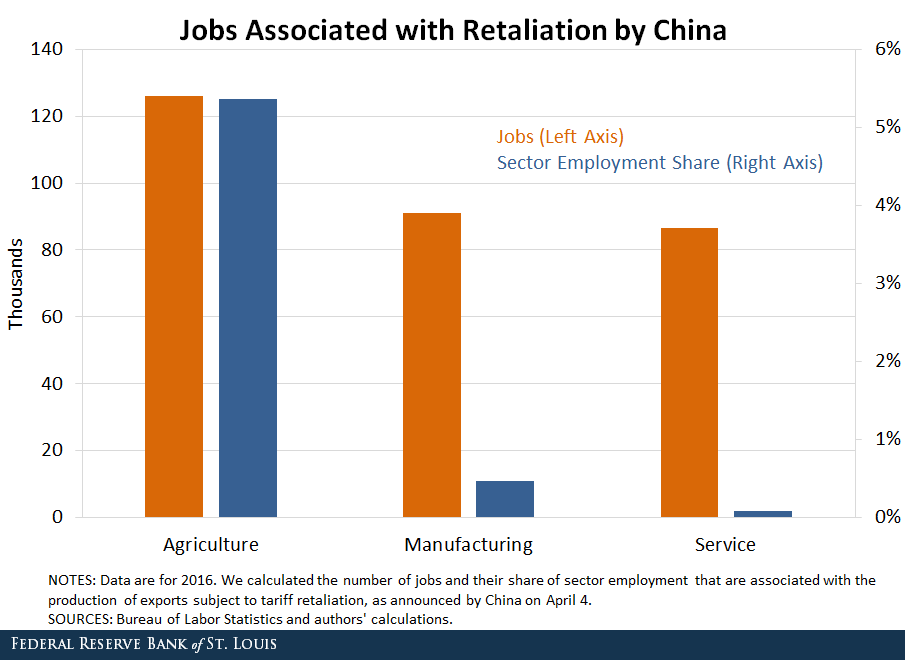
In total, there were 312,800 jobs supported by the exported goods on China’s list, accounting for slightly over 0.2 percent of total private employment in 2016, mainly in three sectors:
- The agriculture sector employed 126,200 workers contributing to the production of these exported goods.
- The manufacturing sector employed 91,200 such workers.
- The service sector employed 86,700 affected employees.
Given the relatively small number of employees in the agriculture sector as a whole, affected employees accounted for 5.4 percent of employment in agriculture. The corresponding shares in the manufacturing and service sectors were much lower at just 0.5 percent and 0.1 percent, respectively.
Not All Jobs Would Be Affected
It is important to note that these numbers are likely biased upward, as they represent the number of jobs supported by the total value of exports on China’s proposed list.
First, a 25 percent tariff would likely reduce exports to China, but it is unlikely to eliminate the entirety of these exports. In addition, producers in the U.S. would very likely shift some of these exports to other countries or sell them domestically.
Finally, there may be some ways to avoid tariffs imposed on exports to China from the U.S. Producers could export these goods to a third country before selling them to China, a process known as transshipping.
Notes and References
1 The Office of the United States Trade Representative published the full list (PDF).
2 Bown, Chad P. “More than Soybeans: Trump’s Section 301 Tariffs and China’s Response.” Peterson Institute for International Economics, April 4, 2018.
3 The matrix and the associated documentation are available at Employment Requirements Matrix.
Additional Resources
- On the Economy: The Weakening of the US Dollar
- On the Economy: The Evolution of US Agricultural Exports
- On the Economy: The Manufacturing Sector’s Evolution and Its Role in an Economy
Source
https://www.stlouisfed.org/on-the-economy/2018/may/china-tariff-retaliation-how-us-jobs-affected
Disclaimer
Views expressed are not necessarily those of the Federal Reserve Bank of St. Louis or of the Federal Reserve System.


