


from The Conversation
— this post authored by James Ohman, Liverpool John Moores University and Asier Gomez-Olivencia, University of the Basque Country
When we think of Neanderthals, we often imagine these distant ancestors of ours to be rather brutish, dying at a young age and ultimately becoming extinct. But new findings show that at least some of these ancient Neanderthals survived into old age – despite suffering from sickness or diseases.

Please share this article – Go to very top of page, right hand side, for social media buttons.
Neanderthals were hunter-gatherers, living in harsh environments, mostly colder than today. And of course they had to face different dangers to modern humans – not only during the hunt, but also because they shared ecosystems with large carnivores such as lions, leopards and hyenas.
But despite this harsh life of the hunter gatherer, our research indicates that some Neanderthals lived to be fairly old and even had some of the signs of age related illnesses – such as degenerative lesions in the spine, consistent with osteoarthritis. Our research also found that an adult male Neanderthal survived bone fractures. And when he died, he was buried by members of his group.
Introducing the Neanderthals
The first fossil remain of a Neanderthal was found in 1829 in Belgium. But it was not until 1856 that the species was named after the discovery of a partial skeleton in Germany. The site (called Feldhofer) was located in the Neander valley. In old German “valley” is written “thal” and hence the scientific name Homo neanderthalensis, which means “the humans from the Neander valley”, was born.
At the beginning of the 20th century, the fossils of several Neanderthals were found in France – comprising the most complete skeletons found to that date. The region, which is on the verges of the rivers Dordogne and Vezère, is an archaeological hotspot with a number of famous sites, such as the Cro-Magnon rockshelter, Lascaux, and La Chapelle-aux-Saints.
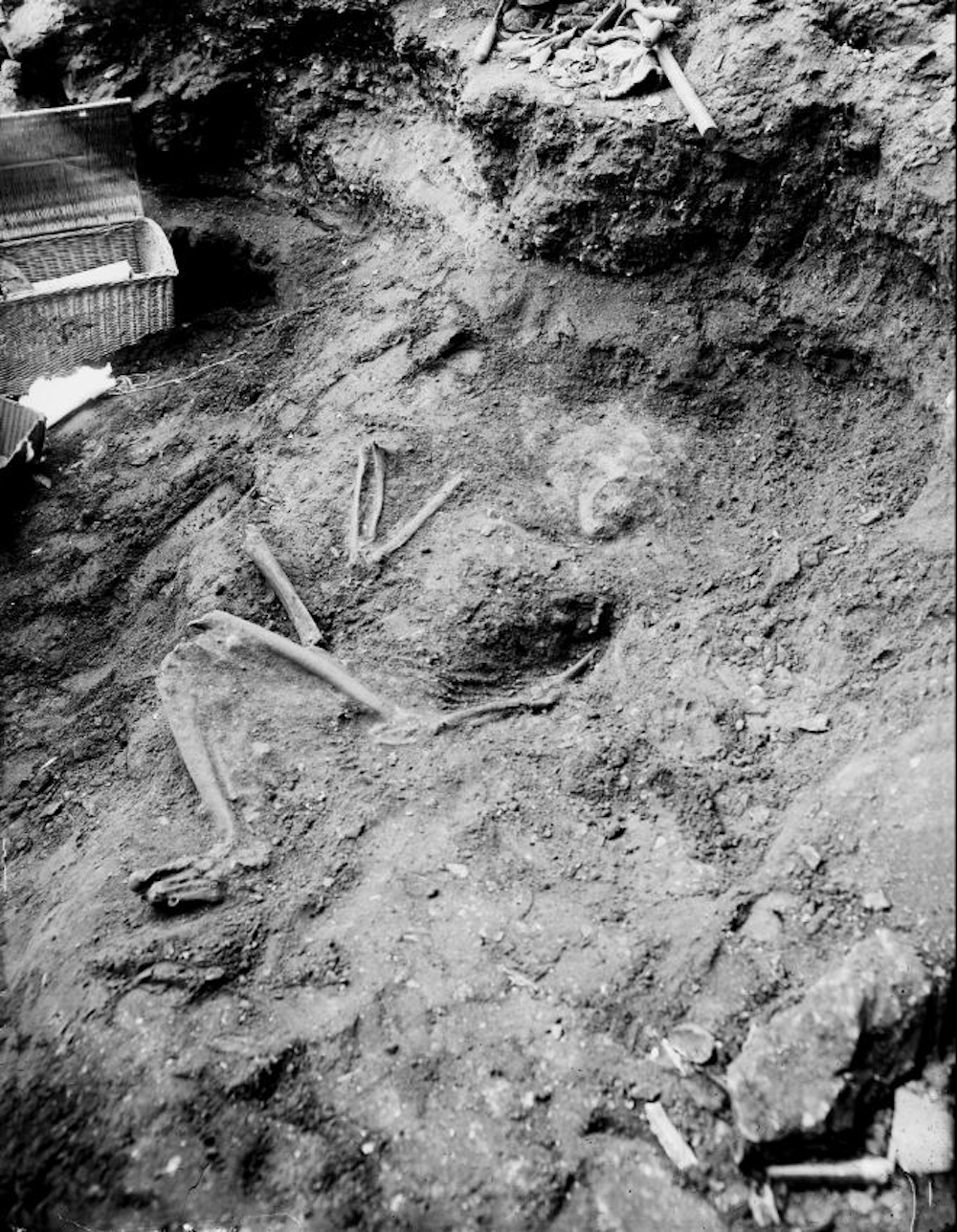
Photo of the discovery of La Ferrassie 1 in 1909. Collections M.N.P. Les Eyzies, Author provided
These sites have been vital in helping archaeologists understand human evolution in Europe during the Upper Pleistocene. This is 126,000 years ago, to the end of the last glacial period which was approximately 12,000 years ago. One of these sites, called La Ferrassie, which is in Dordogne, France, has yielded the complete skeletons of two adult and the incomplete skeletons of five juvenile Neanderthals – as well as a few isolated dental remains.
Most of these skeletons were found at the beginning of the 20th century, but during previous excavations at the sites (between the 1960s to 1970s) archeologists discovered a child skeleton, which was called La Ferrassie 8. And we were able to further complete this skeleton when we reassessed the bone remains more recently.
New data from an ancient grave
La Ferrassie 1 (LF1) was the first skeleton to be found in the La Ferrassie rock shelter in 1909 and is still one of the most complete Neanderthal skeletons ever to be found. LF1 is a male Neanderthal skeleton, found in Dordogne and estimated to be 70,000-50,000 years old. He died when he was between 40 and 55 years old – a relatively old age in this species. He was a fairly tall Neanderthal (172cm or five feet eight inches) and weighed around 85kg.
As part of our research, we used new non-invasive technologies to complete our direct observations of the skeleton of LF1. We observed several anomalies in the spine and in the shape of the clavicle. A CT-scan revealed this was probably due to a fracture of the left clavicle, which happened before this individual became an adult.
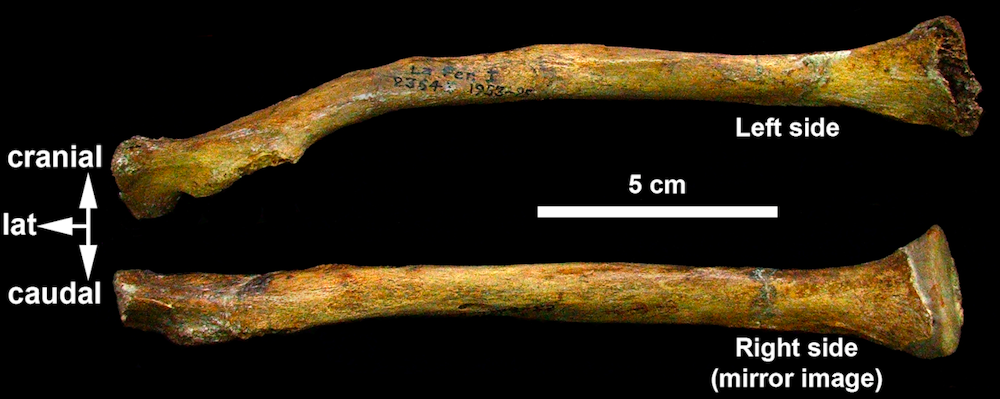
Comparison between the left clavicle (up), which is pathological with the mirror image of the right clavicle (bottom). Asier Gómez-Olivencia, Author provided
This was not the only fracture that this individual suffered. Previous studies have also shown that this Neanderthal also broke part of his femur. We also found degenerative lesions on his spine, consistent with osteoarthritis. And previous research has also shown that he suffered from a lung disease – which could have been the cause of death.
Growing old gracefully
What this all shows is that many Neanderthals may have lived to be older than previously estimated – much like humans of today. And it’s also believed that much like us, some Neanderthal groups actually buried their dead.
French sites such as La Chapelle-aux-Saints and La Ferrassie have provided evidence to support this. In La Ferrassie, at least five of the skeletons show an East-West orientation and the two adults show the same orientation but face opposite directions.
Denis Peyrony, the director of the excavation when La Ferrassie 1 was found, indicated that this individual was lying in a “funeral pit“, a purposefully dug hole where the corpse was laid. And our observations looking at the bone surface and the way the bones are broken are consistent with the corpse being buried shortly after death. The corpse also didn’t suffer any damage from carnivores – which would have been the case if the corpse had been left behind by the group.
 Much like humans of today, then, it seems the Neanderthals, if injured, received help from other members of the group, which helped them to survive – with some of them reaching advanced ages. So maybe it’s time we changed our stereotype of the brutish, thuggish Neanderthals, and instead start viewing them with the respect and awe they really deserve.
James Ohman, Senior Lecturer in Palaeoanthropology, Liverpool John Moores University and Asier Gomez-Olivencia, Research Fellow in Stratigraphy and Paleontology, University of the Basque Country
This article was originally published on The Conversation. Read the original article.


