


from The Conversation
— this post authored by Claire Bowern, Yale University
The approximately 400 languages of Aboriginal Australia can be grouped into 27 different families. To put that diversity in context, Europe has just four language families, Indo-European, Basque, Finno-Ugric and Semitic, with Indo-European encompassing such languages as English, Spanish, Russian and Hindi.

Please share this article – Go to very top of page, right hand side, for social media buttons.
Australia’s largest language family is Pama-Nyungan. Before 1788 it covered 90% of the country and comprised about 300 languages. The territories on which Canberra (Ngunnawal), Perth (Noongar), Sydney (Daruk, Iyora), Brisbane (Turubal) and Melbourne (Woiwurrung) are built were all once owned by speakers of Pama-Nyungan languages.
All the languages from the Torres Strait to Bunbury, from the Pilbara to the Grampians, are descended from a single ancestor language that spread across the continent to all but the Kimberley and the Top End.
Where this language came from, how old it is, and how it spread, has been something of a puzzle. Our research, published recently in Nature Ecology and Evolution, suggests the family arose just under 6,000 years ago around what is now the Queensland town of Burketown. Our findings suggest this language family spread across Australia as people moved in response to changing climate.
Aboriginal Australia is often described as “the world’s oldest living culture”, and public discussion often falsely assumes that this means unchanging. Our research adds further evidence to Australia pre-1788 being a dynamic place, where people moved and adapted to a changing land.
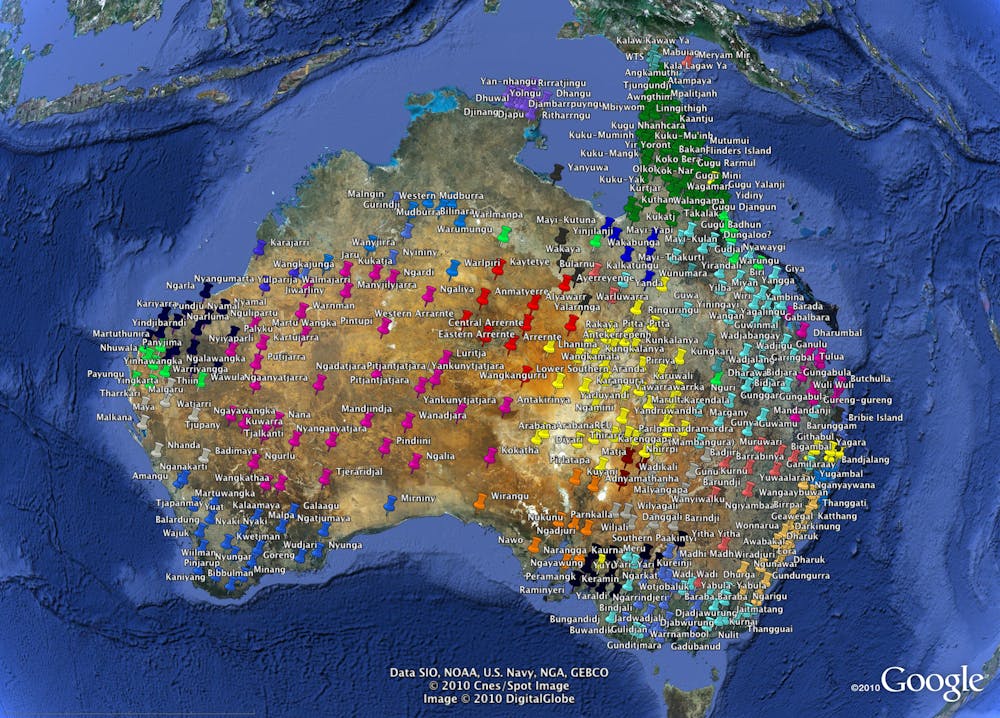
Map of Pama-Nyungan languages, coloured by their main groupings. Compiled by Claire Bowern using data from National Science Foundation grant BCS-0844550.
Tracing Pama-Nyungan
We used data from changes in several hundred words in different languages from the Pama-Nyungan family to build up a tree of languages, using a computer model adapted from those used originally to trace virus outbreaks.
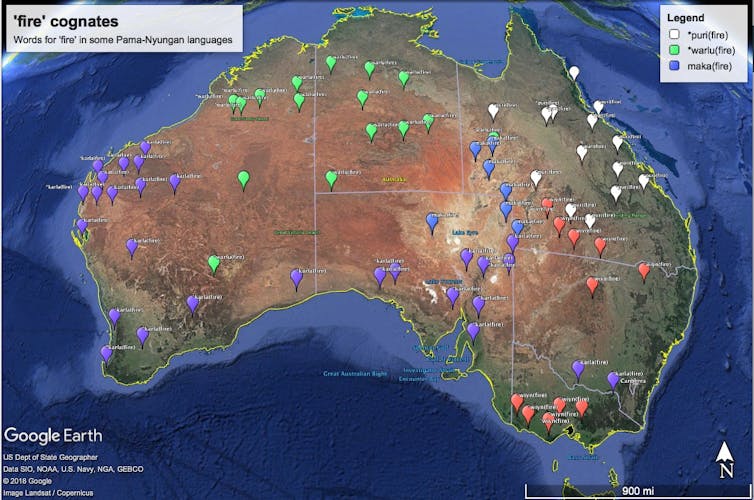
Different related words for ‘fire’ in certain Pama-Nyungan languages. Green dots show languages with a word for ‘fire’ related to *warlu; white has *puri; red has *wiyn; blue has *maka, and purple *karla. Chirila files (http://chirila.yale.edu) and google earth for base image.
Because our models make estimates of the time that it takes for words to change, as well as how words in Pama-Nyungan languages are related to one another, we can use those changes to estimate the age of the family.
We found clear support for the origin of Pama-Nyungan just under 6,000 years ago in an area around what is now the Queensland town of Burketown. We found no support for the theories that Pama-Nyungan spread earlier.
The timing of this expansion is consistent with a theory that increasingly unstable conditions caused groups of people to fragment and spread. But correlation is not causation: just because two patterns appear related, it does not mean that one caused the other.
In this case, however, we have other evidence that access to ecological resources has shaped how people migrated. We found that, in our model, groups of people moved more slowly near the coast and major waterways, and faster across deserts. This implies that populations increase where food and water are plentiful, and then spread out and fissure when resources are harder to obtain.
You can see a simulated expansion here. The spread of Pama-Nyungan languages mirrored this spread of people.
What languages tell us
Languages today tell us a lot about our past. Because languages change regularly, we can use information in them to work out who groups were talking to in the past, where they lived, who they are related to, and where they’ve moved. We can do this even in the absence of a written record and of archaeological materials.
For places like Australia, the linguistic record, though incomplete, has more even coverage across the continent than the archaeological record does. At European settlement, there were about 300 Pama-Nyungan languages. Because there are at least some records of most of them we are able to work with these to uncover these complex patterns of change.
There are approximately 145 Aboriginal languages with speakers today, including languages from outside the Pama-Nyungan family. Many of these languages, such as Dieri, Ngalia and Mangala, are spoken by only a few people, many of whom are elderly.
Other languages, however, are actively used in their communities and are learned as first languages by young children. These include the Yolŋu languages of Arnhem Land and Arrernte in Central Australia. Yet others (such as Kaurna around Adelaide) are undergoing a renaissance, gaining speakers within their communities.
Nathan B. performing “YolÅ‹u Land” using English and YolÅ‹u Matha.
Finally, though not the focus of our study, there are also new languages, such as Kriol spoken across Northern Australia, Palawa Kani in Tasmania, and Gurindji Kriol. Many Aboriginal and Torres Strait Islanders also know English, and most Indigenous Australians are multilingual.
 Without records of all these languages, and without ongoing work to support speakers and communities, we aren’t able to do research like this, and Australia loses a vital link to its history. After all, European settlement of Australia is a tiny chunk of the time people have lived on this land.
Claire Bowern, Professor of Linguistics, Yale University
This article was originally published on The Conversation. Read the original article.


