


from The Conversation
— this post authored by Evita March, Federation University Australia
When it comes to presenting yourself online – such as your profile pic for Facebook or even Tinder – which type of photo do you chose? The selfie you’ve taken after careful consideration of lighting, hair and maybe makeup? (No doubt, you look great!) Or the group photo with friends, possibly less styled, but that captures a moment among peers?

Please share this article – Go to very top of page, right hand side, for social media buttons.
It might come as a surprise that it’s the group photo will make you look more attractive – it’s a phenomenon known as the “cheerleader effect”.
The cheerleader effect is real, but perhaps not for the reasons you think. The group shot with friends may indeed communicate you are sociable and friendly, but this is not what is making you more attractive.
The real explanation boils down to how human brains deal with information.
Read more: Women troll on dating apps just as often as men
Give me an E! For evidence
First popularised by the television series How I Met Your Mother, the character Barney Stinson uses the term cheerleader effect to describe a woman appearing attractive when in a group, but not as an individual.

Cheerleaders like to hang out in groups. dwilliss/flickr, CC BY
His interpretation was typical of American sitcoms, but Barney’s comments are founded in research.
In 2003, scientific evidence of the cheerleader effect was published in a paper where across five studies, both males and females were rated more attractive when presented as part of a group photo compared to a solo photo. The authors, Drew Walker and Edward Vul, presented 130 participants with group photographs containing three female faces or three male faces. Each face was then cropped from the photograph and presented individually.
Participants rated the attractiveness of faces presented in a group and individually. Regardless of gender, attractiveness ratings were higher when people were presented in a group compared to presented individually.
However, this does not mean the bigger the group – the more attractive you are. The authors found that group size, whether 4, 9, or 16 individuals, had no effect on attractiveness ratings. Basically, a handful of friends is all you need to take advantage of this effect.
Importantly, studies have shown the cheerleader effect to be reliable. Additional studies published in 2015 and one just this month continue to find a groups’ attractiveness is significantly higher than the attractiveness of an individual group member.
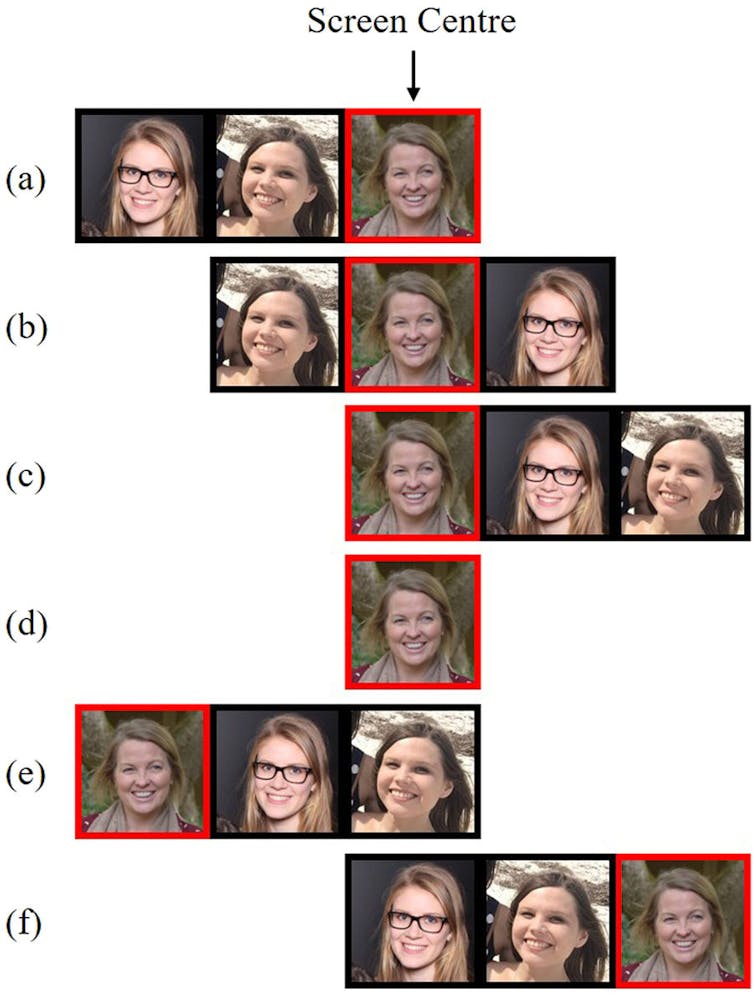
Studies exploring the cheerleader effect ask study participants to rank attractiveness of different individuals alone or with other people. Daniel J. Carragher, Blake J. Lawrence, Nicole A. Thomas & Michael E. R. Nicholls, CC BY
Give me a B! For brain
The robustness of the cheerleader effect is best explained by looking at how your brain works, and understanding perception.
Humans tend not to process every individual detail they perceive in their environment. Instead of devoting significant attention to all individual characteristics, our brain quickly summarises the information as a group. Evidence even suggests that our brains may be wired for such categorisation.
Grouping perceptual information has a distinct evolutionary advantage, enhancing survival by reducing perceptual load (the burden of interpreting a scene from visual information).
This perceptual effect is best demonstrated with the Ebbinghaus Illusion.
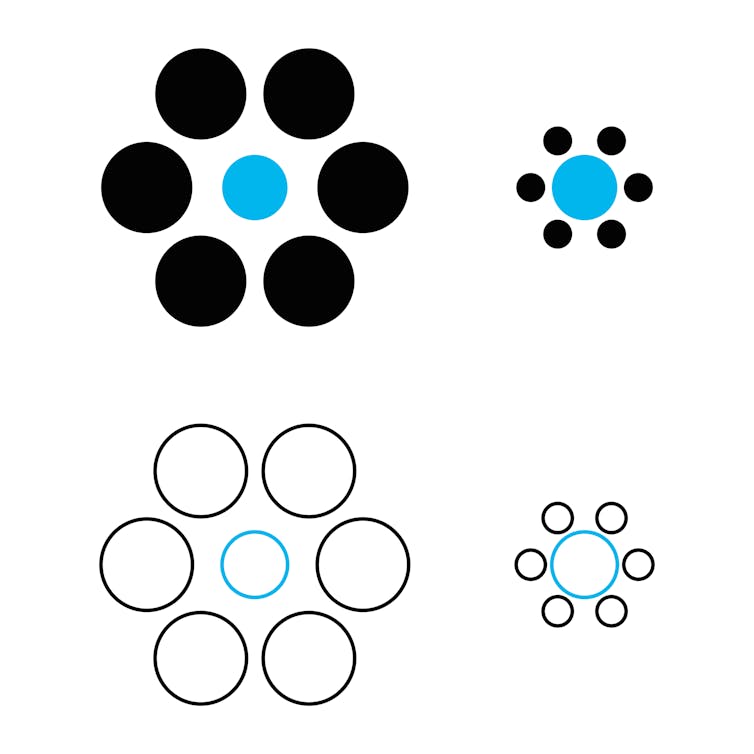
Ebbinghaus Illusion: the two blue circles are exactly the same size – however, the one on the right appears larger. from www.shutterstock.com
In this illusion, the inside circles are identical in size, yet the surrounding information (i.e., surrounding circles) alters our perception. Here, rather than focusing on the individual characteristics of the inside circles, our perception is altered by the group information. This is known as top-down processing, where the whole element is perceived before individual characteristics. This is in contrast to bottom-up processing, where there is progression from the individual characteristics to the whole.
Read more: Three visual illusions that reveal the hidden workings of the brain
The same characteristics of this illusion extend to the cheerleader effect. In this effect, rather than attend to individual characteristics, we focus on the group as a whole.
Such an effect can even be applied to explain social biases. Social categorisation is the process of mentally categorising individuals into groups based on characteristics such as age, sex, and ethnicity. This quick categorisation of social information promotes fast social interactions – but has some serious and broader consequences.
Give me a D! For dating
The evidence suggests that presenting yourself with a group will tend to average out any “unattractive” individual characteristics. So, how can you use this information to your advantage?
Well, you can apply this information when selecting a profile picture. Perhaps you’re seeing someone new, and suspect they could be doing a little Facebook research on you. Select a profile picture of you and a few friends for maximum attractiveness. Bonus – group pictures can also demonstrate that you’re social.
Maybe you’re heading out to the pub to meet the local singles? Don’t forget your “wing” men/women (ideally a group of 4!).
And if you’re online dating, how about including some pictures of you and a few friends in your profile? However, remember to label yourself in the photo to avoid users finding your group photo attractive but moving on because they can’t figure out who in the photo you are.
Give me a B! For Barney
You might not agree with everything Barney Stinson says, but on the question of the cheerleader effect he was broadly right.


Evita March, Lecturer of Psychology, Federation University Australia
This article was originally published on The Conversation. Read the original article.


