


from The Conversation
— this post authored by Thomas Kitching, University College London
Something wonderful happened about 13.8 billion years ago. Everything in the universe was created in an instant as an infinitesimally small point of energy: the Big Bang. We know that this event happened, as the universe is constantly expanding and galaxies are moving away from us. The more we peer into the past, the smaller it gets – that’s how we know it must have once been infinitesimally small, and that there must have been a beginning.

Please share this article – Go to very top of page, right hand side, for social media buttons.
But of course there weren’t any humans around to see how it all started. What would it have been like – what would we have seen and felt? Now new research posted on the open science repository ArXiv, has investigated the amount of light available in the newborn universe to offer some clues.
The universe may seem dark and cold now, but there is a lot of light around. Humans can see some of this, but there’s also light at frequencies that we can’t see. The night sky, for example, appears dark but in fact glows at a frequency of light invisible to human eyes. Still, we can see this light using microwave detectors and it is a light that fills space and is practically exactly the same wherever we look.
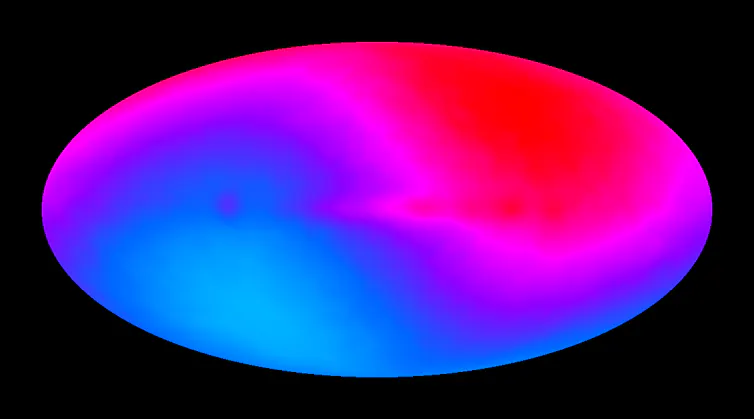
The night sky in microwaves. COBE Satellite view of the current microwave sky, in false colour and uncorrected for the motion of the sun about our galaxy.
The light that fills space now only warms the universe to on average 2.7 degrees above absolute zero – or -270°C. In the future, as the universe continues to expand at an ever-increasing rate, the light will dilute away and the cosmic weather forecast predicts that the temperature will slowly approach the coldest possible temperature of -273°C.
However, run the clock back and it turns out that we arrived here from much warmer climes. In the past, when the universe was smaller and more compressed, the light that filled space was squeezed to higher frequencies and hotter temperatures.
Almost everyone has experienced the physics behind this cooling: when you use a spray can of deodorant it feels cold because the gas has cooled as it expands. This is similar to what happened to the light in the universe as it expanded. That means that if we go all the way and start at the beginning we’ll find that the night sky would have looked and felt very different to what we are now so familiar with.
… and there was light
In the Big Bang, space was suffused with light. A fraction of a second after the event, the universe was over a million trillion times smaller than an atom. It was also hot: a septillion (one followed by 24 zeroes) times hotter than the centre of the sun.
From this small and hot beginning, the expansion and cooling started. In this early stage, the universe was extremely bright and at frequencies of light that humans cannot see. There were no stars, only a uniform and formless soup of particles. In opening your eyes to the night sky – if such a thing were possible in the moment before you burned up – you would have been instantly blinded by the intensity of the light (even light outside visible frequencies can harm our eyes).
Big Bang animation.
This would have been the case until the universe became tolerable to human eyes after about 1.2m years. At this point, there were atoms around. They began to form about 370,000 years after the Big Bang. This may seem like a long time, but it isn’t really when you consider that the universe is nearly 14 billion years old. At this time, the sky would have glowed with the colour and temperature of a candle (the hottest part of a candle is 1,400°C). So while we could have read by the light of the night sky, we would still have been burnt to a crisp while doing so.
The sky would have glowed, slowly becoming dimmer and redder for another 4.6m years, before finally becoming black to human eyes. There were still no stars, so the night sky would have been uniformly and totally dark. However it would have still been very hot and baked any human observer with heat like a very hot oven.
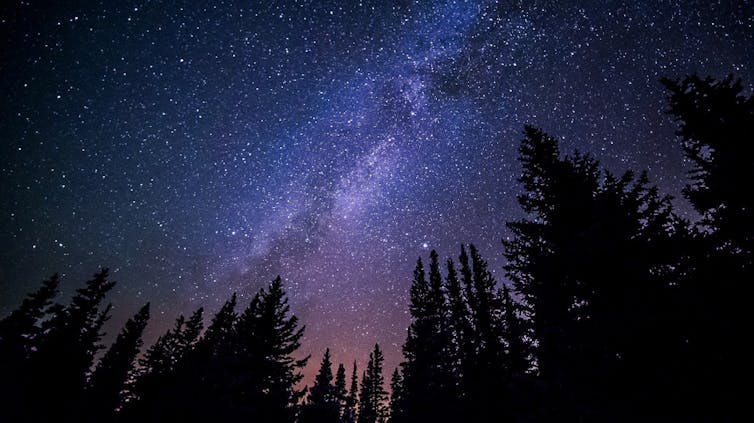
Familiar view: the Milky Way.
As the universe continued to expand, the sky would have remained dark but the temperature would have become more tolerable. It would take another 4.3m years, until the universe was about 10m years old, for the temperature to become bearable – about the same as a sauna. Then another 1m years to reach the temperature of a nice cup of tea, or a warm bath.
You could have worn summer clothes for another 5m years, but it would have started to get a bit chilly around 15m years after the Big Bang, and a jumper would be required. Freezing temperatures – minus figures – began at about 16m years. After about 110m years, the universe had cooled to the temperature of liquid nitrogen.
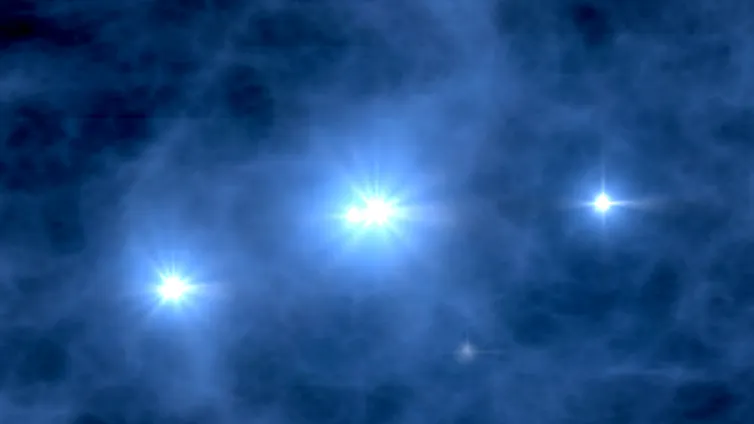
The first stars in the universe turned on about 400m years after the Big Bang. Animation frame by WMAP.
 But if you could have somehow survived these freezing temperatures and an ever cooling universe, then after about 150m years the night sky would have changed. From its uniform and formless beginnings, matter was slowly clumping together, because of gravity, in the dark. In the clumps of matter, a twinkling would have appeared and, at least in some small patches, like the one we now live in, light and warmth returned for a second time. This was when the first stars began to form, and our familiar night sky was born.
Thomas Kitching, Reader in Astrophysics, UCL
This article was originally published on The Conversation. Read the original article.


