


from The Conversation
— this post authored by Darren Griffin and Peter Ellis, University of Kent
The Y chromosome may be a symbol of masculinity, but it is becoming increasingly clear that it is anything but strong and enduring. Although it carries the “master switch” gene, SRY, that determines whether an embryo will develop as male (XY) or female (XX), it contains very few other genes and is the only chromosome not necessary for life. Women, after all, manage just fine without one.

Please share this article – Go to very top of page, right hand side, for social media buttons.
What’s more, the Y chromosome has degenerated rapidly, leaving females with two perfectly normal X chromosomes, but males with an X and a shrivelled Y. If the same rate of degeneration continues, the Y chromosome has just 4.6m years left before it disappears completely. This may sound like a long time, but it isn’t when you consider that life has existed on Earth for 3.5 billion years.
The Y chromosome hasn’t always been like this. If we rewind the clock to 166m years ago, to the very first mammals, the story was completely different. The early “proto-Y” chromosome was originally the same size as the X chromosome and contained all the same genes. However, Y chromosomes have a fundamental flaw. Unlike all other chromosomes, which we have two copies of in each of our cells, Y chromosomes are only ever present as a single copy, passed from fathers to their sons.
This means that genes on the Y chromosome cannot undergo genetic recombination, the “shuffling” of genes that occurs in each generation which helps to eliminate damaging gene mutations. Deprived of the benefits of recombination, Y chromosomal genes degenerate over time and are eventually lost from the genome.
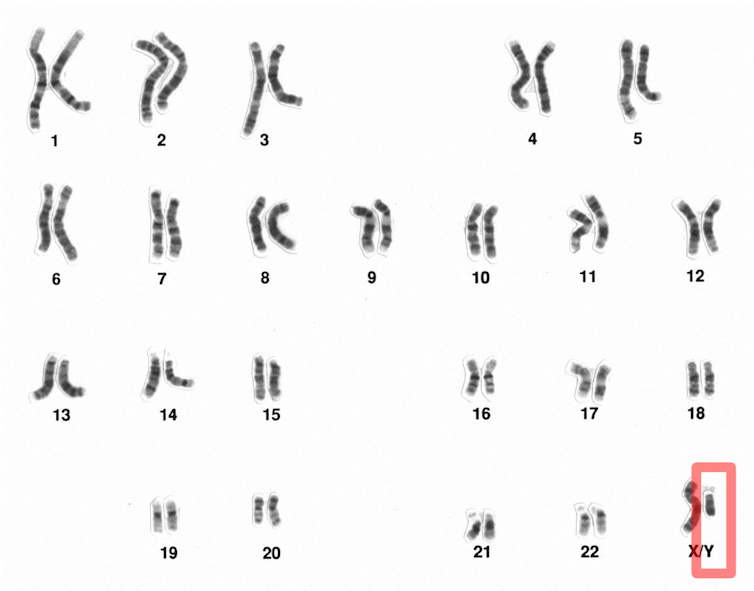
Chromosome Y in red, next to the much larger X chromosome. National Human Genome Research Institute
Despite this, recent research has shown that the Y chromosome has developed some pretty convincing mechanisms to “put the brakes on”, slowing the rate of gene loss to a possible standstill.
For example, a recent Danish study, published in PLoS Genetics, sequenced portions of the Y chromosome from 62 different men and found that it is prone to large scale structural rearrangements allowing “gene amplification” – the acquisition of multiple copies of genes that promote healthy sperm function and mitigate gene loss.
The study also showed that the Y chromosome has developed unusual structures called “palindromes” (DNA sequences that read the same forwards as backwards – like the word “kayak”), which protect it from further degradation. They recorded a high rate of “gene conversion events” within the palindromic sequences on the Y chromosome – this is basically a “copy and paste” process that allows damaged genes to be repaired using an undamaged back-up copy as a template.
Looking to other species (Y chromosomes exist in mammals and some other species), a growing body of evidence indicates that Y-chromosome gene amplification is a general principle across the board. These amplified genes play critical roles in sperm production and (at least in rodents) in regulating offspring sex ratio. Writing in Molecular Biology and Evolution recently, researchers give evidence that this increase in gene copy number in mice is a result of natural selection.
On the question of whether the Y chromosome will actually disappear, the scientific community, like the UK at the moment, is currently divided into the “leavers” and the “remainers”. The latter group argues that its defence mechanisms do a great job and have rescued the Y chromosome. But the leavers say that all they are doing is allowing the Y chromosome to cling on by its fingernails, before eventually dropping off the cliff. The debate therefore continues.
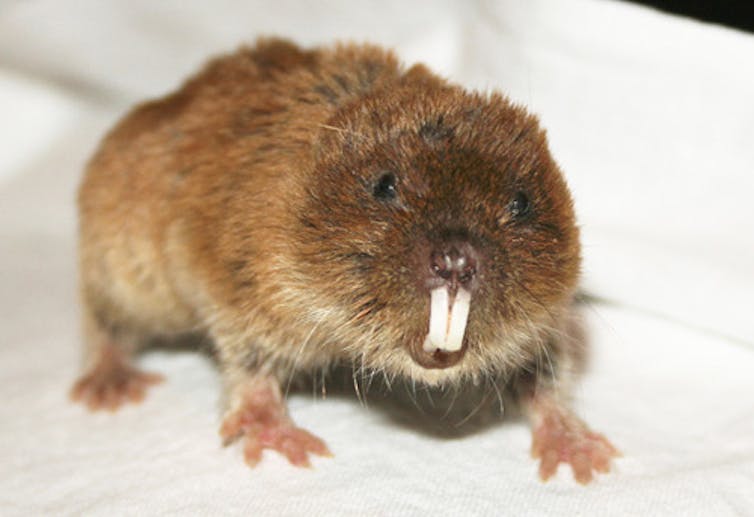
Mole voles have no Y chromosomes. wikipedia
A leading proponent of the leave argument, Jenny Graves from La Trobe University in Australia, claims that, if you take a long-term perspective, the Y chromosomes are inevitably doomed – even if they sometimes hold on a bit longer than expected. In a 2016 paper, she points out that Japanese spiny rats and mole voles have lost their Y chromosomes entirely – and argues that the processes of genes being lost or created on the Y chromosome inevitably lead to fertility problems. This in turn can ultimately drive the formation of entirely new species.
The demise of men?
As we argue in a chapter in a new e-book, even if the Y chromosome in humans does disappear, it does not necessarily mean that males themselves are on their way out. Even in the species that have actually lost their Y chromosomes completely, males and females are both still necessary for reproduction.
In these cases, the SRY “master switch” gene that determines genetic maleness has moved to a different chromosome, meaning that these species produce males without needing a Y chromosome. However, the new sex-determining chromosome – the one that SRY moves on to – should then start the process of degeneration all over again due to the same lack of recombination that doomed their previous Y chromosome.
However, the interesting thing about humans is that while the Y chromosome is needed for normal human reproduction, many of the genes it carries are not necessary if you use assisted reproduction techniques. This means that genetic engineering may soon be able to replace the gene function of the Y chromosome, allowing same-sex female couples or infertile men to conceive. However, even if it became possible for everybody to conceive in this way, it seems highly unlikely that fertile humans would just stop reproducing naturally.
Although this is an interesting and hotly debated area of genetic research, there is little need to worry. We don’t even know whether the Y chromosome will disappear at all. And, as we’ve shown, even if it does, we will most likely continue to need men so that normal reproduction can continue.
 Indeed, the prospect of a “farm animal” type system where a few “lucky” males are selected to father the majority of our children is certainly not on the horizon. In any event, there will be far more pressing concerns over the next 4.6m years.
Darren Griffin, Professor of Genetics, University of Kent and Peter Ellis, Lecturer in Molecular Biology and Reproduction, University of Kent
This article was originally published on The Conversation. Read the original article.


