


from The Conversation
— this post authored by Beth Hewitt, University of Salford
Every time you go online, people are competing for your attention. Friends, strangers, businesses, political organisations, charities and news websites all serve up a constant stream of eye-catching pictures, videos and articles, wherever you might go looking for information – Google, Twitter, Facebook, Snapchat, Instagram or YouTube.

Please share this article – Go to very top of page, right hand side, for social media buttons.
But in the race to catch your eye, not all of these players feel like they have to tell the truth – and you can’t always rely on social media platforms to filter out the falsehoods. The result is fake news: stories that are specially designed to mislead or deliberately misinform people.
Over the past six months, I’ve been part of a team of researchers and producers from the University of Salford and CBBC Newsround working to understand the impact of fake news on young people living in the UK.
We spoke to 300 young people between nine and 14 years old, to discover how they deal with fake news in their everyday lives, and the impact it has on them as they are growing up.
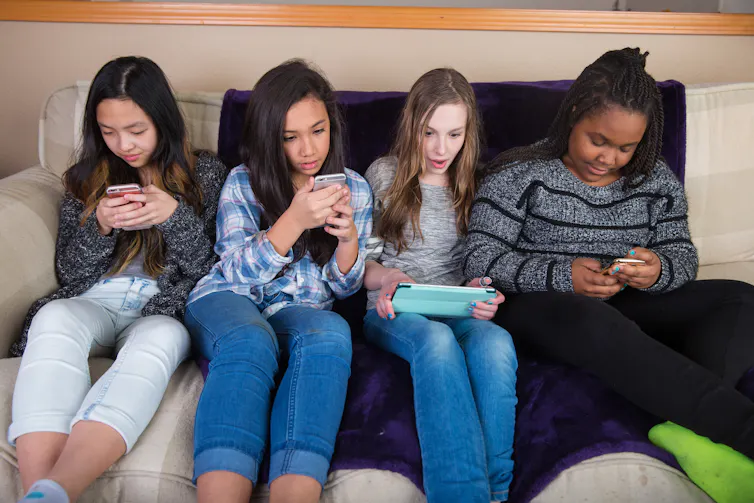
Don’t believe everything you see on your smartphone. from www.shutterstock.com
The results were very complicated, but we discovered that young people urgently need tools to help them navigate the murky waters of social media. Above all, we found that young people need to be able to trust what they hear and see around them as they’re growing up.
If young people don’t believe what they’re reading is true, then their trust will be eroded – and then they could stop believing anything at all. In the long run this means they won’t care about being part of big debates about politics, culture and the society in which they live.
The fake news spectrum
There is a spectrum of fake news: from truly absurd and unbelievable stories, which are easily identified as fake news, to more subtle types of misinformation, which are more difficult to detect.

This second, covert type of fake news comes in the form of editorials, advertorials and stories that go viral across the web. These stories aren’t necessarily absurd or obviously wrong, but they do contain factual untruths or misleading images, put in there deliberately to distort the truth.
Tips and tools
But there are ways that young people can tell the difference between real news and fake news, to help them understand what’s really going on, in a world where smart phones and digital devices have become an extension of our hands, eyes, ears and brains.
- Find out about the source. Look at the website where the story comes from to see if the story is well-presented, if the images are clear, and if the text is written well and without any spelling errors or exaggerated language. If you’re not sure, try clicking on the “about us” section, and check that there’s a clear outline explaining the work of the organisation and its history.
- Look at the author. To check if they are real, reliable and “trustworthy”, look for other pieces they have written and what outlets they have written for. If they haven’t written anything else, or if they write for websites that look unreliable, think twice about believing what they say.
- Check that the article contains references and links to other news stories, articles and authors. Click on the links and check if they seem reliable and trustworthy.
- Do a Google Reverse Image Search. This is an excellent tool, which allows you to search Google by images, rather than words. It’s simple; all you have to do is upload a picture onto the Google Reverse Image Search site and you will see all the other web pages that have similar images. This then tells you the other sites where the images have been used – and if they’ve been used out of context.
- See if the story you are reading about is being shared on any other mainstream news outlets, such as BBC News or Sky News. If it is, then you can feel more sure that the story is not fake, because these organisations take special care to check their sources and very rarely publish a story without having a second source to back it up.
It’s really important to avoid sharing stories that you are unsure about. If you are in any doubt about whether it is real or fake, discuss it with a friend or a family member to find out what they think about the story.
The power is yours
Our research showed that young people who get to talk about fake news – what it is, and what it means – are much better at finding out whether news is real or fake. This means it’s important for schools to start teaching young people how to understand information they find online.
Lessons should be given on how search engines work, where online links lead and how to check whether a story is reliable using information from other sites and what accountability and accuracy mean, in the context of online news.
 Knowing these things about online news, and being able to apply them in everyday life will give you control over what news you read and which stories you choose to share. You will be the heroes fighting for good journalism, so we’re depending on you to help fact win out over fiction, and get real news to rise above fake news.
Beth Hewitt, Senior Lecturer in Media Practice, University of Salford
This article was originally published on The Conversation. Read the original article.


