


from The Conversation
— this post authored by Kathryn Adamson, Manchester Metropolitan University
The largest wildfire ever recorded in Greenland was recently spotted close to the west coast town of Sisimiut, not far from Disko Island where I research retreating glaciers. The fire has captured public and scientific interest not just because its size and location came as a surprise, but also because it is yet another signpost of deep environmental change in the Arctic.

Please share this article – Go to very top of page, right hand side, for social media buttons.

Greenland is an important cog in the global climate system. The ice sheet which covers 80% of the island reflects so much of the sun’s energy back into space that it moderates temperatures through what is known as the “albedo effect“. And since it occupies a strategic position in the North Atlantic, its meltwater tempers ocean circulation patterns.
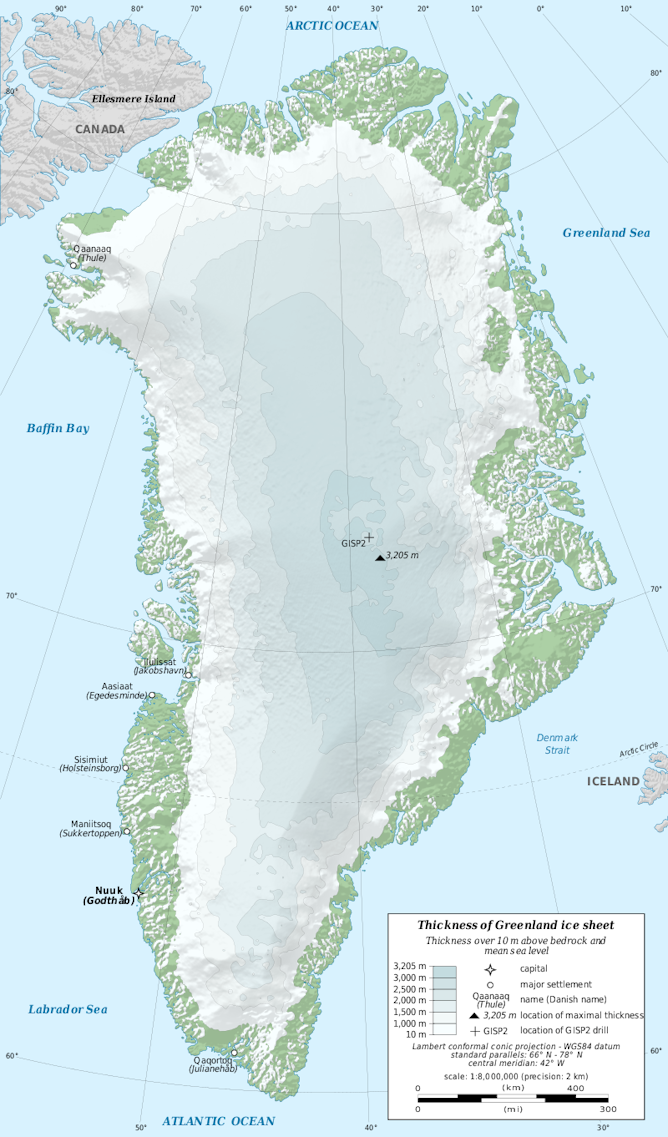
Most of Greenland is covered by more than a kilometre of ice. Eric Gaba / NGDC, CC BY-SA
But Greenland is especially vulnerable to climate change, as Arctic air temperatures are currently rising at twice the global average rate. Environmental conditions are frequently setting new records: “the warmest”, “the wettest”, “the driest”.
Despite its size, the fire itself represents only a snapshot of Greenland’s fire history. It alone cannot tell us about wider Arctic climate change.
But when we superimpose these extraordinary events onto longer-term environmental records, we can see important trends emerging.
The ice sheet is melting
Between 2002 and 2016 the ice sheet lost mass at a rate of around 269 gigatonnes per year. One gigatonne is one billion tonnes. One tonne is about the weight of a walrus.

Leave my weight out of this. BMJ / shutterstock
During the same period, the ice sheet also showed some unusual short-term behaviour. The 2012 melt season was especially intense – 97% of the ice sheet experienced surface melt at some point during the year. Snow even melted at its summit, the highest point in the centre of the island where the ice is piled up more than 3km above sea level.

Change in total mass of the Greenland Ice Sheet (in Gt) from 2002 to 2016. Red crosses indicate the values every April. NOAA
In April 2016 Greenland saw abnormally high temperatures and its earliest ever “melt event” (a day in which more than 10% of the ice sheet has at least 1mm of surface melt). Early melting doesn’t usher in a period of complete and catastrophic change – the ice won’t vanish overnight. But it does illustrate how profoundly and rapidly the ice sheet can respond to rising temperatures.
Permafrost is thawing
Despite its icy image, the margins of Greenland are actually quite boggy, complete with swarms of mosquitoes. This is the “active layer”, made up of peaty soil and sediment up to two metres thick, which temporarily thaws during the summer. The underlying permafrost, which can reach depths of 100m, remains permanently frozen.

Fighting off the mosquitos in boggy Greenland. Kathryn Adamson, Author provided
In Greenland, like much of the Arctic, rising temperatures are thawing the permafrost. This means the active layer is growing by up to 1.5cm per year. This trend is expected to continue, seeing as under current IPCC predictions, Arctic air temperatures will rise by between 2.0°C and 7.5°C this century.
Arctic permafrost contains more than 1,500 billion tonnes of dead plants and animals (around 1,500 billion walrus equivalent) which we call “organic matter”. Right now, this stuff has been frozen for thousands of years. But when the permafrost thaws this organic matter will decay, releasing carbon and methane (another greenhouse gas) into the atmosphere.
If thawing continues, it’s estimated that by 2100 permafrost will emit 850-1,400 billion tonnes of COâ‚‚ equivalent (for comparison: total global emissions in 2012 was 54 billion tonnes of COâ‚‚ equivalent). All that extra methane and carbon of course has the potential to enhance global warming even further.
With this in mind, it is clear to see why the recent wildfire, which was burning in dried-out peat in the active layer, was especially interesting to researchers. If Greenland’s permafrost becomes increasingly degraded and dry, there is the potential for even bigger wildfires which would release vast stores of greenhouse gases into the atmosphere.
Species are adapting to a changing ecosystem
Major changes in the physical environment are already affecting the species that call Greenland home. Just look at polar bears, the face of Arctic climate change. Unlike other bears, polar bears spend most of their time at sea, which explains their Latin name Ursus maritimus. In particular they rely on sea ice as it gives them a deep-water platform from which to hunt seals.
However, since 1979 the extent of sea ice has decreased by around 7.4% per decade due to climate warming, and bears have had to adjust their habitat use. With continued temperature rise and sea ice disappearance, it’s predicted that populations will decline by up to 30% in the next few decades, taking the total number of polar bears to under 9,000.

Where are you, seals? Mario_Hoppmann / shutterstock
I have considered only a handful of the major environmental shifts in Greenland over the past few decades, but the effects of increasing temperatures are being felt in all parts of the earth system. Sometimes these are manifest as extreme events, at others as slow and insidious changes.
 The different parts of the environmental jigsaw interact, so that changes in one part (sea ice decline, say) influence another (polar bear populations). We need to keep a close eye on the system as a whole if we are to make reliable interpretations – and meaningful plans for the future.
Kathryn Adamson, Senior Lecturer in Physical Geography, Manchester Metropolitan University
This article was originally published on The Conversation. Read the original article.


