


from Lakshman Achuthan, Co-Founder and Chief Operations Officer of ECRI
The cyclical strength in Japanese GDP is being taken by some as a vindication of Abenomics, which was meant to end years of low growth and deflation through a three-pronged approach: monetary easing, fiscal stimulus,and a series of broad structural reforms. Although its impact on inflation has been fleeting,one aspect of Abenomics – the so-called womenomics – has seen some modest success.

Womenomics attempted to counter some of the massive demographic challenges brought on by Japan’s rapidly aging society by bringing more women into the workforce. Under the slogan, “women shine,” policies were implemented to bring women into the labor force and to incentivize companies to hire them. Those policy measures clearly had some impact, with the female labor force increasing by more than 6% since late 2012.
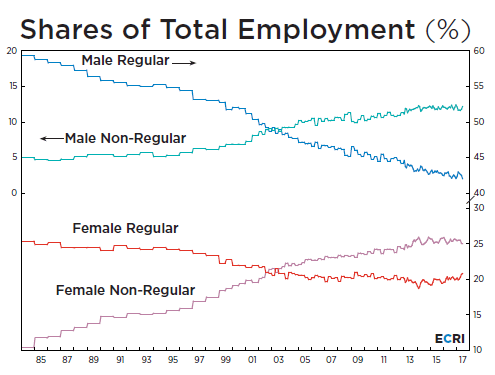
Unfortunately, even with this success consumer prices have not increased as much as many had expected. This is likely related to a long-term shift in the Japanese labor market away from regular employment, towards non-regular employment (chart). While regular employment generally implies a stable job with benefits and regular pay raises, non-regular jobs are typically either part-time or temporary, paying much lower salaries without benefits.
The shift from regular to non-regular employment has happened for both men and women. For men, however, the decline in regular employment has been particularly sharp, from nearly 60% in the mid-1980s to just over 40% in 2017, while the share of male non-regular employees more than doubled, from only 5% to just over 12% (upper panel).
Since the share of women with regular jobs had been much lower to begin with, its decline has been much shallower; moreover, with womenomics, it has been showing a hint of improvement in the past couple of years. Meanwhile, the rise in the share of female non-regular employees has been quite significant, so much so that, by late 2002, more women were employed in non-regular than regular positions, with the gap widening until early 2014 (lower panel). There are now tentative signs that the gap may be closing a bit.
Stepping back, it is clear that the long-term shift towards lower paying, non-regular jobs has put continued downward pressure on average wages. As a result, real household disposable income has been trending down since the turn of the century (not shown).
While there is now much talk about the record-low unemployment rate putting upward pressure on wages, blindly applying Phillips-curve logic ignores the underlying realities. Since the unemployment rate was driven down by more people taking non-regular jobs, the wage pressures are seen mostly in these jobs, which pay much less to begin with. Indeed, yoy wage growth for part-time workers has turned up (not shown). In contrast, wage growth for full-time workers, who are better paid and still account for the majority of employment, has slipped recently (not shown), offsetting the wage gains seen in lower-paying jobs.
Sadly, the long-term shift to non-regular work arrangements may actually exacerbate Japan’s demographic challenges. Such jobs carry a heavy stigma in Japanese society, making it much harder for male non-regular workers to get married. In fact, a 2014 study from Japan’s Cabinet Office showed that, over their lifetimes, the proportion of men who never married was much higher for non-regular employees than for other workers, and closer to those who were unemployed. Indeed, the rise in the share of poorly-paid men – making them far less likely to become fathers – is a demographic time bomb threatening the long-term future of an economy with already-dismal demographics.


