


Written by Econintersect
Early Bird Headlines 19 July 2017
Econintersect: Here are some of the headlines we found to help you start your day. For more headlines see our afternoon feature for GEI members, What We Read Today, which has many more headlines and a number of article discussions to keep you abreast of what we have found interesting.

Please share this article – Go to very top of page, right hand side for social media buttons.
Global
- Most Asian markets gain as dollar edges up above 10-month lows; Aussie banks climb (CNBC) Asia markets were mostly higher as the dollar nursed losses after it hit 10-month lows overnight on dimmed prospects for U.S. health care reforms. The dollar index was up at 94.753 at 12:01 p.m. HK/SIN. Brent crude futures declined 0.14% to trade at $48.77 a barrel and U.S. West Texas Intermediate crude edged down 0.17% to trade at $46.32. Spot gold was nearly flat at $1,241.46 per ounce at 0408 GMT. In the previous session, it hit its highest since June 30 at $1,244.56.

- The oil price is living on borrowed time (Financial Times) Emerging market demand for oil in vehicles will dissipate faster than many expect. According to this article the last age of oil will come as the transportation revolution displaces oil’s major role as a fuel for transportation, especially in motor vehicles.

​U.S.
- Trump blames Dems, ‘a few Republicans’ for collapse of healthcare bill (The Hill) President Trump on Tuesday put blame on Democrats and “a few Republicans” for the collapse of the Senate GOP’s healthcare bill.
- US inflation decline is too persistent to ignore (Financial Times) Hat tip to Edward Harrison. The US CPI report for June, published on Friday, was the fourth successive monthly print that surprised on the low side. Initially, these inflation misses were dismissed by the Federal Reserve as idiosyncratic and temporary, but they are now becoming too persistent to ignore. If they are not reversed fairly soon, the FOMC will need to give greater weight to the possibility that inflation may not return to target over the next couple of years.


- How Silicon Valley Is Turning Itself Into Detroit (Inc.) The author argues that the resurgence of Open Plan offices is a regression to the mid-20th century Detroit automaker work configuration and will result in the same destruction of corporate campuses in the future as occurred in Detroit starting 30-40 years ago.
- Trump’s Terrific Trade War (Mauldin Economics) Patrick Watson writes:
Speaking to reporters last week, the president said China is “dumping steel and destroying our steel industry. They’ve been doing it for decades, and I’m stopping it.”
Notice the alliteration? Dumping, destroying, doing, decades. Nicely done.
In that spirit, I propose to name the collection of forthcoming tariffs and quotas, “Trump’s Terrific Trade Tempest.”
This conflict won’t end with steel, nor will it be quick. Other governments will fire back. They’re already taking aim.
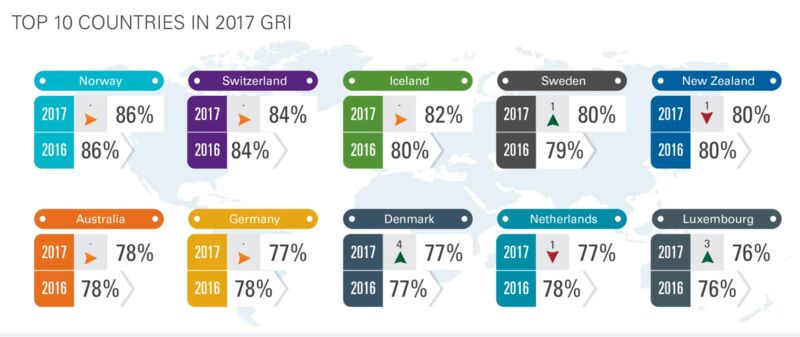
- The U.S. Falls in a Global Retirement Security Ranking (Bloomberg) Retirement security in the U.S. took a significant hit in a global ranking, falling three notches to No. 17 among 43 developed countries.
The fifth annual Global Retirement Index ranking from Natixis Global Asset Management has Norway, Switzerland, and Iceland holding on to the top three slots from 2016. The ranking creates an overall retirement security score for each country from 18 performance indicators that address finances, healthcare, material well-being, and quality of life. Countries are also ranked by those four sub-indexes.
- Top US general warns against rogue killer robots (The Hill) The second highest-ranking general in the U.S. military on Tuesday warned lawmakers against equipping the military with autonomous weapons systems that humans could lose control of and advocated for keeping the “ethical rules of war” in place. In a Senate Armed Services Committee hearing on Tuesday, Gen. Paul Selva responded to a question from Sen. Gary Peters (D-MI) about a Defense Department directive that requires a human operator to be involved in the decision-making process when it comes to taking lives with autonomous weapons systems. Selva warned lawmakers that the military should keep “the ethical rules of war in place lest we unleash on humanity a set of robots that we don’t know how to control.” Selva told the committee:
“I don’t think it’s reasonable for us to put robots in charge of whether or not we take a human life.”
- The Healthcare Bill And The Fallacy Of 18% Of GDP (Global Macro Monitor) It is probably true to say that the U.S. spends 18 percent of GDP on health care, but it is not true to say health care is 18 percent of the U.S. economy. In fact, on a value added basis health care us only 7.4 percent of U.S. GDP, smaller than the real estate sector, for example, which is now the largest subcomponent of GDP.

​UK
- Is Productivity Growth Becoming Irrelevant? (Project Syndicate) Adair Turner writes:
As the Nobel laureate economist Robert Solow noted in 1987, computers are “everywhere but in the productivity statistics.” Since then, the so-called productivity paradox has become ever more striking. Automation has eliminated many jobs. Robots and artificial intelligence now seem to promise (or threaten) yet more radical change. Yet productivity growth has slowed across the advanced economies; in Britain, labor is no more productive today than it was in 2007.
Some economists see low business investment, poor skills, outdated infrastructure, or excessive regulation holding back potential growth. Others note wide disparities in productivity between leaders and laggards among industrial manufacturers. Still others question whether information technology is really so distinctively powerful.
But the explanation may lie deeper still. As we get richer, measured productivity may inevitably slow, and measured GDP per capita may tell us ever less about trends in human welfare.
Pakistan
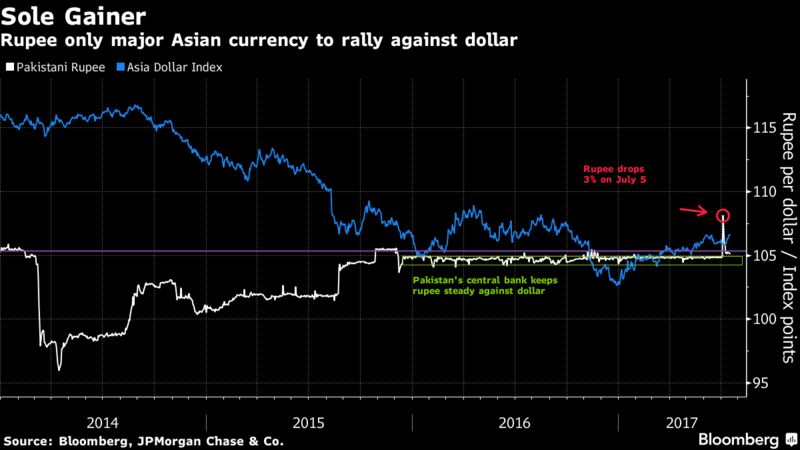
- Devaluation Risk Another Hazard for Battered Pakistan Market (Bloomberg) Signs that Pakistan, home to one of the world’s top five stock markets last year, is headed for a currency devaluation is giving investors another reason to stay away from the world’s newest emerging market. Foreign reserves are falling, the current-account deficit has more than doubled in less than a year and the benchmark KSE100 Index has lost its mojo. Now Moody’s Investors Service has joined the International Monetary Fund, which said last year the rupee is as much as 20% overvalued, in urging the central bank to abandon its grip on the currency and allow more flexibility.
Australia
- The new Department of Home Affairs is unnecessary and seems to be more about politics than reform (The Conversation) The Home Affairs model appears to stand on contestable grounds. There may be an argument to be made about potentially improving internal bureaucratic efficiencies by having power centralised under one minister. However, this is debatable. And the move upends long-standing conventions on how security intelligence and executive police powers are managed separately.
Bringing ASIO and the AFP together in one department and away from the attorney-general is a fraught move.
Multiple royal commissions and a protective security review following the Hilton Hotel bombing in February 1978 saw the police, security and intelligence functions tried and tested by fire. They were found wanting, but were then subject to significant review and reform.
That reform led to an understanding about how best to delineate and maintain the separation of powers while upholding robust accountability. That understanding has come to be broadly accepted as the best way of managing intelligence and security affairs.
Canada
- A Chinese policy instrument is buying into a Vancouver mountain, and Canadian naivete is an inadequate response (CNBC) A Chinese company with gold-plated political connections is buying into a Canadian mountain. And not just any mountain: Grouse Mountain, whose ski slopes famously look down on Vancouver.

Mexico
- Mexico: The Cactus Democracy (The Conversation) Visitors to Mexico are almost always struck by its dramatic contrasts. Here is a vast and varied, rugged and beautiful land so sparkling yet so spoiled by contradictions that it seems to be less a country and more a word for bewilderment, a place where reality is undone by the unreal.
The Chilean poet Pablo Neruda famously described Mexico as a land of deserts and hurricanes, colourful creations and violent destruction, a spellbinding place “covered in flowers and thorns”. He saw Mexico as the land of the cactus plant. So does the official symbol: a golden eagle devouring a snake perched atop a prickly pear cactus.


