


from The Conversation
— this post authored by Richard B. Rood, University of Michigan
Earth’s climate is changing rapidly. We know this from billions of observations, documented in thousands of journal papers and texts and summarized every few years by the United Nations’ Intergovernmental Panel on Climate Change. The primary cause of that change is the release of carbon dioxide from burning coal, oil and natural gas.

Please share this article – Go to very top of page, right hand side for social media buttons.
One of the goals of the international Paris Agreement on climate change is to limit the increase of the global surface average air temperature to 2 degrees Celsius, compared to preindustrial times. There is a further commitment to strive to limit the increase to 1.5℃.
Earth has already, essentially, reached the 1℃ threshold. Despite the avoidance of millions of tons of carbon dioxide emissions through use of renewable energy, increased efficiency and conservation efforts, the rate of increase of carbon dioxide in the atmosphere remains high.
International plans on how to deal with climate change are painstakingly difficult to cobble together and take decades to work out. Most climate scientists and negotiators were dismayed by President Trump’s announcement that the U.S. will withdraw from the Paris Agreement.
But setting aside the politics, how much warming are we already locked into? If we stop emitting greenhouse gases right now, why would the temperature continue to rise?
Basics of carbon and climate
The carbon dioxide that accumulates in the atmosphere insulates the surface of the Earth. It’s like a warming blanket that holds in heat. This energy increases the average temperature of the Earth’s surface, heats the oceans and melts polar ice. As consequences, sea level rises and weather changes.
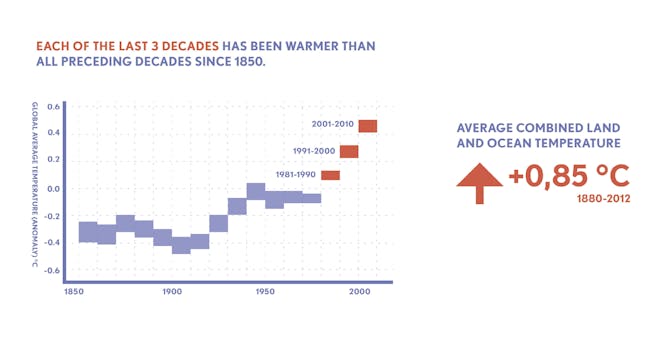
Global average temperature has increased. Anomalies are relative to the mean temperature of 1961-1990. Based on IPCC Assessment Report 5, Working Group 1. Finnish Meteorological Institute, the Finnish Ministry of the Environment, and Climateguide.fi, CC BY-ND
Since 1880, after carbon dioxide emissions took off with the Industrial Revolution, the average global temperature has increased. With the help of internal variations associated with the El Niño weather pattern, we’ve already experienced months more than 1.5℃ above the average. Sustained temperatures beyond the 1℃ threshold are imminent. Each of the last three decades has been warmer than the preceding decade, as well as warmer than the entire previous century.
The North and South poles are warming much faster than the average global temperature. Ice sheets in both the Arctic and Antarctic are melting. Ice in the Arctic Ocean is melting and the permafrost is thawing. In 2017, there’s been a stunning decrease in Antarctic sea ice, reminiscent of the 2007 decrease in the Arctic.
Ecosystems on both land and in the sea are changing. The observed changes are coherent and consistent with our theoretical understanding of the Earth’s energy balance and simulations from models that are used to understand past variability and to help us think about the future.

A massive iceberg – estimated to be 21 miles by 12 miles in size – breaks off from Antarctica’s Pine Island Glacier. NASA, CC BY
Slam on the climate brakes
What would happen to the climate if we were to stop emitting carbon dioxide today, right now? Would we return to the climate of our elders?
The simple answer is no. Once we release the carbon dioxide stored in the fossil fuels we burn, it accumulates in and moves among the atmosphere, the oceans, the land and the plants and animals of the biosphere. The released carbon dioxide will remain in the atmosphere for thousands of years. Only after many millennia will it return to rocks, for example, through the formation of calcium carbonate – limestone – as marine organisms’ shells settle to the bottom of the ocean. But on time spans relevant to humans, once released the carbon dioxide is in our environment essentially forever. It does not go away, unless we, ourselves, remove it.
If we stop emitting today, it’s not the end of the story for global warming. There’s a delay in air-temperature increase as the atmosphere catches up with all the heat that the Earth has accumulated. After maybe 40 more years, scientists hypothesize the climate will stabilize at a temperature higher than what was normal for previous generations.
This decades-long lag between cause and effect is due to the long time it takes to heat the ocean’s huge mass. The energy that is held in the Earth by increased carbon dioxide does more than heat the air. It melts ice; it heats the ocean. Compared to air, it’s harder to raise the temperature of water; it takes time – decades. However, once the ocean temperature is elevated, it will release heat back to the air, and be measured as surface heating.
So even if carbon emissions stopped completely right now, as the oceans’ heating catches up with the atmosphere, the Earth’s temperature would rise about another 0.6℃. Scientists refer to this as committed warming. Ice, also responding to increasing heat in the ocean, will continue to melt. There’s already convincing evidence that significant glaciers in the West Antarctic ice sheets are lost. Ice, water and air – the extra heat held on the Earth by carbon dioxide affects them all. That which has melted will stay melted – and more will melt.
Ecosystems are altered by natural and human-made occurrences. As they recover, it will be in a different climate from that in which they evolved. The climate in which they recover will not be stable; it will be continuing to warm. There will be no new normal, only more change.
Runaway glaciers in Antarctica.
Best of the worst-case scenarios
In any event, it’s not possible to stop emitting carbon dioxide right now. Despite significant advances in renewable energy sources, total demand for energy accelerates and carbon dioxide emissions increase. As a professor of climate and space sciences, I teach my students they need to plan for a world 4℃ warmer. A 2011 report from the International Energy Agency states that if we don’t get off our current path, then we’re looking at an Earth 6℃ warmer. Even now after the Paris Agreement, the trajectory is essentially the same. It’s hard to say we’re on a new path until we see a peak and then a downturn in carbon emissions. With the approximately 1℃ of warming we’ve already seen, the observed changes are already disturbing.
There are many reasons we need to eliminate our carbon dioxide emissions. The climate is changing rapidly; if that pace is slowed, the affairs of nature and human beings can adapt more readily. The total amount of change, including sea-level rise, can be limited. The further we get away from the climate that we’ve known, the more unreliable the guidance from our models and the less likely we will be able to prepare.
It’s possible that even as emissions decrease, the carbon dioxide in the atmosphere will continue to increase. The warmer the planet gets, the less carbon dioxide the ocean can absorb. Rising temperatures in the polar regions make it more likely that carbon dioxide and methane, another greenhouse gas that warms the planet, will be released from storage in the frozen land and ocean reservoirs, adding to the problem.
If we stop our emissions today, we won’t go back to the past. The Earth will warm. And since the response to warming is more warming through feedbacks associated with melting ice and increased atmospheric water vapor, our job becomes one of limiting the warming. If greenhouse gas emissions are eliminated quickly enough, within a small number of decades, it will keep the warming manageable. It will slow the change – and allow us to adapt. Rather than trying to recover the past, we need to be thinking about best possible futures.
 This article has been updated from an original version published in December 2014, when international climate talks in Lima were laying the foundation for the 2015 Paris Agreement.
Richard B. Rood, Professor of Climate and Space Sciences and Engineering, University of Michigan
This article was originally published on The Conversation. Read the original article.


