


from The Conversation
— this post authored by Alex Dunhill, University of Leeds
Of all the species that have ever lived, more than 99% are now extinct. Most of them quietly disappeared during periods of “background extinction”, whereby a handful of species become extinct every 100,000 years or so.

Please share this article – Go to very top of page, right hand side for social media buttons.
But there were also occasions when extinction rates increased rapidly in short periods of time and wiped out a significant proportion of all life on Earth. These are known as mass extinctions. They have profoundly influenced the history of life – and many scientists now argue that we are in the midst of another one. To see if they’re right, we can look at previous occasions when large numbers of species went extinct.
Traditionally, scientists have referred to the “Big Five” mass extinctions, including perhaps the most famous mass extinction that brought about the end of the dinosaurs. This was triggered by a meteorite impact at the end of the Cretaceous period, but the other major mass extinctions were caused by phenomena originating entirely on Earth. While they are less well known, we may learn something from exploring them that could shed light on our current environmental crises.
1. The Late Ordovician

Global cooling has led to mass extinction. Mark Brennan/Flickr, CC BY-SA
This ancient crisis around 445m years ago saw two major waves of extinction, both caused by climate change associated with the advance and retreat of ice sheets in the southern hemisphere. This makes it the only major extinction to be linked to global cooling.
This extinction caused the demise of around 57% of marine genera (the taxonomic rank above the species level), including many trilobites, shelled brachiopods, and eel-like conodonts.
2. The Late Devonian
This period is now regarded as a number of “pulses” of extinction spread over 20m years, beginning 380m years ago. It saw the extinction of around 50% of marine genera; among the species killed off were many corals, trilobites, sponges and the heavily armoured fish known as placoderms. This extinction has been linked to major climate change, possibly caused by an eruption of the volcanic Viluy Traps area in modern-day Siberia. A major eruption might have caused rapid fluctations in sea levels and reduced oxygen levels in the oceans.
3. The Middle Permian
Scientists have recently discovered another event 262m years ago that rivals the “Big Five” in size. This event coincided with the Emeishan eruption in what’s now China, and is known to have caused simultaneous extinctions in the tropics and higher latitudes. In particular, there were exceptionally high extinction rates: more than 80% of species were wiped out, among them brachiopods and single-celled benthic foraminifera.
4. The Late Permian
The Late Permian mass extinction around 252m years ago dwarfs all the other events, with about 96% of species becoming extinct. This included more trilobites, corals, and whole branches of species of terrestrial animals. The extinction was triggered by a vast eruption of the Siberian Traps, a gigantic and prolonged volcanic event that covered much of modern day Siberia, which led to a cascade of environmental effects.
A greenhouse effect rapidly took hold in the atmosphere, while the oceans suffered acidification and oxygen depletion. The ozone layer was partially destroyed, meaning lethal levels of UV radiation reached the Earth’s surface. The recovery took almost 10m years and even then, the unstable environment this catastrophic crisis created meant the subsequent Triassic period saw intermittent bursts of heightened extinction.
5. The Late Triassic
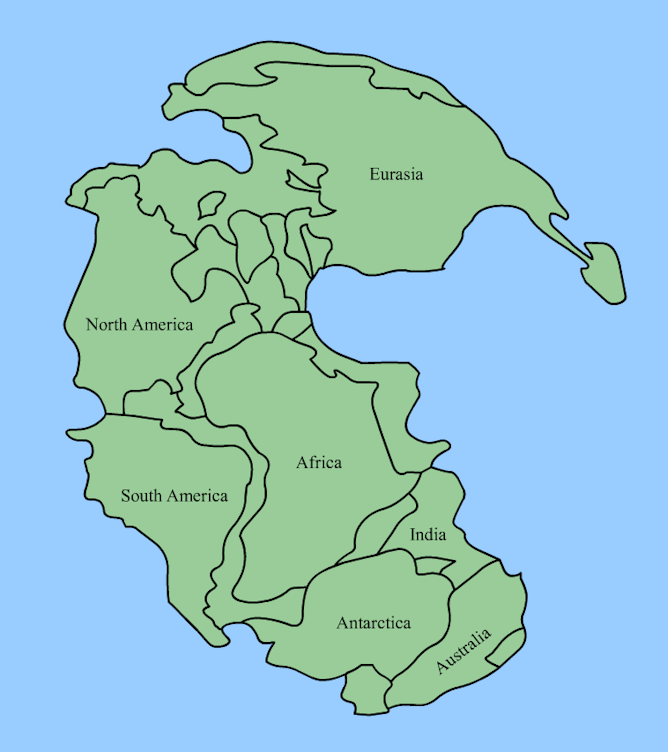
The supercontinent Pangaea before it split. Wikimedia Commons, CC BY-SA
The Late Triassic event, 201m years ago, shares a number of similarities with the Late Permian event. It was caused by another large-scale eruption, this time of the Central Atlantic Magmatic Province, which heralded the splitting of the supercontinent Pangaea and the initial opening of what would later become the Atlantic Ocean.
A similar cascade of environmental effects, as seen during the Late Permian, led to the extinction of around 47% of all genera. The extinction led to the final demise of the eel-like conodonts, as well as the largest known extinction of scleractinian corals. It also wiped out a significant proportion of terrestrial reptiles and amphibians, paving the way for the diversification of the dinosaurs in the Jurassic period.
A mass extinction in slow motion
So, are we currently in the middle of a mass extinction? If we really are, this time the cause is not a meteorite impact or volcanic eruptions. It is the work of a single species: Homo sapiens. Habitat destruction and climate change from rising carbon dioxide levels has driven extinction rates to levels reminiscent of the mass extinctions of the ancient past.
The similarities between today and the past are uncanny. The majority of past extinctions are associated with carbon dioxide from volcanoes causing rapid global warming, which led to a number of environmental cascade effects. The cause may be different, but the results will be the same.
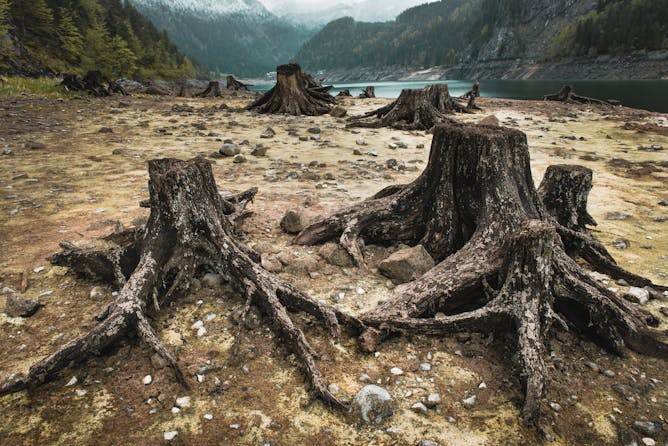
Habitat destruction fuelling the current crisis. Nina Lishchuk/Shutterstock
However, it is now 66m years since the last mass extinction. Earth’s ecosystems are very different, and perhaps more stable given the length of time elapsed since the last major biotic crisis. The position of the continents has changed, meaning atmospheric and ocean circulation are different; that makes it very difficult to use past data to predict the outcomes of any future mass extinctions.
Current extinction rates are 50 times higher than expected background rates, suggesting that another mass extinction event is underway. But mass extinctions are also about magnitude: if we could travel millions of years into the future and examine rocks preserving today’s ecosystems, I’d wager we’d see little evidence of a major extinction event.
 If we can stop the biodiversity decline in the near future, we may yet escape mass extinction. But 100 or 1,000 years more of human-caused stress on the biosphere will likely tip us over the edge into oblivion.
Alex Dunhill, Research Fellow in Palaeobiology, University of Leeds
This article was originally published on The Conversation. Read the original article.


