


from the St Louis Fed
— this post authored by Maximiliano Dvorkin and Hannah Shell
Over the past several decades, the skill composition of the U.S. labor market has shifted. Employers are hiring more workers to perform nonroutine types of tasks (such as managerial work, professional services and personal care) and fewer workers for routine operations (such as construction and manufacturing). This shift in the type of skills in demand is referred to as job polarization.

One way to see evidence of job polarization is to look at employment growth in certain occupational classifications. The figure below divides occupational employment growth into four groups:
Cognitive Nonroutine: managers, computer scientists, architects, artists, etc.
Manual Nonroutine: food preparation, personal care, retail, etc.
Cognitive Routine: office and administrative, sales, etc.
Manual Routine: construction, manufacturing, production, etc.

The black lines represent the average growth rate across all occupations within a group, while the bars represent the growth rate in that particular occupation.
The fastest growing occupational groups are cognitive nonroutine and manual nonroutine, both growing about 2 percent every year on average since the 1980s. Cognitive routine and manual routine occupations are growing significantly slower, less than 1 percent on average (or shrinking, in the case of production occupations).
Physical Demands of Work
One of the implications of job polarization is a shift in the type of work required to be performed by the average employee. A new survey from the Bureau of Labor Statistics – the Occupational Requirements Survey – gathers data on the type of work performed in each occupation.
The figure below looks at two physical task requirements:
The percentage of hours in an eight-hour day spent standing or walking
The percentage of workers required to perform pushing or pulling tasks with one or both hands
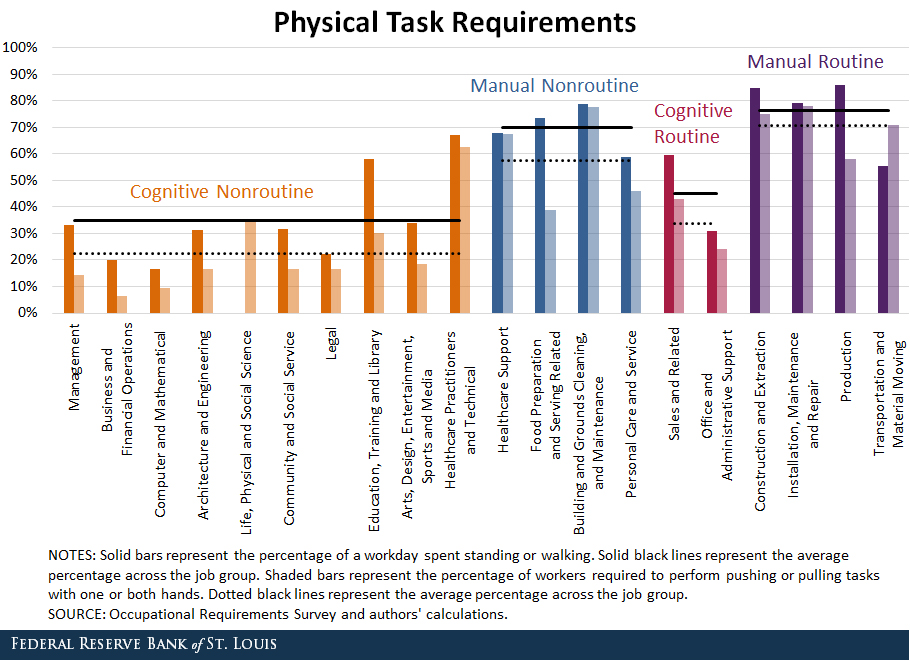
The most physically demanding occupational groups are manual nonroutine and manual routine. In both of these groups, on average more than half of the employees are required to push or pull with their hands, and over half of their day is spend standing or walking.
In contrast, less than 35 percent of workers in the cognitive nonroutine and cognitive routine groups push or pull with their hands. These groups also spend much less time standing/walking.
Decision-Making at Work
The last figure looks at two cognitive task requirements:
The percentage of workers where decision-making in uncertain situations or conflict is required
The percentage of workers whose supervision is based on broad objectives and review of results
These requirements are easier to think about in terms of a spectrum. For example, occupations that require less cognitive activity either lack decision-making entirely or involve straightforward decisions from a predetermined set of choices.
Similarly, occupations with a greater cognitive requirement usually involve broad objectives with end-result review only, while more manual occupations require detailed instructions and frequent interactions with supervision (for example, a consultant’s quarterly performance review versus daily quality control checks in a factory).

By a large margin, the cognitive nonroutine occupations involve more challenging decision-making and less frequent interactions with supervision. The other occupational groups all have fewer than 10 percent of employees engaging in these types of cognitive tasks.
Job Growth According to Skill Requirements
The figures above show a stark contrast between the skill requirements in the two occupational groups growing the fastest. The cognitive nonroutine group requires complex decision-making, independent working conditions and less physical effort, while the manual nonroutine group still requires quite a bit of physical effort and does not involve a high level of cognitive tasks.
This difference results in a polarization in the labor market, between skilled employees capable of performing the challenging tasks in the cognitive nonroutine occupations and entry-level employees that are physically strong enough to perform the manual nonroutine tasks.
Additional Resources
On the Economy: Jobs Involving Routine Tasks Aren’t Growing
On the Economy: What Is the Impact of Chinese Imports on U.S. Jobs?
On the Economy: What Is the Informal Labor Market?
Source
https://www.stlouisfed.org/on-the-economy/2017/may/growing-skill-divide-us-labor-market
Disclaimer
Views expressed are not necessarily those of the Federal Reserve Bank of St. Louis or of the Federal Reserve System.


