


from the St Louis Fed
— this post authored by Guillaume Vandenbroucke
The decision to have a child can be a costly decision. So are there any reasons to believe that economic considerations play a role in deciding to have children?

The figure below shows the relationship between fertility (more specifically, the total fertility rate) and gross domestic product (GDP) per capita (measured in 2010 U.S. dollars) across countries in 2000. The total fertility rate is the expected number of births a woman would have over the course of her life.
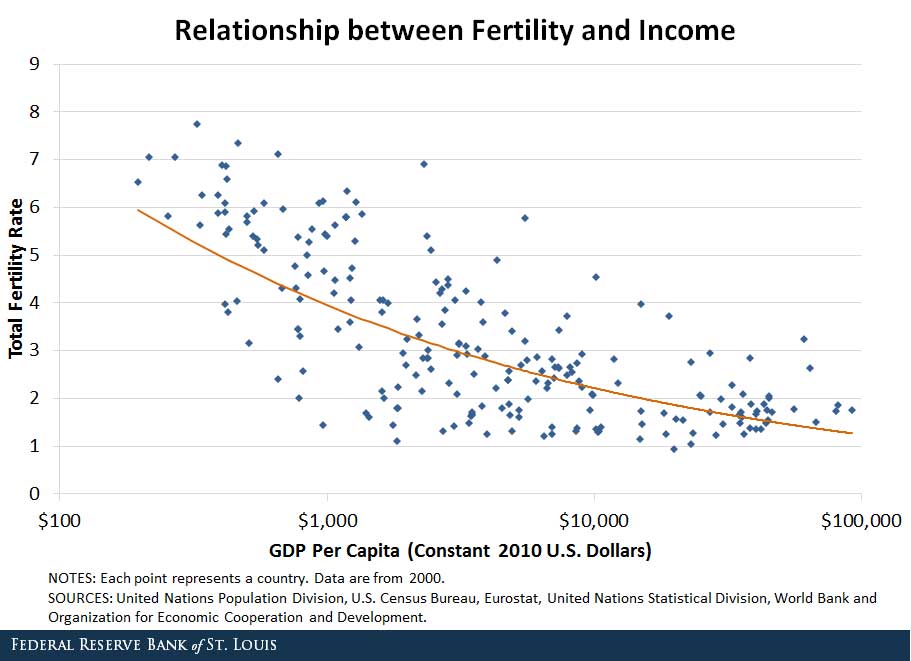
The decreasing relationship between the two variables demonstrates the connection between fertility choices and economic considerations. In general, poor countries tend to have higher levels of fertility than rich countries.
In particular, women tend to give birth to no fewer than three children in countries where GDP per capita is below $1,000 per year. In countries where GDP per capita is above $10,000 per year, women tend to give birth to no more than two children.
This decreasing relationship between fertility and income is well known to economists and demographers alike. In addition, it holds true over time: Rich countries, such as the U.S., have experienced a remarkable decline in their fertility rate as they became rich. Also, the relationship holds at the individual level, as rich families tend to have fewer children than poor families.
Why is fertility so much higher in poor countries? There are several possible reasons:
Time is relatively cheap in poor countries, so spending time away from work to take care of a child is not as costly as in a rich country. If this effect is strong enough, it can (and probably does) offset the fact that it is difficult to afford a child on a low income.
A child may require more education to be successful in a rich country. Thus, a child may be more costly there, so families may opt to have fewer, more educated children.
Infant mortality can play a role. More births might be needed to achieve a desired number of surviving children when infant mortality is high, as it tends to be in poor countries.
Children can take care of their parents when they are old. However, this is not necessary in rich countries with a well-developed social security system and functioning financial markets.
Additional Resources
On the Economy: Did China’s One-Child Policy Really Have an Effect?
On the Economy: How World War I Changed Marriage Patterns in Europe
On the Economy: Russia’s Demographic Problems Aren’t New
Source
https://www.stlouisfed.org/on-the-economy/2016/december/link-fertility-income
Disclaimer
Views expressed are not necessarily those of the Federal Reserve Bank of St. Louis or of the Federal Reserve System.


