


Written by Econintersect
Early Bird Headlines 06 December 2016
Econintersect: Here are some of the headlines we found to help you start your day. For more headlines see our afternoon feature for GEI members, What We Read Today, which has many more headlines and a number of article discussions to keep you abreast of what we have found interesting.

Global
Asia shares higher as investors shake off Italian referendum concerns (CNBC) Asian markets bounced back on Tuesday with the central bank in Australia holding its benchmark rate steady and as market uncertainty faded following the failed referendum in Italy. Oil was down less than 1%.

U.S.
Trump gets chance to remake the courts (The Hill) President-elect Donald Trump has a chance to stack the courts with conservative judges, thrilling Republicans who suddenly have the opportunity to remake the judicial system. Conservatives watched with dismay as Congress confirmed 327 of President Obama’s judicial nominees, fearing it would further entrench liberal control of the courts. Now the tables have turned. Trump could come into office with around 117 judicial vacancies to fill, and unlike Obama in his first term, will need only 51 votes in the Senate to confirm his nominees. Democrats eliminated filibusters for most federal judicial nominees and executive-office appointments in 2013. Now only a simple majority, rather than 60 votes, is required to advance a nominee.
A history of the American anti-feminism behind Clinton’s defeat (The Conversation)
The victory of Donald J Trump in the November 2016 US presidential election came as a particular shock to those who had believed that the American nation was ready and willing to elect its first female president. Evidence of Trump’s sexually suspect tendencies in the infamous “Access Hollywood” tapes had seemed likely, for a while, to signal the end of his campaign.
But even this wasn’t sufficient to derail him. Incomprehensible though Trump’s success may at first have seemed, his victory over a female candidate in a battle fought and won with apparent contempt for women’s rights makes a curious kind of sense if we read it as just the latest manifestation of a misogynist and anti-feminist line in American cultural life, stretching back to the 1940s and beyond.
GOP Leader Makes Dubious Claim That More People Will Have Health Insurance Without Obamacare (The Huffington Post) Econintersect: This is more news in the age of “post-truth”.
House Majority Leader Kevin McCarthy (R-Calif.) suggested on Monday that more people would have health insurance once Republicans repeal Obamacare ― and that Congress would be able to retain popular provisions requiring companies to insure people with pre-existing conditions.
Asked how Republicans could be confident premiums wouldn’t skyrocket if they repealed the 2010 Affordable Care Act, McCarthy told reporters it came down to a “philosophical difference of belief.”
Winning An Election Does Not Entitle One To Upend Basic Values (Social Europe) Former Treasury Secretary Lawrence Summers unloads of the “dark side” of Donald Trump.
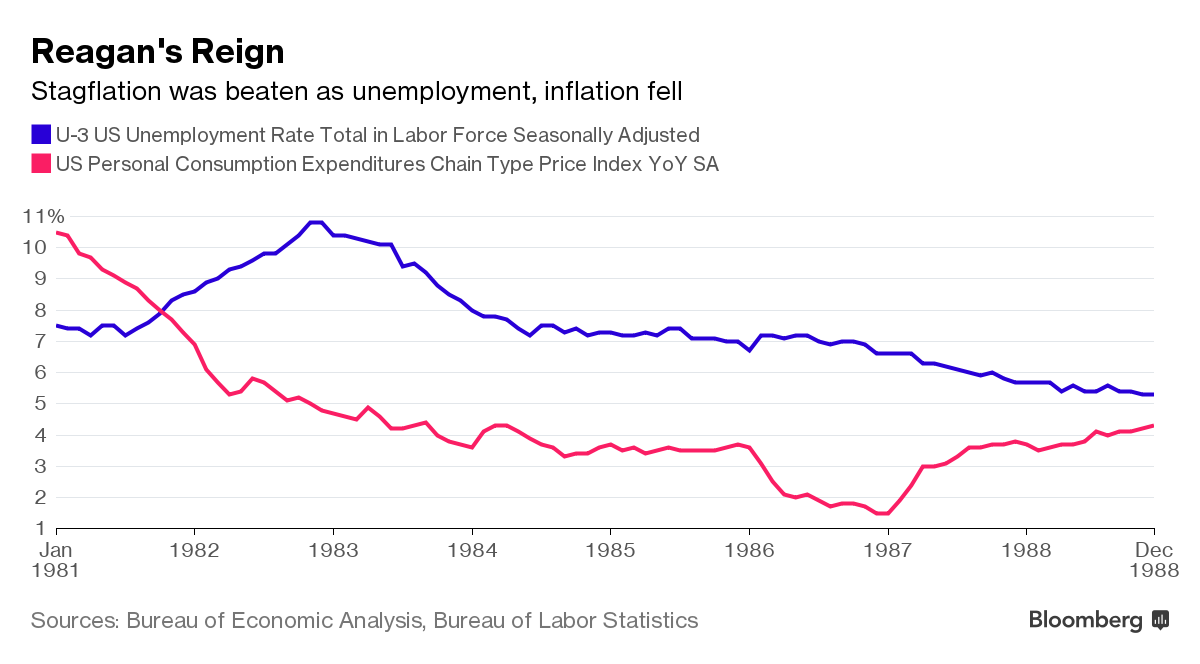
Trump Fans Seeing Reagan Economic Redux Forget Lessons of 1980s (Bloomberg) Donald Trump is no Ronald Reagan. But then again, neither was Reagan. Stocks and the dollar have risen since the Nov. 8 presidential election on hopes that Trump’s advocacy of big tax cuts, increased defense spending and deregulation will usher in another period of prosperity. The coming change will be a “profound president-led ideological shift” akin to Reagan’s, according to Bridgewater Associates founder Ray Dalio. Trump’s advisers and the billionaire himself have embraced the comparison. Yet in their rush to buy, investors may be forgetting that the economy is in a different place now than it was then and that former Federal Reserve Chairman Paul Volcker was as much responsible for the good times in the 1980s as Reagan was.
EU
Italy’s referendum has started the clock ticking on the collapse of Europe (City A.M.) See also Italy’s exit from the Eurozone is now almost inevitable.
A country too big to fail is now just two moves away from leaving the euro. With little likely to economically change for the better between now and February 2018 (and in fact with the banking crisis likely to worsen), surely Renzi’s catastrophe is the beginning of the end of the Italian elite as we knew it. Surely the demise of the broader European elite itself cannot be far behind.
Trump’s Win Is A Warning: Europe Urgently Needs A New Deal (Social Europe)
President Franklin D. Roosevelt’s policies allowed the United States to avoid the perils of right-wing populism that plunged Europe into war in the 1930s – Europe should learn from his example.
UK
UK suffers its first lost decade in 150 years (The Times) Britain has endured its first lost decade in 150 years, Mark Carey, the governor of the Bank of England, said yesterday, as he called on politicians to do more to spread wealth and to end the populist uprisings that have hit Britain, America and Italy. A retreat into isolationism would be a “tragedy“, Carney warned, despite acknowledging that free trade had hurt the poor and that pay had been too weak for years. He accepted that globalisation was “associated with low wages, insecure employment, stateless corporations and striking inequalities“, but said:
“Why doesn’t it feel like the good old days? Because anxiety about the future has increased, because productivity hasn’t recovered and because real wages are below where they were a decade ago, something that no one alive today has experienced before.”
Financial sector’s tax contribution hits a record £71.4bn (City A.M.) The tax take from Britain’s financial sector has hit record levels, underscoring its economic importance as talks between the government and the City enter a new phase in the run up to Brexit. Fifty financial services firms, largely UK-listed and including the Square Mile’s banking titans, paid £71.4 billion ($89 billion) into HM Treasury’s coffers for the year to 31 March according to a study launched this morning by PwC and the City of London Corporation. The huge sum represents an increase of 7.4% on the 2015 figures, and means financial services businesses contributed 11.5% of all UK government tax receipts last year. In total, almost one pound in every four earned by the sector during the last financial year went straight into the public purse.
Italy
A damning defeat for Matteo Renzi but Italy’s referendum is not a populist triumph (The Conversation) This was a vote against the prime minister – not a show of support for his rivals.
Italy’s angry young jobless led revolt that toppled Renzi (The Times) Italy’s disenfranchised youth powered the revolt that toppled the prime minister, it emerged last night as opposition parties demanded snap elections after Matteo Renzi’s referendum defeat. As Mr Renzi tendered his resignation, exit polls showed that between 69 and 81% of Italians under 34 years old had voted against his plans to streamline the parliamentary system, far outstripping the overall figure of 59% of “no” voters. Chronic youth unemployment appears to have been a key factor.
Russia
Putin Jumps on Trump’s Syria Pivot to Strengthen Hand in Mideast (Bloomberg) Vladimir Putin is seizing on President-elect Donald Trump’s pledge to reverse U.S. policy on Syria to press for a military victory that could mark Russia’s return as a great-power rival in the wider Middle East. With Trump vowing to focus on defeating Islamic State rather than on arming militias fighting Syrian leader Bashar al-Assad’s forces, Putin is moving decisively to oust rebels from Aleppo, their last major stronghold.
Putin Shows Off Russia’s Embarrassing Aircraft Carrier (Bloomberg) Russian involvement in the war in Syria is about more than just propping up the Assad regime. President Vladimir Putin has also been putting on a demonstration of military might, both to enhance Russia’s status as a resurgent power and to show off all its new hardware to prospective international buyers. And things had been going well: Ground-based Russian planes have been flying sorties at a highly efficient pace; warships in the Caspian Sea have hit targets in northern Syria with cruise missiles; one of Russia’s new T-90 tanks survived relatively unscathed after being hit by a U.S.-made TOW missile. ut when Putin decided to send Russia’s lone aircraft carrier, the Admiral Kuznetsov, down to the Mediterranean, he blundered. First, there is no military purpose. Second, the ship is simply embarrassing to look at. It lumbers along belching black smoke, accompanied by tugboats standing ready to tow because of frequent breakdowns. Its distinctive “ski jump” prow is an admission of technological defeat — because the deck lacks the catapults found on U.S. carriers, jets need the extra boost of the ramp to avoid toppling into the ocean.
India
India’s economy to rebound next year as cash crunch impact ebbs, Goldman and Deutsche Bank say (CNBC) India will rejoin the ranks of the fastest growing major economies in the world next fiscal year, even as a massive cash crunch is expected to drag growth lower in the current year. India’s economy is forecast to grow 7.5% in the financial year through March 2018, according to Deutsche Bank. Goldman Sachs pegged the number higher at 8.6%.
China
Did China’s Currency Just Drop Off a Cliff? (Foreign Policy) On Monday, the Chinese renminbi fell by about 10% against the dollar in a matter of hours, one of the biggest one-day moves since Beijing allowed its money to partially float. The yuan dropped from about 6.8 to the dollar to about 7.5. This pushed China’s currency to the cheapest level since the 2008-09 financial crisis. The move was double the 5% decline for 2016 before Monday. The move came on a day when the dollar index also declined more than 1%. See next article.
USD/CNY – US Dollar Chinese Yuan (Investing.com) The 10% drop in the yuan (see preceding article) lasted on a few hours and then the yuan returned to previous levels. The “collapse” of the yuan could just have been a data bug.

Mongolia
How to Stand Up to China? Mongolia’s Got a Playbook (Foreign Policy) The day before the Dalai Lama’s November 18 trip to Mongolia, Beijing issued a “strong demand” to its neighbor to cancel the visit of the “anti-Chinese separatist” or face (unstated) consequences. The Dalai Lama would be making his ninth visit to the sparsely populated nation of 3 million people, just to China’s north. Previous visits triggered retaliation from China, including the temporary closure of parts of the Sino-Mongolian border. Just like in the past, Ulaanbaatar ignored the warnings.


