


Written by Econintersect
Early Bird Headlines 17 November 2016
Econintersect: Here are some of the headlines we found to help you start your day. For more headlines see our afternoon feature for GEI members, What We Read Today, which has many more headlines and a number of article discussions to keep you abreast of what we have found interesting.

Global
Asia stocks mixed as oil prices extend slide (CNBC) Asian markets were mixed Thursday, pausing for breath after oil prices extended declines. During Asian trade, U.S. crude futures fell 0.35% to $45.41 a barrel, while Brent futures shed 0.34% to $46.47 a barrel. Oil prices slipped on Wednesday in the U.S. session, after the U.S. Energy Information Administration said crude inventory climbed by 5.3 million barrels last week, compared to a Reuters poll of analysts that had forecast a 1.5 million barrel-build. The greenback traded at 100.37 against a basket of currencies as of 2:46 pm HK/SIN. In the U.S. on Wednesday, the dollar touched 100.57, its highest since April 2003.

CO2 emissions stay steady for third consecutive year (Science News) Global emissions of carbon dioxide won’t increase much in 2016 despite overall economic growth, newly released bookkeeping suggests. The result marks a three-year-long plateau in the amount of CO2 released by human activities, scientists from the Global Carbon Project report November 14 in Earth System Science Data. The group’s projected rise in CO2 emissions of 0.2 percent for 2016 is far lower than the rapid emissions growth of around 2.3 percent annually on average from 2004 through 2013. Emissions increased by about 0.7 percent in 2014 over the previous year and remained largely flat in 2015. China is largely responsible for the emissions slowdown, the researchers write. The country is the world’s largest carbon dioxide emitter and is projected to reduce its CO2 emissions by 0.5 percent this year.
U.S.
Mike Pence drains Donald Trump’s swamp, looks to purge transition team of lobbyists (Salon) In keeping with some his most fervent campaign promises, President-elect Donald Trump is “draining the swamp“, even within his transition team. Mike Pence, who usurped leadership of the transition team from New Jersey Gov. Chris Christie on Friday, would “move to get rid of lobbyists in key roles“, according to Fox News. Christie’s transition team consisted in large part of the lobbyists and government insiders (i.e. “special interests”) against whom Trump ran an effective 18-month campaign.
D.C. residents lost the most sleep of anyone in nation the night of the presidential election, study shows (The Washington Post) Econintersect: The alligators were restless in the swamp.
Trump Transition Team Gives Detailed Update Amid Infighting (Bloomberg) President-elect Donald Trump’s transition team gave its first detailed update amid reports of infighting and disorganization. In a conference call with reporters Wednesday night, aides named more than a dozen people who are either candidates for jobs in the Trump administration or were meeting with Trump to provide advice. The list includes South Carolina Governor Nikki Haley, who once said Trump represented “everything a governor doesn’t want in a president” but more recently has said she looks forward to working with a Republican president and Congress.
Facebook Didn’t Tilt the Election (Barry Ritholtz, Bloomberg View) Facebook’s algorithms help people find the information they want to see. Barry Ritholtz explains why that has created the false impression that Facebook is biased:
Mark Zuckerberg, co-founder and chief executive officer of Facebook Inc., finds himself in some hot water. His company is being blamed(or credited, depending upon your point of view) for Donald Trump’s election because its algorithms facilitated the circulation of misleading or false news stories.
This controversy is misdirected: it should be less about Facebook’s algorithms and more about human cognitive issues. Here is yet another lesson for investors. This will be our third and likely final extrapolation from the presidential election; earlier discussions looked at hindsight bias and fabricated narratives.
Today’s topic is confirmation bias. This is the tendency for people to seek out news, information and opinion that reinforces existing beliefs. We pay more attention to, interpret more favorably and tend to remember the things with which we agree. The opposite is also true: We tend to not notice, interpret unfavorably and more easily forget that which is at odds with what we already think.


UK
95% of new workers are foreigners (The Times) Employment levels in Britain are at an all-time high, fuelled by the biggest surge of foreign-born workers since the expansion of the European Union. And unemployment is at an 11-year low. The number of people in work increased by 454,000 between July and September last year and the same period this year. Workers born overseas made up nearly 95% of the increase – just over 430,000. The rise in foreign-born workers accounting for jobs growth is the largest since 2004 when eight eastern European states joined the EU, setting off one of the biggest waves of immigration in British history.
Sweden
How Swedish literature reflects the benefits of a shorter working day (The Conversation) Staff are feeling “refreshed” and enjoying the extra time they have for hobbies, friends and families. Time away from work also allows people an opportunity to think about work tasks in new ways and from different perspectives, so they return to their desks feeling stimulated.
Israel
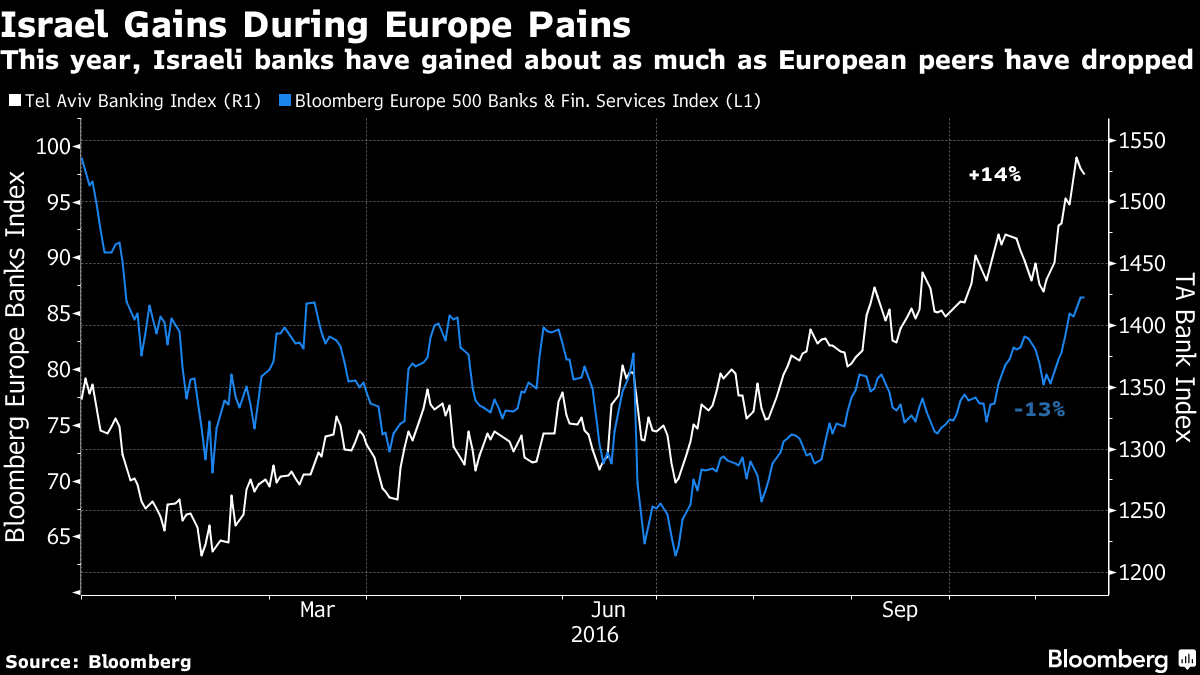
Largest Wealth Fund Finds Value in Israeli Banks After Job Cuts (Bloomberg) Israeli banks, criticized for years as wasteful by their regulator, are attracting interest from the world’s top investors after announcing thousands of job cuts to boost efficiency. Norges Bank, which manages Norway’s $860 billion sovereign wealth fund, said last month it raised its stake in Israel Discount Bank by half. U.S. money managers Dimensional Fund Advisors, BlackRock Inc., and Vanguard Group Inc. also increased their holdings in the country’s lenders in recent months. The buying helped fuel a rally that pushed Israel’s lenders to record highs, even as their European peers slumped amid fresh capital concerns, suggesting a three-year government push to reduce labor costs and improve competitiveness is beginning to pay off. Israel’s banks have announced 3,200 job cuts over the coming years, equal to 8% of the workforce. Now some are moving to reinstate or increase dividends that had been curbed by regulators.
India
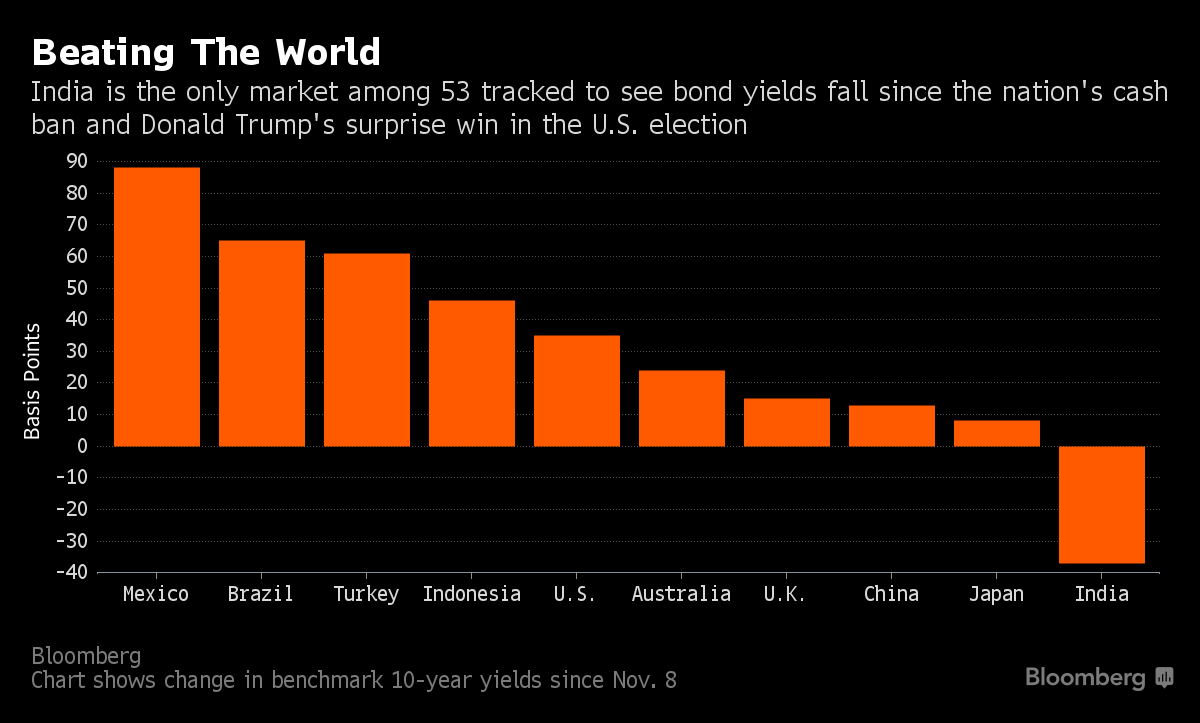
The Strange Consequences of India’s Unprecedented Banknote Ban (Bloomberg) From keeping Indian defense jets on the ready to transfer cash from mints, to banks knocking on the doors of religious institutions to access smaller change, Indian ingenuity is being stretched by Prime Minister Narendra Modi’s cash ban to crackdown on unaccounted money. India’s cash economy has been thrown into turmoil since Modi announced last week that 500 and 1,000 rupee notes would cease to be legal tender and would have to be deposited at banks by year-end, leaving about one-seventh of currency in circulation. Economists say the move will be beneficial in the long-run as it is targeted at weeding out tax evasion and corruption. Unaccounted money makes up nearly a fourth of the economy. In the short-term, though, the biggest crackdown on money laundering in India’s history is having some unusual side-effects.
Philippines
Philippine president Duterte says may follow Russia’s ICC withdrawal (Reuters) Philippines President Rodrigo Duterte said on Thursday he might follow Russia’s step to withdraw from the International Criminal Court, citing criticism from Western nations for a rash of killings unleashed by his war on drugs. In comments ahead of his departure for Lima to attend an Asia-Pacific summit, Duterte also railed against the United States and said that if Russia and China were to create a “new order” then the Philippines would be the first to join it.
Japan
Abe to meet Trump in first bilateral with foreign leader (Financial Times) After an election campaign during which he questioned basic assumptions about US strategy in Asia, Donald Trump will on Thursday give the first cluesa about his actual approach to the region when he meets Shinzo Abe, the Japanese prime minister, in New York. Mr Abe will become the first foreign leader to meet the president-elect since his election victory last week, giving the Japanese leader the chance to lobby Mr. Trump at a time when many of his policies have yet to take shape. Although Mr. Trump is expected to maintain his promise to abandon the Trans-Pacific Partnership (TPP) trade deal, a move that will particularly upset the Japanese, he could surprise Washington’s allies in the region with other aspects of his strategy.
Vietnam
Vietnam PM backs off from U.S-led TPP, emphasizes independent foreign policy (Reuters) Vietnam will shelve ratification of a U.S.-led Pacific trade accord due to political changes ahead in the United States, but wants to maintain good relations with Washington as much as it does all other countries, its prime minister said on Thursday. Vietnam’s legislature was almost certain to ratify the 12-nation Trans-Pacific Partnership (TPP) agreed last year but had deferred it until after the U.S. presidential election won by Republican Donald Trump, whose protectionist agenda on the campaign trail has unnerved Asian economies.


