Written by Econintersect
Early Bird Headlines 11 November 2016
Econintersect: Here are some of the headlines we found to help you start your day. For more headlines see our afternoon feature for GEI members, What We Read Today, which has many more headlines and a number of article discussions to keep you abreast of what we have found interesting.

Global
Asia markets stutters as the strong dollar weighs on EM (CNBC) Asian markets stuttered on Friday as the rally in the dollar following Donald Trump’s win in the U.S. presidential election dampened demand for emerging market assets. The dollar index traded down 0.12% at 98.664 as of 2:45 pm HK/SIN, but had touched 99.081, its highest level in more than two weeks, during U.S. hours. The dollar strength stemmed from the ongoing sell-off in U.S. Treasurys and the steepening of the yield curve after the U.S. election results.

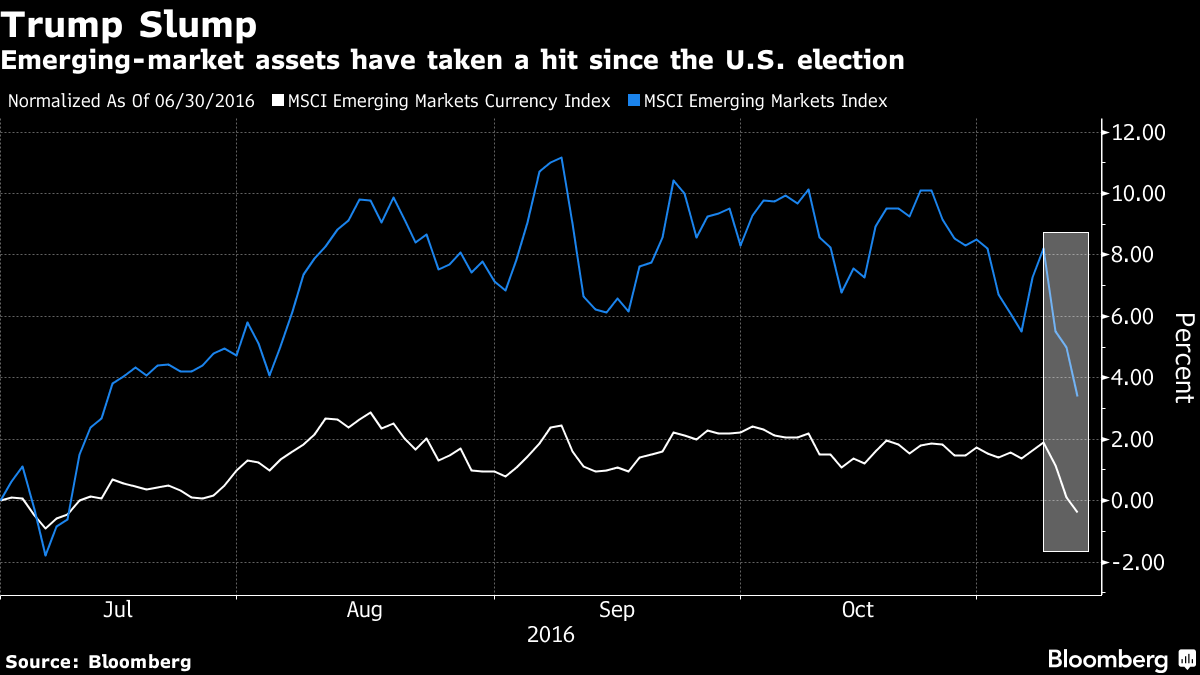
Emerging Markets Extend Post-Trump Slump as Bond Rout Deepens (Bloomberg) An emerging-markets selloff deepened amid concern developing economies will face capital outflows and weakening exports once Donald Trump is in The White House, while Treasuries capped their worst week since 2009 before a U.S. holiday on Friday. MSCI gauges of emerging-market equities and currencies sank to four-month lows since the election of Trump, who pledged to restrict imports and add fiscal stimulus that’s seen hastening interest-rate hikes by the Federal Reserve. More than $1 trillion was wiped off the value of bonds this week, something that’s happened only once before in the last two decades, and Bloomberg’s dollar index rallied the most since May 2015.
U.S.
Trump could easily erase much of Obama’s foreign policy legacy (Reuters) U.S. President Barack Obama’s foreign policy legacy rests in part on a foundation of unilateral actions that his successor Donald Trump could reverse with the stroke of a pen. Due to take office on Jan. 20, Trump, the winner in Tuesday’s election, campaigned at times to dismantle Obama’s nuclear deal with Iran and to reimpose sanctions Obama eased on Cuba. Trump also disagreed with foreign policy decisions that included the way Obama has deployed troops abroad to combat Islamist militant groups. In his most notable foreign policy achievements, Obama, a Democrat, used executive authorities that offered a convenient legal path around a Republican-controlled Congress committed to blocking his agenda. The U.S. Constitution gives a president broad executive powers to enact foreign policy. Both Republican and Democratic presidents have sought to exercise those powers by issuing executive orders, presidential memoranda and what are called findings.
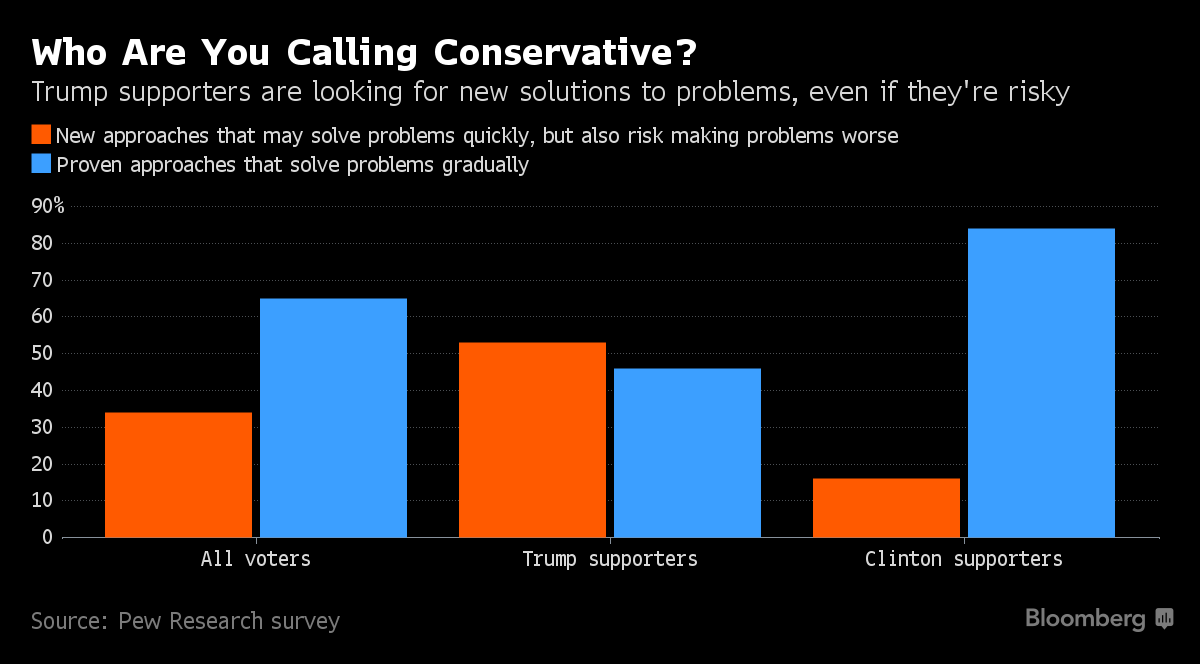
Trump’s Conservatives Embrace the Idea of Risky Change (Bloomberg) Today’s conservatives are far more likely than liberals to favor riskier, quick fixes for the country’s economic and social challenges. The non-partisan Pew Research Center looked at registered voters who planned to back Trump, surveying the group between Oct. 25 and Nov. 8, as they headed to the polls. Unlike Democrats, who favored tried-and-true methods of solving society’s problems, they were looking for new solutions – even if those were more likely to fail and make matters worse. (Econintersect: This was a ‘hand grenade’ election. Donald Trump pulled the pin and the voters threw it into the national bunker.)
How Trump Could Walk Away From Decades of Climate Deals (Bloomberg) It took more than two decades for nations around the world to forge an agreement to save the planet from global warming. Within one year, Donald Trump could leave it in tatters. Trump, who has said climate change is a hoax perpetrated by the Chinese, has vowed to “cancel” the Paris agreement brought into force this year by more than 190 other countries. While he can’t rip up the entire accord, he has several options for pulling the U.S. out. A withdrawal could have significant consequences. As the richest nation on Earth and the second-largest polluter, the U.S.’s role in the Paris accord is critical, helping to secure participation from China, India and others. A withdrawal by Trump would hobble the agreement’s effort to cut fossil-fuel emissions and could leave the U.S. facing grave diplomatic repercussions.
How Hillary Clinton’s white voters melted away (Reuters) A combination of previous Dem voters staying home and others flipping to Trump got the GOP candidate the win. See also next two articles.
Trump Had No Surge – Clinton Collapsed (Twitter)

42 States Shifted to the Right in 2016 (The New York Times) The shifting voting patterns for battleground states is shown below. Shifts for the other states are shown at The NYT. In total, 42 states had a higher percentage of Republican votes than in 2012.

EU
Fortress Europe continues to treat migrants as criminals (The Conversation) The European Union, one of the strongest economies in the world and home to some of the most advanced state apparatuses in human history, is preparing to shut down its borders, one after the other, because it can’t cope with the number of refugees arriving from war in the Middle East. These same institutions were, of course, able to find the resources to finance an expensive military operation on the European sea borders against the same refugees. All this emphasis on policing and military measures is based on the idea that being a refugee is a crime. See also Raids on migrant squats in Greece push solidarity efforts further to the margins.
UK
The special relationship’s back on: Donald Trump has invited Theresa May to visit him as soon as possible (City A.M.) Econintersect: Does Trump envision resurrecting a Thatcher-Reagan-like relationship?
Spain
The messy politics behind Spain’s new government (The Conversation) When Spanish prime minister Mariano Rajoy was finally able to announce the formation of a minority government after 10 months of deadlock, he called for political unity. The national parliament must work together to make up for lost time, he said. But that unity will not easily be achieved while most other political parties are embroiled in their own internal struggles. Rajoy was only able to make his breakthrough thanks to a decision by the Socialist Party (PSOE) to abstain from a vote to allow him to form a government, rather than voting against him. That decision has split the party and led to the resignation of its leader, Pedro Sflnchez. Spain has endured two elections in the past year alone, and Rajoy’s centre-right People’s Party (PP) was the only major party to increase its vote and number of seats between those two votes. Another election within the next 6-8 months is a distinct possibility.
Russia
Russian hackers accused of post-election attacks on U.S. think tanks (Reuters) A Russian hacking group began attacking U.S.-based policy think tanks within hours of Donald Trump’s presidential election victory, according to cyber experts who suspect Moscow is seeking information on the incoming administration. Three cyber security firms told Reuters that are tracking a spear-phishing campaign by a Russian-government linked group known as Cozy Bear, which is widely suspected of hacking the Democratic Party ahead of the election.
Russian Officials Were in Contact With Trump Allies, Diplomat Says (The New York Times) The Russian government maintained contacts with members of Donald J. Trump’s “immediate entourage” during the American presidential campaign, one of Russia’s top diplomats said Thursday. Later the Russian government said diplomat was referring to close Trump associates, but not members of his campaign staff. Sergei A. Ryabkov, the deputy foreign minister, was quoted as saying by the Interfax news agency:
“There were contacts. We continue to do this and have been doing this work during the election campaign. I cannot say that all, but a number of them maintained contacts with Russian representatives.”
Philippines
Philippine leader says honoring defense pacts with ‘friends’ U.S. (Reuters) Philippine President Rodrigo Duterte said on Friday he would respect defense treaties with “friends” and “ally” the United States, but still wanted foreign troops to leave his country by the end of his term. Duterte spared the United States one of his trademark verbal lashings and took a more conciliatory tone than usual, although he hinted at revoking the 2014 Enhanced Defense Cooperation Agreement (EDCA) that gives U.S. troops rotational access to Philippine bases. Duterte has taken a less confrontational tone since Tuesday’s U.S. election.
China
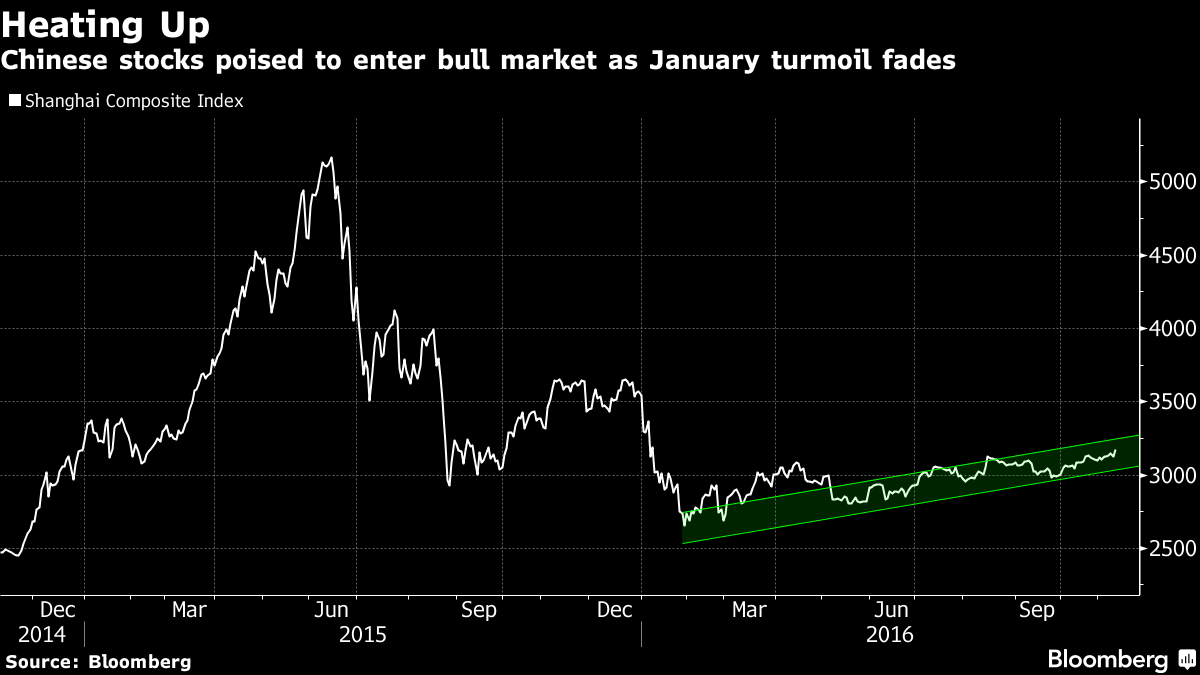
China’s Stocks Poised to Enter Bull Market as Economy Stabilizes (Bloomberg) China’s stocks rose, with the benchmark index poised to enter a bull market, as the economy showed signs of stabilization and the rollout of property curbs boosted the lure of equities. The Shanghai Composite Index climbed 0.7% to 3,193.37 as of 2:18 p.m. local time, taking its advance from its Jan. 28 low to more than 20%. Gains on Friday were led by metal producers including Jiangxi Copper Co. and Aluminum Corp. of China Ltd. The Hang Seng China Enterprises Index slipped 0.8%.