


Written by Econintersect
Early Bird Headlines 27 October 2016
Econintersect: Here are some of the headlines we found to help you start your day. For more headlines see our afternoon feature for GEI members, What We Read Today, which has many more headlines and a number of article discussions to keep you abreast of what we have found interesting.

Global
Asia markets fall as energy stocks come under pressure amid declines in oil prices (CNBC) Markets in Asia Pacific were mostly lower on Thursday, with energy plays in the region under pressure after oil prices extended their losing streak during the U.S. session.

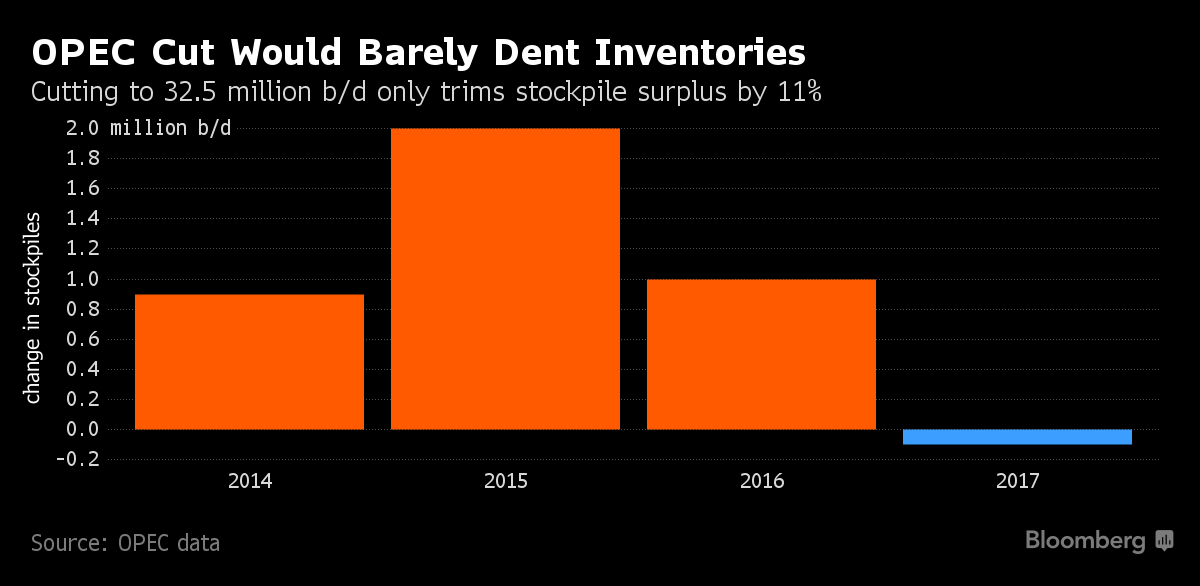
OPEC May Need Help to End the Global Glut of Oil (Bloomberg) Even if OPEC defies a skeptical market by implementing output cuts in full, it still won’t drain the ocean of surplus oil already pumped from the ground. The Organization of Petroleum Exporting Countries aims to shrink the world’s bloated oil inventories with its first production cut in eight years, according to Secretary-General Mohammed Barkindo. Yet the bloc’s own data show that even the maximum reduction under consideration would barely dent record stockpiles next year. That makes securing help from competitors — chiefly Russia — critical to ending the glut.
U.S.
Next U.S. Offshore Wind Farm Set to Emerge From Lake Erie (Bloomberg) The next U.S. offshore wind farm in the U.S. will probably be almost 500 miles (800 kilometers) from the nearest ocean. The Lake Erie Energy Development Corp. expects to finalize a deal by yearend with Fred. Olsen Renewables AS to build a 20.7 megawatt wind project in Lake Erie, off the Ohio coast, the president of the Cleveland-based non-profit group said in an interview. LeedCo is developing the $127 million Icebreaker project to demonstrate that offshore turbines are viable in the Great Lakes, a region with the potential to generate 1,000 megawatts of wind energy by 2020. Construction may start in early 2018. The only U.S. offshore wind farm was completed this year near Block Island, by Deepwater Wind LLC.
Obamacare Will Survive (With Some Tweaks) (Bloomberg Editorial Board) Next Tuesday will be the start of open enrollment for Obamacare’s state exchanges, which offer health insurance to the 7% of Americans who buy their own coverage. It’s an anxious moment for the program: Enrollment is expected to remain significantly less than originally hoped. Some insurers have pulled out of the exchanges altogether. And those that remain have boosted premiums for typical plans by an average of 25%. These problems aren’t great enough to bring the exchanges down. Eighty-five percent of people who participate get federal subsidies, so they will have to pay little more than they did last year. Seventy-seven percent of current enrollees will still be able to buy coverage for $100 a month at most. And in 45 states, more than one insurer will still offer policies. But rising prices and low participation, by insurers and customers alike, are problems that need to be addressed if the exchanges are to succeed.
A Chinese billionaire is staking his legacy – and thousands of American jobs – on this factory in Ohio (The Washington Post) Now it is China that experts fear is losing steam, forcing the country’s wealthy investors and corporations to seek out profits overseas. They are snapping up U.S. businesses at a record rate and employing tens of thousands of U.S. workers. But, whereas the average manufacturing wage in the U.S. is more than $25 an hour, these new jobs are paying much less – $12 an hour at one glass factory in Ohio.
Tesla’s Rare Profit Delivers ‘Pie’ Musk Ordered for His Skeptics (Bloomberg) Tesla Motors Inc. posted an unexpected profit and said it expects to get through the rest of the year without raising cash, easing one concern for investors as it expands production of electric cars and prepares to acquire money-losing SolarCity Corp. The profit, Tesla’s first in eight quarters, boosted its shares more than 4% in late trading Wednesday after they slumped 16% this year. It also provided welcome vindication to Chief Executive Officer Elon Musk, who in an August e-mail obtained by Bloomberg pushed workers to cut costs, deliver every car possible and drive the results into positive territory.

Who will win the Senate? (FiveThirtyEight) The most likely outcome right now is a net gain of 6 seats for the Democrats. The last time we reported (over a week ago) the most probable result was a gain of 8 seats.


UK
Lost UK influence over EU financial services regulation could come back to bite the City (City A.M.) Theresa May’s suggestion at the European Council meeting in Brussels last week that the UK would continue to play a role in EU institutions and their respective decision-making processes post-Brexit was met with thinly disguised incredulity by European leaders. Manfred Weber, leader of the European People’s Party in the European Parliament, commented after the meeting:
“when somebody wants to leave a club, it is not normal that such a member wants to decide about the future of this club”.
Heathrow expansion is a start, but it’s not enough to guarantee UK’s future (The Conversation) The move to expand Heathrow airport’s capacity with a third runway is encouraging and a positive step towards boosting the UK’s economic growth. But it is not enough. Heathrow is used by more than 80 airlines flying to 185 destinations in 84 countries – Britain’s busiest airport handles about 75m passengers every year – but there is the potential to do more. Airport expansion is urgently needed both at Heathrow and Gatwick. Heathrow and Gatwick are among the world’s busiest airports. Heathrow has two runways and Gatwick just one – and they are both currently operating at capacity. If growth in air travel demand continues as projected, there is a risk that a shortage of airport capacity will impede Britain’s economic development – particularly in the southeast, where capacity constraint is the most serious.
China
China’s Millennials Are Risk Takers – and They’re Dreaming Big (Bloomberg) Having grown up in a booming economy that grew nine-fold since the turn of the century, China’s 7.5 million school leavers this year are intent on forging paths very different from their parents, who defaulted to the factory floor, construction site or staid state-sector job. About 48% of those born after 1995 don’t want to enter the traditional job market upon graduation, according to recent research by QQ Browser, part of tech giant Tencent Holdings Ltd., which polled 13,000 college students and mined data from its 84-million daily internet search traffic.

Chinese Bank Liabilities Rise Above 200 Trillion Yuan For The First Time (Zero Hedge) By now it is widely accepted that the biggest credit risk facing the global financial system is arising from China, especially the leverage within its opaque, murky financial system. As for bank liabilities, or loans and other even murkier obligations, the Chinese regulators reported that this number had grown by 15.5% (more than twice the rate of growth of GDP), and has for the first time ever surpassed 200 trillion yuan – just shy of USD $30 trillion – for the first time, and hitting CNY200.4 trillion as of September 30. By comparison, total US bank liabilities are roughly half this number. Something between 15% and 20% of these loans (up to $6 trillion) are bad loans – not paying interest or repaying principle.

Brazil
Deep in the Amazon jungle, Brazil’s ‘hidden cities’ are in crisis (The Conversation) Brazil is experiencing corruption scandals, political turmoil, and its worst recession in decades. Yet for all the chaos in centers of political and financial power, the country’s challenges are perhaps most acute in remote corners of the Amazon. There, a swathe of newly-elected local leaders, empowered by Brazil’s decentralized governance, are struggling to safeguard the health of their citizens as long-term problems are exacerbated by recent drastic public spending cuts. The “deep” Amazon is now surprisingly urbanized yet its cities are largely invisible in academic and political debates. In the 21st century, it is generally taken for granted that towns and cities are connected by roads. However, in the Brazilian state of Amazonas almost a million people live in dozens of roadless cities of 3,000 to 70,000 residents. These settlements are wholly reliant on rivers.


