


from the St Louis Fed
— this post authored by Ana Maria Santacreu
In recent years, developed countries have experienced a change in the age composition of their population. In particular, these countries have seen an increase in the age-dependency ratio, computed as the ratio of the young population (under 15) and elderly population (65 and over) to the working-age population (15 to 64).

Because the young and the elderly are the most likely to be economically dependent, analyzing their recent evolution may help us understand how changes in the age-dependency ratio could affect other economic outcomes in the developed world. In particular, the evolution of the three variables making up the age-dependency ratio – the elderly population, the young population and the working-age population – is of interest.
The figure below plots the annual age-dependency ratio for the G-7 countries over the period 1990-2012. In recent years, all these countries have experienced an increase in age-dependency ratios.

Among the G-7, Japan has experienced the largest increase in its age-dependency ratio. It was also the country where these demographic trends started first.
From the early 90s, Japan has seen a large increase in its elderly population, with 25 percent of its total population being 65 and older in 2014. Its age-dependency ratio was 61 percent.
In all the G-7 countries, the increase in the age-dependency ratio has been driven by an increase in the elderly population together with a decrease in the working-age population. This increase has happened despite a decrease in the young population ratio in all of the G-7 countries. The young, working-age and elderly populations as percentages of the entire populations of countries are shown in the figures below.
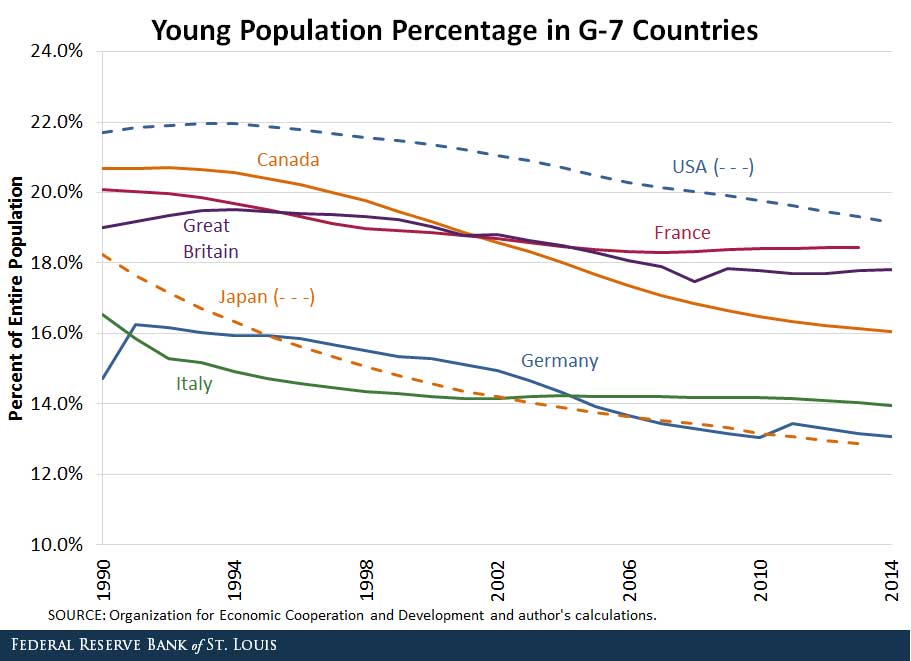
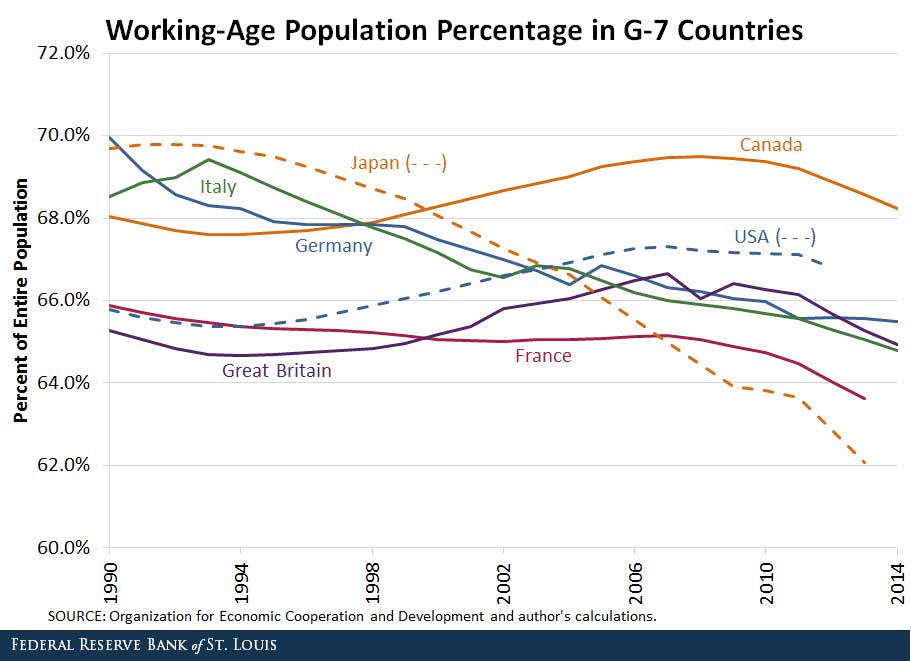
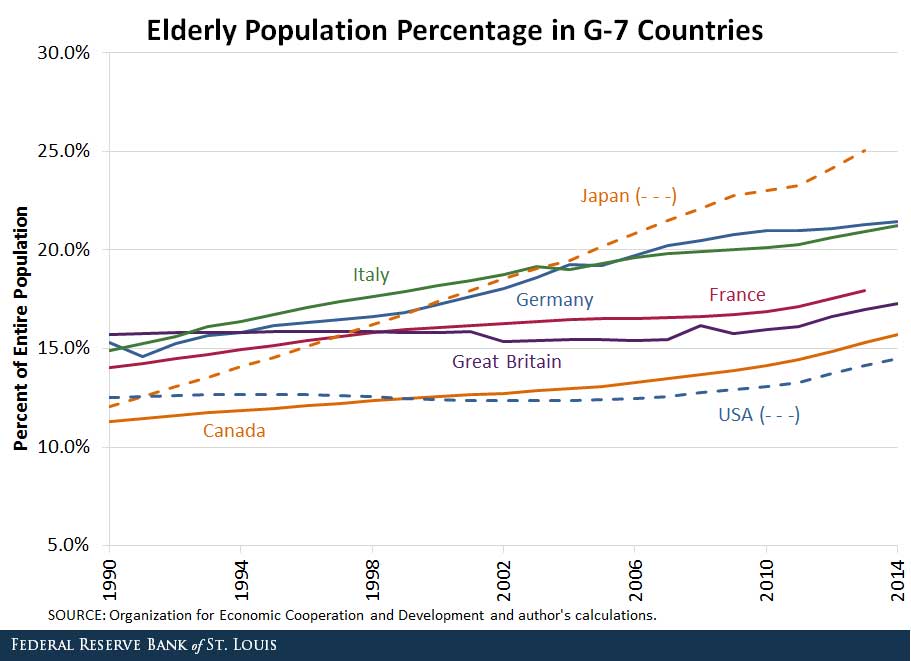
The decrease in the young population may also pose problems for the economic future of countries, since it is likely going to contribute to a reduction in labor force participation in the long run. Indeed, fertility has been declining in all these countries.
A decrease in the labor force due to demographic trends may result in a slowing down of economic growth. This could eventually spill over to developing economies. Policies aimed at alleviating these problems could address increasing productivity to counteract a shrinking working population or stimulating the labor force participation of the elderly population.
Additional Resources
Regional Economist: A Closer Look at the Decline in the Labor Force Participation Rate
On the Economy: Many Negative Labor Market Trends Started before the Great Recession
On the Economy: Looking beyond the Unemployment Rate
Source
https://www.stlouisfed.org/on-the-economy/2016/august/how-populations-shifting-developed-countries
Disclaimer
Views expressed are not necessarily those of the Federal Reserve Bank of St. Louis or of the Federal Reserve System.


