


from the Congressional Budget Office
CBO projects a $534 billion deficit in fiscal year 2016, about $100 billion more than in 2015. If current laws generally remained unchanged, the deficit would increase from 2.9 percent to 4.9 percent of GDP over the next decade.

As it typically does after the President’s budget is released, CBO has updated the 10-year baseline budget projections it published early in the year. CBO now estimates that if no further legislation is enacted this year that affects the federal budget, the total federal deficit for fiscal year 2016 will be $534 billion, about $100 billion greater than the shortfall posted in fiscal year 2015. If current laws generally remained unchanged, the deficit would increase (in dollar terms) in nearly every year over the next decade and, CBO projects, by 2026 it would be considerably larger as a share of the nation’s output (gross domestic product, or GDP) than its average over the past 50 years (see figure below). Debt held by the public also would rise significantly from its already high level, reaching 86 percent of GDP by 2026.

Growing Deficits Are Projected to Drive Up Debt
This year is likely to be the first since 2009 in which the federal deficit will increase as a share of the nation’s output – from 2.5 percent of GDP in 2015 to 2.9 percent in 2016, by CBO’s estimate. That growth in the deficit will result in part from a shift in the timing of some federal payments from the beginning of fiscal year 2017 to the end of 2016 because October 1, 2016 – the first day of fiscal year 2017 – falls on a weekend. Without that shift of an estimated $41 billion in payments, the deficit projected for 2016 would be $493 billion, or 2.7 percent of GDP.
In CBO’s baseline, deficits rise because growth in revenues over the next 10 years is outpaced by increases in spending – particularly for Social Security, Medicare, and interest payments on the federal debt. The deficit remains at roughly 2.8 percent of GDP through 2018 but climbs to 4.9 percent of GDP by 2026. The cumulative deficit projected for the 2017 – 2026 period is $9.3 trillion.
One important effect of such deficits would be a burgeoning amount of debt held by the public. In 10 years, debt held by the public would equal 86 percent of GDP – more than twice its average over the past five decades. Debt that high – and heading higher – would have significant negative budgetary and economic consequences (see figure below):
Once interest rates returned to more typical, higher levels, federal spending on interest payments would increase substantially.
Because federal borrowing reduces national saving over time, the nation’s capital stock ultimately would be smaller, and productivity and total wages would be lower, than would be the case with lower debt.
Lawmakers would have less flexibility to use tax and spending policies to respond to unexpected challenges.
The probability of a fiscal crisis in the United States would increase. Specifically, the risk would rise of investors’ becoming unwilling to finance government borrowing unless they were compensated with significantly higher interest rates. If that occurred, interest rates on federal debt would rise suddenly and sharply relative to rates of return on other assets.
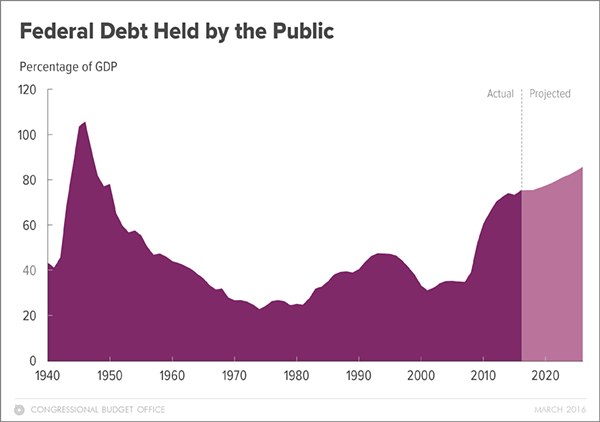
Beyond the 10-year period, if current laws remained in place, the pressures that contributed to rising deficits during the baseline period would build, and the consequences would be even more severe. Under those circumstances, debt held by the public three decades from now would constitute 155 percent of GDP, a far larger percentage than any recorded in the nation’s history.
Changes Since January Are Relatively Small
CBO currently projects a deficit for 2016 that is $10 billion (or 2 percent) lower than the amount it projected in January – estimated outlays have been reduced by $22 billion and revenues by $12 billion. The cumulative 10-year deficit projection has dropped by $95 billion (or 1 percent), mostly as the result of a $79 billion increase in projected revenues.
Those changes stem largely from the agency’s full incorporation of the economic forecast it published in the January 2016 volume, The Budget and Economic Outlook: 2016 to 2026. (Last-minute changes to that forecast to reflect major legislation enacted in December and economic developments through the end of that month could not be incorporated into the January budget projections published in that volume.) Those economic revisions involved changes in corporate profits relative to GDP, among other factors, and they reduced the cumulative projected deficit for the 2017 – 2026 period by $168 billion. Other, technical, updates partially offset the revisions resulting from changes in the economic forecast. Legislation enacted since January has had a negligible effect on CBO’s projections of revenues and outlays.


