


from Lakshman Achuthan, Co-Founder and Chief Operations Officer of ECRI
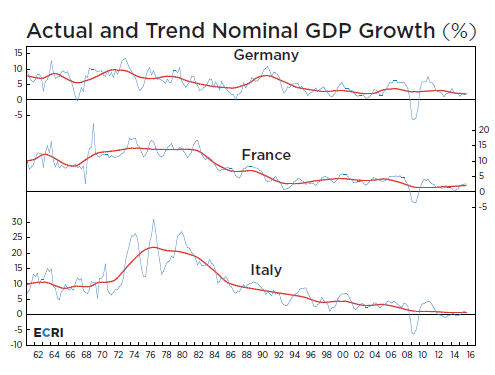
As we recently noted, the cyclical slowdown in global growth is unfolding in the context of the long-term declines in secular trend growth that we identified years ago. It is in this context that we revisit the patterns in nominal GDP (NGDP) growth, which “unites these global patterns of slowing real activity and falling inflation.”

In the chart, the thin blue lines represent yoy NGDP growth, and the red lines being their long-term trends.
The inexorable declines in trend NGDP growth have become even more evident lately. Specifically, trend NGDP growth is under 2% in Germany (top panel) and France (middle panel), and just about ½% in Italy (bottom panel). To place this in perspective, please note that trend NGD growth has fallen to 3¼% in the U.S. (not shown), where 5% NGDP growth – the sum of the Fed’s 2% inflation target and a “realistic” trend growth of 3% in real GDP – was considered a standard definition of “business as usual” not long ago.
The GFC and its aftermath have seen an extraordinary buildup of debt – including government debt – more so than ever before in human history. In the aggregate, the two ways these debts can be repaid over time are by generating sufficient real growth to do so; or by inflating away the debts, so that they can be repaid in currency that is worth much less. These considerations of real growth and inflation are unified in the form of NGDP growth, which is set to decline well below popularly assumed NGDP growth rates in all G7 economies, where debt-to-GDP ratios have risen substantially. In the U.S., for instance, federal debt has climbed by nearly 40 percentage points since the eve of the GFC to just about 100% of GDP today. The increases are of comparable magnitudes in the U.K. and the Eurozone, where the debt-to-GDP ratios are almost as high. Thus, not only are the prospects of debt repayment fading rapidly as NGDP growth falls off, but also these debt-to-GDP ratios are mounting inexorably as growth slows, with interest payments, even at current super-low rates, gobbling up increasing portions of government budgets.
With cyclical slowdowns also bearing down in the U.S. and Europe alike and the efficacy of further monetary easing increasingly in doubt, central bankers are predictably implementing, or at least considering, unconventional options like negative interest rates.
Last month, St. Louis Fed President James Bullard finally expressed his explicit agreement with the “yo-yo years” thesis that ECRI laid out years ago; namely, that the economy is “at a lower trend growth rate,” implying “a higher probability of recession.” Moreover, with regard to the Fed’s options in the face of a sharper downturn, given the lower long-term trend, “monetary policy tricks are not going to do it” because “monetary policy is about stabilization … around a trend [which] is lower. [So] you gotta do other things to [boost] the trend.”
Obviously, this is true not only for the Fed, but also for other central banks, who have collectively added some 11 trillion dollars to their balance sheets in the last eight years. But until policymakers find ways to boost long-term trend growth, it will keep ebbing in the years to come.


