


from the Rodger Malcolm Mitchell, www.nofica.com
There have been select technological advances in human history that have “changed everything” – the use of fire, the lever, the wheel, the knife, the use of electricity, the computer, the Internet, to name a few, and now . . .

You live at a time of the most important invention since the Internet and you may not yet have heard of it.
It was invented by two women, Jennifer Doudna (UC Berkeley) and Emmanuelle Charpentier (Max Planck Institute).
The invention: CRISPR-Cas9 (pronounced: crisper).
Sound familiar? No? It soon will be all you’ll think about.
Everything You Need to Know About CRISPR, the New Tool that Edits DNA
CRISPR allows scientists to edit genomes with unprecedented precision, efficiency, and flexibility.
The past few years have seen a flurry of “firsts” with CRISPR, from creating monkeys with targeted mutations to preventing HIV infection in human cells.
Earlier this month, Chinese scientists announced they applied the technique to nonviable human embryos, hinting at CRISPR’s potential to cure any genetic disease. And yes, it might even lead to designer babies.
“Designer babies” is the pejorative used to describe human babies that have been “improved” genetically to be faster, taller, smarter, better-looking, stronger, disease-free or in some other ways, to have been changed far more quickly than what breeding by nature accomplishes slowly.
This power is threatening as all power is.
There is an irony to the fact that, for instance, assuring your baby is free of horrible genetic and communicable diseases is an anathema. A distant relation of mine is in a family containing the dreaded Huntington gene. I’m sure they and their afflicted children, would have welcomed a bit of “designing.”
But power corrupts, and CRISPR truly is powerful, so expect the corrupt to use it for corrupt purposes.
CRISPR is actually a naturally-occurring, ancient defense mechanism found in a wide range of bacteria.
CRISPR is one part of bacterias’ immune system, which keeps bits of dangerous viruses around so it can recognize and defend against those viruses next time they attack.
The second part of the defense mechanism is a set of enzymes called Cas (CRISPR-associated proteins), which can precisely snip DNA and slice the hell out of invading viruses.
There are a number Cas enzymes, but the best known is called Cas9. It comes from Streptococcus pyogenes, better known as the bacteria that causes strep throat.
In short, the whole thing is as natural as eating corn on the cob (a human-modified grain). Natural, yes. But that is not where its power lies.
All biologists have to do is feed Cas9 the right sequence, called a guide RNA, and boom, you can cut and paste bits of DNA sequence into the genome wherever you want.
All you have to do is design a target sequence using an online tool and order the guide RNA to match. It takes no longer than few days for the guide sequence to arrive by mail.
You can even repair a faulty gene by cutting out it with CRISPR/Cas9 and injecting a normal copy of it into a cell.
Fast, cheap and powerful, CRISPR will change the world. The question: Will it be a better world?
There already is work being done to apply CRISPR to genetic diseases of the blood, like sickle-cell anemia, where we can repair the mutation that causes it.
CRISPR could, for example, be used to introduce genes that slowly kill off the mosquitos spreading malaria (or the genes for harboring malaria).
Or put the brakes on invasive species like weeds. It could be the next great leap in conserving or enhancing our environment.
CRISPR has been getting a lot of coverage as a future medical treatment. But focusing on medicine alone is narrow-minded.
Precise genome engineering has the potential to alter not just us, but the entire world and all its ecosystems.
Of course, the above-mentioned use of fire, the lever, the wheel, the knife, the use of electricity, the computer, the Internet, etc. all have altered the entire world and its ecosystems. Should we have done without them?
Of course not, but power needs control, and so far, there has been little control over CRISPR.
Easy DNA Editing Will Remake the World. Buckle Up.
Using (CRISPR), researchers have already reversed mutations that cause blindness, stopped cancer cells from multiplying, and made cells impervious to the virus that causes AIDS.
Agronomists have rendered wheat invulnerable to killer fungi like powdery mildew, hinting at engineered staple crops that can feed a population of 9 billion on an ever-warmer planet.
Bioengineers have used Crispr to alter the DNA of yeast so that it consumes plant matter and excretes ethanol, promising an end to reliance on petrochemicals.
With CRISPR, we theoretically could rid the world of every single mosquito, quickly, cheaply and easily (but then, what of the bats and fish that eat mosquitoes and their larvae?)
Over time, we could rid the world of all human diseases. We could extend human life. We could grow more and better foods. We could eliminate any species.
And, of course, this being an economics blog, we should mention money, and as we spoke earlier, corruption:
Just before Doudna’s team published its discovery in Science, Feng Zhang, a molecular biologist at the Broad Institute of MIT and Harvard, applied for a federal grant to study Crispr-Cas9 as a tool for genome editing.
Doudna’s publication shifted him into hyperspeed. He knew it would prompt others to test Crispr on genomes. And Zhang wanted to be first.
Zhang had asked the Broad Institute and MIT, where he holds a joint appointment, to file for a patent on his behalf.
Doudna had filed her patent application – which was public information – seven months earlier. But the attorney filing for Zhang checked a box on the application marked “accelerate” and paid a fee, usually somewhere between $2,000 and $4,000.
A series of emails followed between agents at the US Patent and Trademark Office and the Broad’s patent attorneys, who argued that their claim was distinct.
A little more than a year after those human-cell papers came out, Doudna (learned) that Zhang, the Broad Institute, and MIT had indeed been awarded the patent on Crispr-Cas9 as a method to edit genomes. “I was quite surprised,” she says, “because we had filed our paperwork several months before he had.”
The Broad win started a firefight. The University of California amended Doudna’s original claim to overlap Zhang’s and sent the patent office an 114-page application for an interference proceeding – a hearing to determine who owns Crispr – this past April.
In Europe, several parties are contesting Zhang’s patent on the grounds that it lacks novelty. Zhang points to his grant application as proof that he independently came across the idea.
The stakes here are high. Any company that wants to work with anything other than microbes will have to license Zhang’s patent; royalties could be worth billions of dollars, and the resulting products could be worth billions more.
When the stakes are high, the corrupt move in. And as yet, we don’t even know what “corrupt” means with regard to the use of CRISPR.
This post already has grown too long, but I urge you to use the links referenced above and learn the many biological and ethical implications of CRISPR.
You should make it your mission to learn about the most important invention since the Internet.
THE RECESSION CLOCK
Recessions begin an average of 2 years after the blue line first dips below zero. There was a dip in 2015.
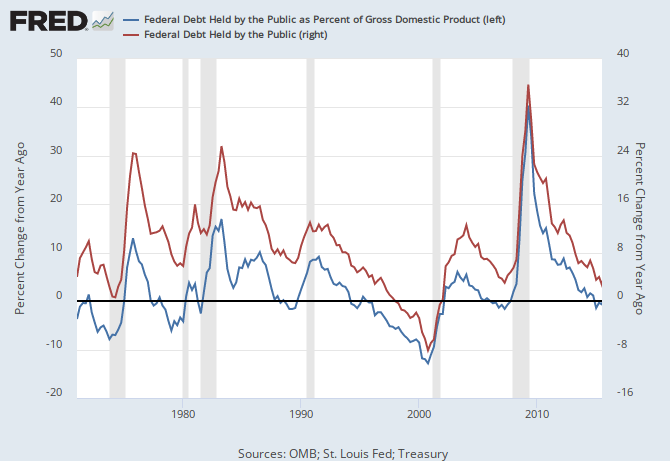
Vertical gray bars mark recessions.
As the federal deficit growth lines drop, we approach recession, which will be cured only when the growth lines rise. Increasing federal deficit growth (aka “stimulus”) is necessary for long-term economic growth.
Mitchell’s laws:
Those, who do not understand the differences between Monetary Sovereignty and monetary non-sovereignty, do not understand economics.
Any monetarily NON-sovereign government – be it city, county, state or ation – that runs an ongoing trade deficit, eventually will run out of money.
The more federal budgets are cut and taxes increased, the weaker an economy becomes..
Liberals think the purpose of government is to protect the poor and powerless from the rich and powerful. Conservatives think the purpose of government is to protect the rich and powerful from the poor and powerless.
The single most important problem in economics is the Gap between rich and the rest..
Austerity is the government’s method for widening the Gap between rich and poor.
Until the 99% understand the need for federal deficits, the upper 1% will rule.
Everything in economics devolves to motive, and the motive is the Gap between the rich and the rest..


