


from Lakshman Achuthan, Co-Founder and Chief Operations Officer of ECRI
We welcome the Fed’s recognition that the long-term decline in trend growth, that ECRI first identified before Lehman blew up, is not going away.

To wit, the Fed minutes state that “the equilibrium level of short-term real interest rates would likely remain low relative to estimates of its level before the financial crisis if trend growth of total factor productivity does not pick up and if demographic projections for slow growth in working-age populations are borne out.”
This is in line with what we reiterated in June, namely, that “economic expansions have been weakening for decades due to the long-term decline in U.S. trend growth. … [T]he GDP calculus is based on simple math; namely, growth in output per hour (i.e., labor productivity) plus growth in hours worked equals real GDP growth.”
On a related note, the minutes go on to state that it would be prudent to haveadditional policy tools that could be used in such an environment. Specifically, the “equilibrium real rate … currently is close to zero, notably below its historical average.” But a “lower long-run [real interest rate] would also imply that the gap between the actual level of the federal funds rate and its near-zero effective lower bound would be smaller on average. A smaller gap might increase the frequency of episodes in which policymakers would not be able to reduce the federal funds rate enough to promote a strong economic recovery and rapid return to maximum employment or to maintain price stability in the aftermath of negative shocks to aggregate demand. Some participants noted that it would be prudent to have additional policy tools that could be used in such situations” (emphasis ours).
Now that the debate seems to be settling on the problem of long-term trend growth, perhaps it will move beyond stimulus-based shots at attaining “lift-off” toward how to improve productivity and demographics.
===
Original story from June 11, 2015 below:
Simple Math: ½% + ½% = 1%
Recoveries have been weakening due to declines in growth in output per hour (i.e., productivity), growth in hours worked, or both. Taken together, they add up to real GDP growth. It’s just simple math.
For the past four years, productivity growth (green line) has averaged just over ½% per year (red line), leading Fed Vice Chairman Stanley Fischer to lament that it “has stayed way, way down.” Given the latest data, one could say that the U.S. is in a “productivity recession,” having seen the largest back-to-back quarterly productivity declines in 22 years.
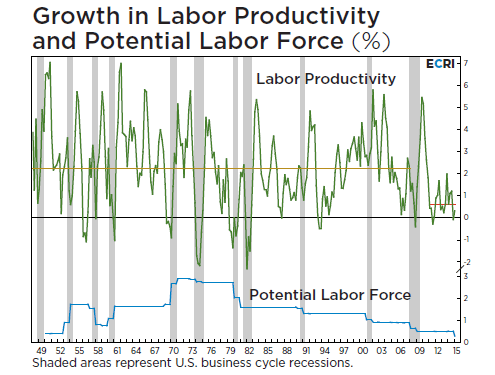
It’s often assumed that productivity growth will rebound to its post-World War II average – around 2¼% per year (gold line). But you know what they say about assumptions. To quote Fischer again, “productivity is extremely difficult to predict,” and “will perhaps eventually return” to its earlier pace. In other words, there’s no clear reason why that will happen anytime soon. Indeed, since the end of 2013, productivity growth has averaged minus 0.7% a year.
Potential labor force growth (blue line) should reflect the long-term trend in growth in hours worked. But the Congressional Budget Office says it will stay at½% per year at least for the next decade. This is pretty much set in stone, given the demographics.
Adding up the likely trend growth of these two measures – ½% for productivity plus ½% for hours worked – gives us just 1% longer-term real GDP growth.
So, unless there’s good reason to believe that productivity growth will revive, trend GDP growth may very well stay stuck in the 1% range for years to come. If so, growth slowdowns could much more easily push growth below zero, leaving very little room for error. Is the Fed ready?
>>>>> Scroll down to view and make comments


