


Money Morning Article of the Week
by Abby Higgs
Criminals who engage in stock manipulation are subject to civil and criminal penalties.
But prison time and hefty fines certainly haven’t stopped budding manipulators from trying. Market manipulation is up 37% in the last decade, according to the U.S. Securities and Exchange Commission (SEC).

In fact, nowadays, it’s par for the course. CNBC‘s popular “Mad Money” host Jim Cramer admitted he used to habitually manipulate the market when he ran his hedge fund. In a 2009 interview with TheStreet.com, he called it “a fun and lucrative game” and suggested that all hedge fund managers do it.
Of course, the rise in market manipulation is far from surprising. After all, there’s a reason we compare Wall Street brokers to predatory animals – they are willing to go to any length to profit, even if it harms others less advantaged in the process. Just look at the subprime crisis we’re still suffering from.
What Is Stock Market Manipulation?
Stock market manipulation is the intentional distortion of market prices by brokers or by entire investor enterprises. These manipulators gain profits at the expense of other market participants’ losses. “Manipulation can involve a number of techniques to affect the supply of, or demand for, a stock,” recites the U.S. Securities and Exchange Commission (SEC).
“They include: spreading false or misleading information about a company; improperly limiting the number of publicly available shares; or rigging quotes, prices or trades to create a false or deceptive picture of the demand for a security.”
These four manipulators expected to break away clean with not just millions, but billions…
Four Infamous Stock Manipulation Cases
Stock Manipulation Case No. 1, Enron: In 1985, after merging two pipeline companies to form Enron Corp., founder Kenneth Lay established the market for selling electricity. He successfully lobbied the U.S. Congress to deregulate the sale of natural gas. Lay also lobbied for, and was granted, government deregulation over his company’s earnings reports.
With Enron’s newfound accounting free reign, executives promptly set to cooking the books.
First, they failed to report losses in order to keep investors interested in what seemed like a profitable company.
Second, the financial officers concealed debts so that they didn’t show up in the company’s accounts. Lay and CEO Jeff Skilling used accounting loopholes and misappropriated investments to keep billions off the company’s records.
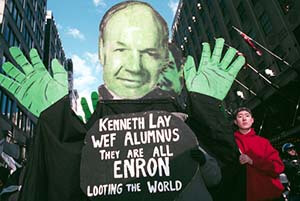
Protesters hold up an effigy of Enron founder Kenneth Lay during a march against the World Economic Forum Feb. 2, 2002 in New York City.
In 2001, after eight years of witnessing Enron’s stock market manipulation, in-house accountant Sherron Watkins blew the whistle.
The Enron scandal ended in one of the biggest bankruptcies in history. Enron stock crashed from $90 per share in mid-2000 to less than $1 by the end of November 2001. Investors lost more than $70 billion.
The scandal eventually led to the enactment of the Sarbanes-Oxley Act to expand the accuracy of financial reporting for public companies and punish those attempting to defraud shareholders. The Texas-based energy-trading giant, once America’s seventh-biggest company, declared bankruptcy on Dec. 2, 2001.
Stock Manipulation Case No. 2, “The Cartel”: On May 20, 2015, Citibank N.A., JPMorgan Chase & Co. (NYSE: JPM), Barclays Plc. (NYSE: BCS), and Royal Bank of Scotland Group Plc. (NYSE: RBS) (a conglomerate that actually referred to themselves as “the cartel”) pled guilty to a felony count of conspiring to violate the Sherman Antitrust Act. Specifically, the banks tried to rig the U.S. dollar-to-euro exchange rate. Another bank involved in the scandal, UBS Group AG (NYSE: UBS), pled guilty to another charge.
According to a May 20 exclusive from Reuters:
“The misconduct occurred until 2013, after regulators started punishing banks for rigging the London Interbank Offered Rate (LIBOR), a global benchmark, and banks had pledged to overhaul their corporate culture and bolster compliance.”
UBS pled guilty to a one-count charge of wire fraud for manipulating the LIBOR, as well as other benchmark interest rates. The other four banks were fined over $10 billion for failing to attempt to stop traders from manipulating forex rates.
The next notorious case coincided with the height of the Great Recession in 2008…
Stock Manipulation Case No. 3, Kaupthing Bank: In October 2008, four of six executives from the Iceland-based Kaupthing Bank were caught trying to inflate share prices. According to a Jan. 25, 2015, article from The Iceland Monitor, the bank fully financed share purchases with no other surety than the shares themselves, which gave a false and misleading impression of demand for Kaupthing securities when, in reality, there was none. The bankers were also accused of concealing an investor from Qatar who bought a 5.1% stake in the bank with money illegally provided as a loan from the bank itself.
The four men were found guilty of stock market manipulation by the Reykjavik District Court in December 2013 and appealed to the Supreme Court of Iceland. Their Supreme Court appeal was denied on Feb. 13, 2015.
As far as sentencing went, Hreidar Mar Sigurdsson, former CEO of Kaupthing, got the longest at fiveand a half years. Sigurdur Einarsson, former chairman of the board, had his sentence reduced from five years to four, while Olaf Olafsson, bank owner, was sentenced to three years. Magnus Gudmundsson, the director of Kaupthing Luxembourg, got three and a half years. The remaining two executives who were not charged were granted immunity in return for their testimonies against the others.
Stock Manipulation Case No. 4, WorldCom: Former telecommunications giant WorldCom came under intense scrutiny after some serious “book cooking” in the early 2000s. The company recorded its operating expenses as investments. By doing this, WorldCom was able to offset costs of run-of-the-mill expenses like office supplies and travel.
The pens, pencils, and paper WorldCom called “investments” accounted for more than $3.8 billion in expenses over five quarters. WorldCom also exaggerated profits in 2001. Its inflated assets totaled $11 billion.
The telecommunications giant was ultimately busted for stock market manipulation by its own internal auditing department in April 2002, which reported findings to the SEC.
On June 26, 2002, WorldCom fired Chief Financial Officer Scott Sullivan and began layoffs. Ultimately, the firm let 30,000 employees go, incurred $180 billion in losses, and its stock price plummeted from more than $60 per share to less than 20 cents.
Editor’s Note: Trading expert, Tom Gentile, shows how you can earn 100% return in 27 days on the worlds’ most valuable company. You’ll be amazed how easy it is to do. To get the details on this trade, along with all of Tom’s research free, just click here.


