


by Seth Mason, ECOMINOES.com
Published originally at Solidus.Center 31 October 2014.
An adviser to Solidus.Center recently suggested that we make one of our platforms support of antitrust suits against medical monopolies. At first glance, this platform seems tangential to our organization’s mission of promoting reform of the Federal Reserve System. In reality, it’s integral.

Although the Fed claims to be an apolitical institution, it is in fact heavily influenced by Washington. Like many central banks throughout the world, the Fed is compelled to monetize the debt of its profligate-spending paternal government. As you can see from the following chart, health care spending has become the largest component of the federal budget and has therefore become the largest component of the national debt, which grows in perpetuity because the government continuously deficit spends.
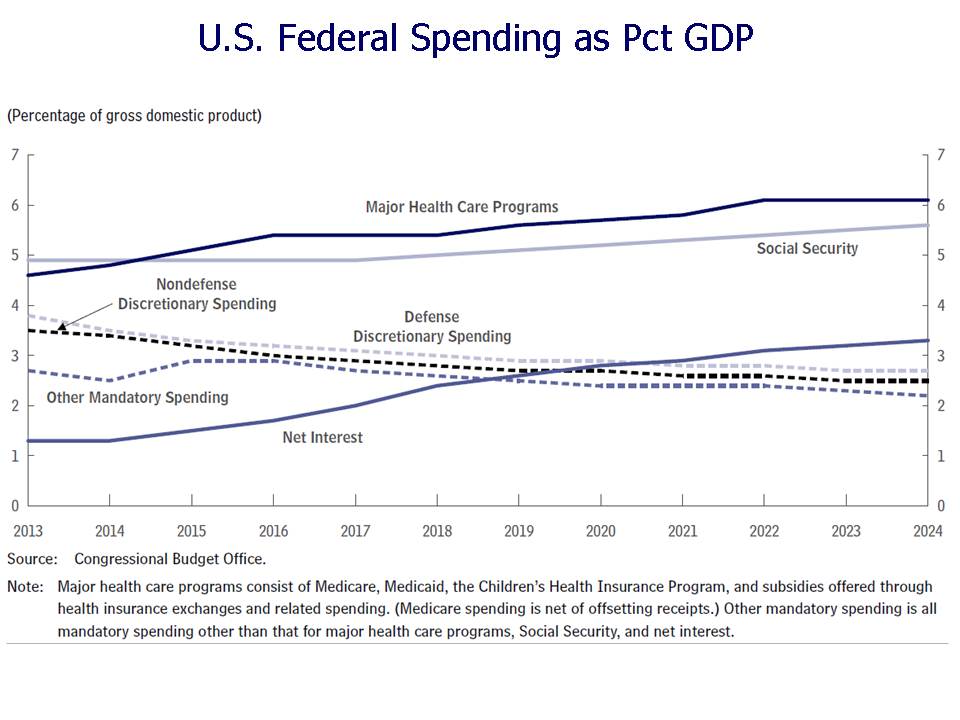
Health care spending has become the largest component of the federal budget and has therefore become the largest component of the national debt. Some scholars argue that, by breaking up medical monopolies, the federal government would save billions of dollars in annual health care expenditures.
As you can also see on the chart, interest paid on the national debt has also become a large budget line-item and is also expected to grow in perpetuity. Even under its unrealistic assumption that the economy will perpetually expand, the Congressional Budget Office admits that interest payments on the debt will soon EXCEED ALL DEFENSE AND ALL OTHER MANDATORY SPENDING WITH THE EXCEPTION OF SOCIAL SECURITY. This is tremendously problematic. The Fed has no choice but to keep the federal government solvent by monetizing some of its ballooning debt.
Some scholars argue that, by breaking up medical monopolies, the federal government would save billions of dollars in annual health care expenditures, thereby shrinking its largest budget line-item and reducing its increasingly-burdensome debt. It’s common sense: monopolies limit competition, and less competition yields higher prices for the consumer. The U.S. pays far more for health care per capita than any other country in part because its regulatory bodies protect Big Medical and Big Pharma.
For an idea of how out-of-whack America’s health care spending is, consider the following chart.
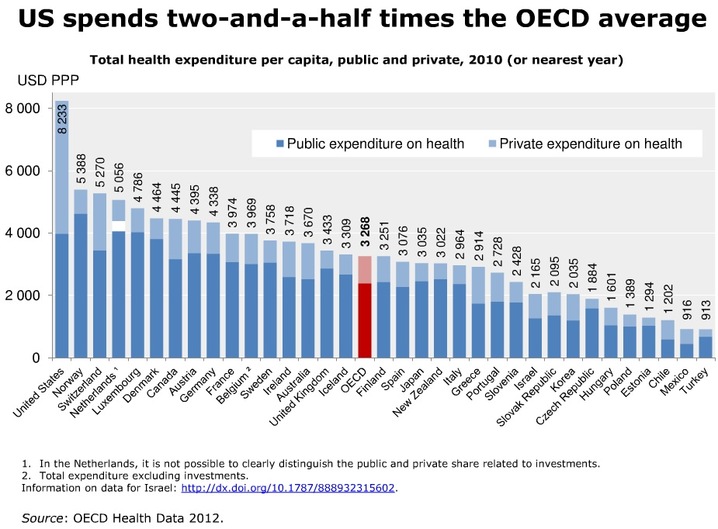
America’s health care spending is this out-of-whack with the rest of the developed world. Do we get 250% better care for our money?
We spend 250% more per capita on health care than the developed country average. Do we get 250% better care? Is this figure the result of the natural relationship between supply and demand? Or is it the natural outcome of the monopolistic American medical paradigm?
We believe it’s the latter.
We believe that if the government enforced the anti-trust laws it has on the books and broke up the medical monopolies, the cost of health care would decrease, as would the cost of the national debt. We believe that, under this scenario, the Fed would be less inclined to monetize the debt. That is why we have made support of antitrust suits against medical monopolies a platform of Solidus.Center.


