


from the Congressional Budget Office
As discussed in yesterday’s blog post and in CBO’s The 2014 Long-Term Budget Outlook, if current laws remain generally unchanged, debt held by the public is projected to exceed its current percentage of GDP—74 percent—after 2020 and to continue rising on a path that would ultimately be unsustainable. To put the federal budget on a sustainable path for the long term, lawmakers would have to make significant changes to tax and spending policies: reducing spending for large benefit programs below the projected levels, letting revenues rise more than they would under current law, or adopting some combination of those approaches.

One way to think about the magnitude of that challenge is to assess the changes in spending or revenues that would be needed to achieve a chosen goal for federal debt.
What Are the Size of Policy Changes Needed to Meet Various Goals?
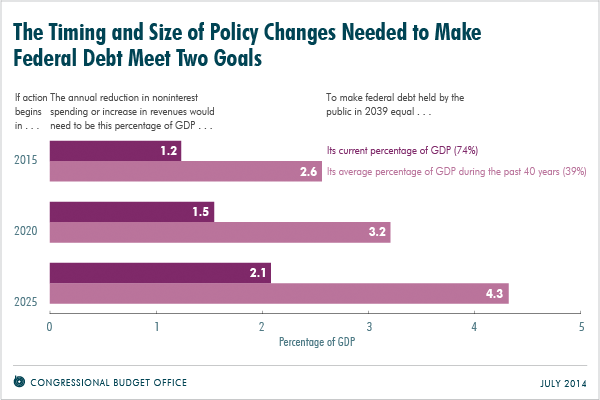
The size of such changes would depend on the amount of federal debt that lawmakers considered appropriate. For example, a combination of cuts in noninterest spending (that is, spending excluding interest payments) and increases in revenues that equaled 1.2 percent of GDP in each year beginning in 2015—about $225 billion in that year—would hold debt 25 years from now, in 2039, to the same percentage of GDP that it is now (without accounting for the economic effects of the reduction in debt or of the policy changes that might be used to achieve it), by CBO’s estimate. If those changes came entirely from revenues, they would amount to a roughly 6½ percent increase relative to the revenues projected for the 2015–2039 period under current law. If the changes came entirely from noninterest spending, they would represent a cut of 6 percent from the amount of noninterest spending projected for that period.
Another option for lawmakers would be to set a goal of bringing debt held by the public back down to the average percentage of GDP seen over the past 40 years—39 percent. As shown in the figure below, meeting that goal by 2039 would require much larger changes in tax and spending policies—a combination of increases in revenues and cuts in noninterest spending, relative to current law, totaling 2.6 percent of GDP in each year beginning in 2015 (again, without accounting for the economic effects of the reduction in debt or of the policy changes that might be used to achieve it). In 2015, 2.6 percent of GDP would equal about $465 billion. If those changes came entirely from revenues, they would represent an increase of 14 percent from the revenues projected for the 2015–2039 period under current law. If the changes came entirely from noninterest spending, they would represent a cut of 13 percent from the amount of noninterest spending projected for that period.
How Quickly Should Policy Changes Be Implemented?
In deciding how quickly to carry out policies to put federal debt on a sustainable path, lawmakers face trade-offs:
- The sooner significant deficit reduction was implemented, the smaller the government’s accumulated debt would be, the smaller policy changes would need to be to achieve a particular long-term outcome, and the less uncertainty there would be about what policies would be adopted. However, if lawmakers implemented spending cuts or tax increases quickly, people would have little time to plan and adjust to the policy changes, and those changes would weaken the economic expansion during the next few years.
- Reductions in federal spending or increases in taxes that were implemented several years from now would have a smaller effect on output and employment in the short term. However, waiting for some time before reducing federal spending or increasing taxes would result in a greater accumulation of debt, which would represent a greater drag on output and income in the long term and would increase the size of the policy changes needed to reach any chosen target for debt.
If lawmakers wanted to minimize both the short-term economic costs of reducing deficits quickly and the longer-term costs of running large deficits, they could enact a combination of changes in tax and spending policies that increased the deficit in the next few years relative to what it would be under current law but reduced the deficit thereafter.
Even if policy changes to shrink deficits in the long term were not implemented for several years, making decisions about them sooner rather than later would offer significant advantages. If decisions were reached sooner, people would have more time to alter their behavior to be prepared for the time when the changes would be carried out. In addition, decisions about policy changes that would reduce future debt relative to the amounts projected under current law would tend to increase output and employment in the next few years by holding down longer-term interest rates, reducing uncertainty, and enhancing businesses’ and consumers’ confidence.
Source: http://www.cbo.gov/publication/45557
About the Authors
Michael Simpson and Julie Topoleski are analysts in CBO’s Health, Retirement, and Long-Term Analysis Division.


