


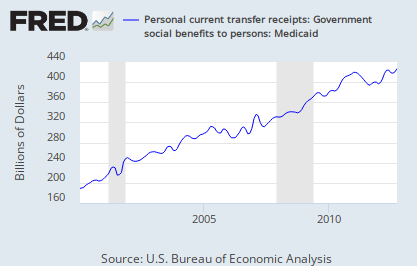
Econintersect: Medicaid was primarily designed to provide benefits to those Americans who have run out of options for medical care after Medicare and private options are depleted. In theory, this means that Medicare is a backup program for only the lower quartiles of the population as Medicare requires beneficiaries to be out of assets. A Chicago Fed study looked into who was receiving or who believed they would be receiving benefits.
In the United States, there are two major public insurance programs helping the elderly with their medical expenses. The first is Medicare, a federal program that provides health insurance to almost every person over the age of 65. The second is Medicaid, a means-tested program that is run jointly by the federal and state governments.
An important characteristic of Medicaid is that it is the payer of “last resort”: Medicaid contributes only after Medicare and private insurance pay their share, and the individual spends down his assets to a “disregard” amount. Because Medicaid restricts benefits to those with assets below the disregard, it discourages saving through an additional channel not present in non-means-tested insurance, which reduces savings only by reducing risks. One area where Medicaid is particularly important is long-term care. Medicare reimburses only a limited amount of long-term care costs, and most elderly people do not have private long-term care insurance. As a result, Medicaid covers almost all nursing home costs of poor old recipients; in fact, Medicaid now assists 70 percent of nursing home residents. In fact, Medicaid ends up financing 70% of nursing home residents (Kaiser Foundation [42]), and these costs are of the order of $60,000 to $75,000 a year (in 2005).
Medicaid-eligible individuals can be divided into two main groups. The first group comprises the categorically needy, whose income and assets fall below certain thresholds. People who receive SSI typically qualify under the categorically needy provision. The second group comprises the medically needy, who are individuals whose income is not particularly low, but who face such high medical expenditures that their resources become small in comparison.
The categorically needy provision thus affects the saving of people who have been poor throughout most of their lives, but has no impact on the saving of middle- and upper-income people. The medically needy provision, instead, provides insurance to people with higher income and assets who are still at risk of being impoverished by expensive medical conditions.
The working paper concludes:
In this paper we assess both the distribution of Medicaid payments and the valuation placed on these payments by elderly singles. Our initial results for age 74 show that even though the poorest individuals use Medicaid most frequently, even retirees in the highest income quintile expect to receive non-trivial Medicaid transfers. Although richer people qualify for Medicaid only if their medical conditions deplete their financial resources, they live longer and are more likely to face expensive medical conditions. Hence they receive lifetime payments that are almost half of those for people at the bottom of the income distribution, who die much more quickly.
Once one accounts for risk, Medicaid is even less redistributive. Compensating differential calculations suggest that although all individuals value Medicaid well in excess of the payments they expect to receive, it is the rich, who have the most to lose, who value Medicaid most highly.


