


by Elliott Morss, Morss Global Finance
Introduction
In 2011, I wrote a piece saying that bailouts would not solve the problems of Greece, Ireland, Portugal or Spain. I followed that with an open letter to the Prime Ministers of Greece, Ireland, Portugal and Spain explaining why they should leave the Eurozone and how.

The letter said:
- You must issue your own currency and make it legal tender for purchases and sales in your country.
- You must default on all or part of your international debt.
Below, I review and refine these recommendations. And yes, I was wrong on Ireland.
The Need to Leave the Eurozone
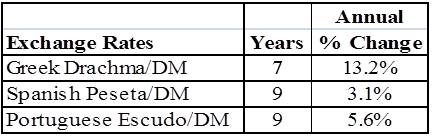
The simplest way to understand why it is not viable for Greece et al to continue to use the euro is to look at Table 1. It shows what happened to their currencies relative to the German Deutsche Mark just before entering the Eurozone. These weakening currencies reduced the buying power of the respective countries. These adjustments corrected for different levels of productivity in these countries vis-à-vis Germany. The adjustments meant the costs of German products rose to these “weak sisters”. And weak sister prices fell to German buyers. The result was that things “remained in balance.”
Table 1. – Exchange Rate Adjustments, 1990 to Eurozone Entry
Fast forward to when all countries use the euro. The currency adjustment mechanism is lost. So what happens? As German productivity grows and its prices fall relative to the “weak sisters’, the trade deficits of the weak sisters grow as they increasingly buy products from Germany. Ultimately, they run out of euros. That, in essence, is what happened in Greece and is happening more gradually in Portugal and Spain.
Now in theory, this problem could be resolved if producers (capitalists and laborers) in weak sister countries got together and agreed to reduce their € costs by 30% – In other words, if they all agreed to take a pay cut of 30%. But this will never happen. So how, realistically, can the ‘weak sisters’ costs be reduced so that their workers can find jobs again and their trade deficits become manageable via lower imports and higher exports? The answer: start using their own currencies again.
Going to a New Currency
Introducing a new currency is a complex and tricky business. I offer questions/guidelines below, but many technical details will need to be worked out.
- The Greek banks are closed for the week. What happens next week? If the banks open, depositors will want to get all their euros out. Of course, the banks cannot cover such demands. But depositors need some money to cover living expenses so should minimum withdrawals be allowed?
- It will take some time to get new currencies printed. That effort should start now.
- Foreign currency deposits should be allowed, but perhaps the government should announce that starting immediately:
- All government transactions should be made in the new currency.
- All export proceeds should be exchanged at the central bank for local currency.
- A daily auction will be run for a limited amount of hard currencies. The auctions should help determine market based exchange rates for your new currencies.
- Retailers should set prices in the local currency and accept the local currency for sales. If buyers only have euros, they should be allowed to use them for purchases with the daily auction exchange rate to determine euro prices.
- The government should not ban foreign currency use. Such bans never work. They only enable criminals to make lots of money. Banks should be encouraged to make exchanges between all currencies at competitive rates.
Matters will be very unsettled for a while.
Debt
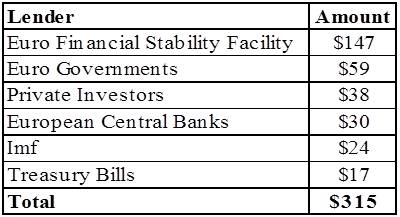
Greece owes $315 billion (Table 2), of which over $30 billion is supposed to be paid back by the end of this year. On top of that, there are additional interest payments to be made up. Euro zone countries have already extended the maturities of their loans to Greece from 15 to 30 years and reduced the interest rates on some to just 0.5 basis points above their borrowing cost. They also granted Greece a 10-year moratorium on interest payments on the second bailout loan from the euro zone rescue fund.
Table 2. – Greek Government Debts
Source: Wall Street Journal
Greece effectively has no money. In such circumstances, how and what do you renegotiate? And keep in mind: defaults are tricky and become more so when creditors are not all treated in the same manner.
Conclusions
Things are uncertain. One hopes the Greek government has started to think through and take the steps needed to return to its own currency. It is quite possible that Portugal and Spain will start down the same path in the near future.


