


from US Census
— this post authored by TAYELOR VALERIO
The average age of U.S. women who gave birth for the first time was 26.9 in 2018, but many became parents much earlier: There were 1.8 million biological parents ages 15-22 and roughly half were living with a spouse or unmarried partner, according to the Census Bureau’s 2018 Survey of Income and Program Participation (SIPP).

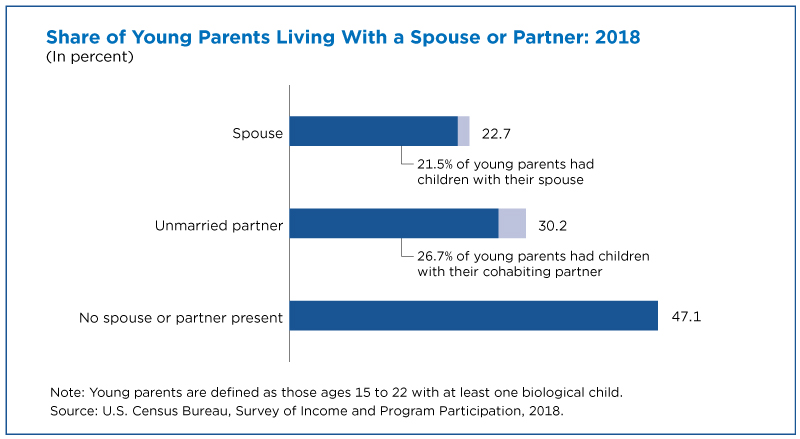
About one-fifth (22.7%) of young parents in the U.S. lived with a spouse and an additional 30% with a partner in 2018.
SIPP collects full fertility histories from both men and women ages 15 and over and provides a unique window into the households and relationships of young parents.
Are they married or with a partner? Alone or living with their own parents?
Relationships of Young Parents
About one-fifth (22.7%) of young parents in the U.S. lived with a spouse and an additional 30% with a partner in 2018.
About 4.0% were cohabiting with someone who was not their child’s biological parent.
Living arrangements of young parents reflected national trends in living arrangements of young adults. The median age at first marriage was estimated to be around 30 for the U.S. population and many young adults opted to live with an unmarried partner rather than marry.
Census Bureau research suggests that having children with more than one partner, known as multiple partner fertility (MPF), is more common among those who had their first birth at younger ages.
Part of the reason is that those who begin having children earlier simply have more time as they age to have children with multiple partners.
According to SIPP, 6.3% of young parents in 2018 had already had children with more than one partner.
Living Arrangements of Young Parents and Their Children
According to previous research from the Census Bureau’s American Community Survey, 87% of all U.S. mothers in 2006 lived with their infants born in the last 12 months. SIPP provides the complete fertility histories of parents and stats on others in their households.
Seventy-seven percent of parents ages 22 and younger lived with at least one of their biological children at the time of interview.
However, it differed by the parent’s sex: 85.6% of young mothers and 56.5% of young fathers lived with at least one child.
Additionally, 14.4% of young mothers and 43.5% of young fathers didn’t live with any of their children.
Estimates of parents who lived with all of their children versus at least one child did not differ statistically because most parents in this age group had only had one child.

Solo Parenting
Many young parents are also solo parents – those who lived with at least one of their children and no spouse or partner in their household.
About 470,000 young parents (26.2% of all parents ages 22 and younger) were solo parents at the time of the survey interview.
However, just because these young parents were living without a spouse or partner does not mean they were living without others. Many were living with a child and an additional relative or nonrelative.
For example, about 57.4% of solo parents lived with one or both of their own parents, significantly higher than the overall share (38.3%) of young parents in 2018.
About 70% of solo parents lived with a child and at least one other adult age 18 or older. These additional household members may provide important sources of support to young parents and their children.
About SIPP
SIPP collects detailed information about the social and economic characteristics of U.S. households.
In 2014, the SIPP began collecting full fertility histories of both men and women ages 15 and over. Data for the 2018 panel cited in this article were released in August 2020.
About the Author
Tayelor Valerio is a survey statistician in the Census Bureau’s Fertility and Family Statistics Branch.
Source
https://www.census.gov/library/stories/2021/06/living-arrangements-of-young-parents-solo-with-spouse-partner-or-parent.html


