


from the St Louis Fed
The previous post examined how much time U.S. workers typically devote to home production – such as cooking and doing laundry – when they lose their jobs or see their work hours reduced. This post will look at the change in home production because of the large employment losses during the early months of the COVID-19 pandemic.

In a Regional Economist article, St. Louis Fed Research Officer Oksana Leukhina and Zhixiu Yu, a Ph.D. candidate in economics at the University of Minnesota, examined 20 different types of households according to characteristics such as marital status, gender and presence of children in the home. They estimated the number of lost hours these households suffered from February to April, which marks the peak to trough of many employment statistics during the pandemic-induced recession.
Employment Losses among Households
The authors determined that the reduction in weekly working hours during the first wave of the pandemic ranged from three hours to 9.6 hours. Households affected the most were less-educated (no bachelor’s degree) married men with children and stay-at-home spouses, at 9.6 hours. The next most impacted were single households with kids and no bachelor’s degree, at 7.8 hours for men and women.
How Many Hours Were Shifted to Home Production
Leukhina and Yu then estimated the effect of the pandemic on home production hours by combining the estimated reduction in work hours and the rate that these households shifted lost work hours to home production hours. For the latter, they estimated the latter using American Time Use Survey (ATUS) data from the Bureau of Labor Statistics for 2003-10, a period that incorporates the Great Recession.
The figure below shows the predicted change in home production among various types of households.
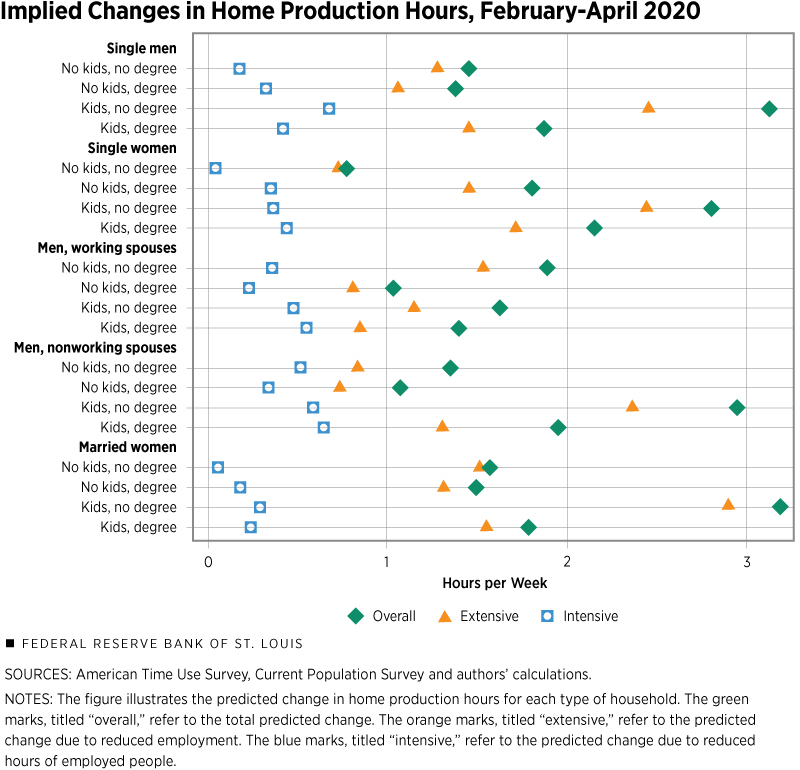
They found that total effects ranged from 0.8 to 3.2 hours per week, with the largest increase in home production hours for less-educated married women with children.
“This group of women had the highest ratio of home production hours to lost market hours (49%) and experienced a substantial loss of employment during the pandemic, reducing their average market hours by 6.5 a week,” they wrote.
In general, home production rose more for married individuals and households with children, they observed.
Aggregate Impact of the Shift
Leukhina and Yu took the results of these groups of households and estimated the overall effect by weighting them by population. They found that weekly home production increased by about 1.7 hours between January and April.
“While the 1.7-hour increase in home production hours may not seem like a lot, it is almost a third of the total average 6.2-hour decline in weekly market hours,” they wrote.
They added this estimate is likely to be smaller than the actual change because leisure options were limited during the economic shutdown.
The Shift’s Aggregate Value
To calculate the aggregate value of the increase in home production hours, the authors assumed an hourly wage of $17.35. This was based on the average wage of private workers employed in industries that provide substitutes for home production, such as cooks and child care workers.
“We estimate the value of monthly home production increased by $26.5 billion between February and April,” they concluded. “This gain is equivalent to about 9.1% of the estimated $292.6 billion drop in monthly gross domestic product (GDP) over the same period.”
Additional Resources
- Regional Economist: Home Production Activity during the COVID-19 Shutdown
- On the Economy: Employment Losses in Contact-Intensive Industries
- On the Economy: Rising Student Debt and the Great Recession
Source
https://www.stlouisfed.org/on-the-economy/2021/january/covid19-impact-home-production
Disclaimer
Views expressed are not necessarily those of the Federal Reserve Bank of St. Louis or of the Federal Reserve System.


